Car Buyer Messaging in Ireland: What to Send and When
How to message car buyers in Ireland: reply timing, templates for dealers and private sellers, the ePrivacy rules on texts, and how to avoid scams.

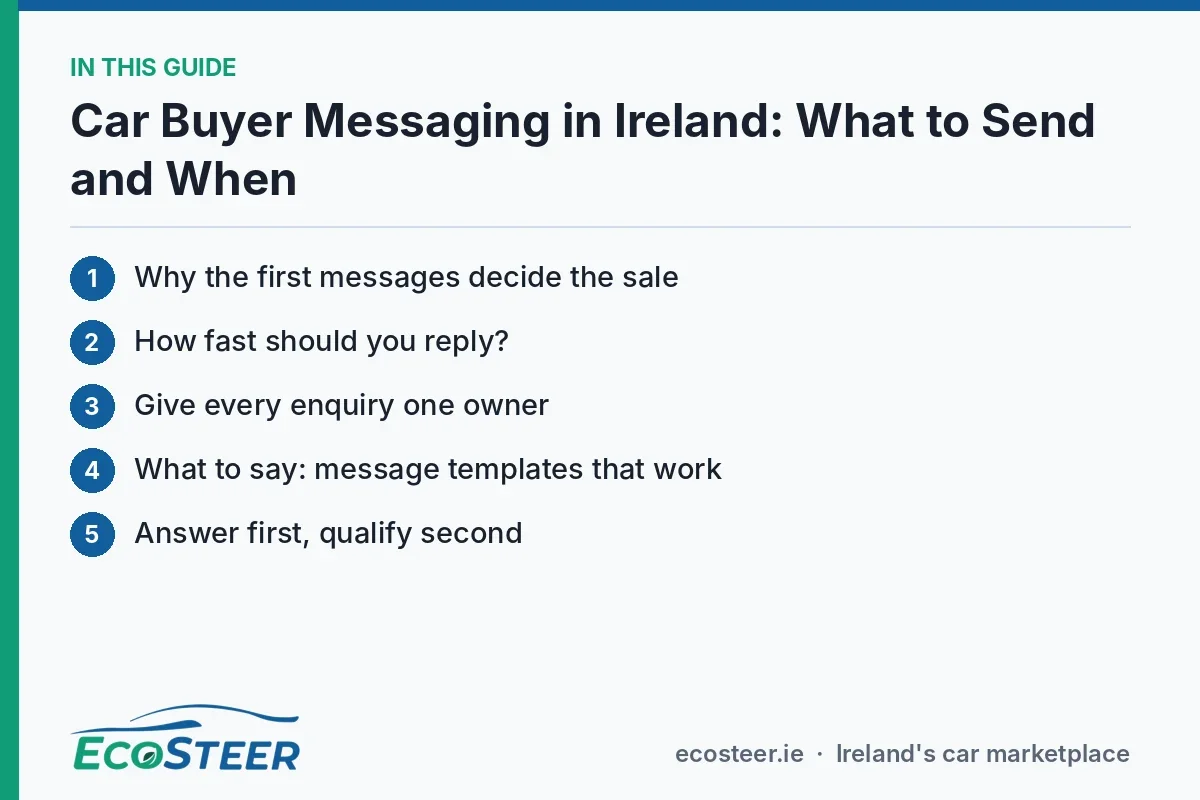
Good car buyer messaging is fast, specific and honest. Answer the question the buyer actually asked, say what happens next, and keep a record of what you promised. This guide covers both sides: dealers and private sellers who want to turn enquiries into viewings, and buyers who want to ask the right questions before travelling to see a car. It also covers the Irish rules on marketing texts and emails, which catch out more dealers than you might expect.
TL;DR
- Answer the buyer’s question first. Ask for a phone number, trade-in details or finance preferences only after you have been useful.
- Choose a reply time your team can keep every day, and give each enquiry one named owner rather than a shared inbox.
- Messages about a specific car are a reply to an enquiry. Promotional texts or emails need consent, or must fit the narrow “soft opt-in” exception under Irish law.
- Buyers should get the seller’s answers on crashes, mileage and outstanding finance in writing before travelling.
- Keep payment and personal details off open messaging until you have met the car and the seller.
Table of Contents
- Why the first messages decide the sale
- How fast should you reply?
- Give every enquiry one owner
- What to say: message templates that work
- Answer first, qualify second
- Channels: WhatsApp, SMS, email or platform chat
- The Irish rules on texts and emails to buyers
- Messaging as a buyer: what to ask before you travel
- Messaging as a private seller
- Our view: messaging is a sales discipline
- Put it into practice on Ecosteer
- Common questions
- Sources
Why the first messages decide the sale
An online enquiry is a small act, but it signals intent. In most cases the buyer has already looked at several listings and is now testing who is easiest to deal with. The first reply tells them whether the car is real, whether the seller knows it, and whether a visit is worth the drive.
That is why messaging deserves the same attention as photos and price. A report on what happens after a lead lands makes the same point from the dealer side: the reflex is to chase more leads, while the bigger gain often sits in what you do with the ones you already have.
For Irish sellers, there is a second reason. Buyers here compare across counties. Someone in Cork may be happy to drive to Kildare for the right car, but only if the seller’s messages give them confidence before they set off.
How fast should you reply?
You will see “reply in five minutes” advice everywhere, including on our own pages, such as our guide to responding to car leads in five minutes and our one-hour reply guide for Irish dealers. Speed matters. The practical question is what speed your team can sustain on a wet Tuesday as well as a quiet Saturday.
One Irish lead management guide argues that the aim is a consistent service level rather than an arbitrary target, and suggests tracking your median response time. We agree. A promise of “within the hour, 9 to 6” that you keep beats a five-minute promise you break by lunchtime.
A workable approach:
- Set a reply window for working hours and write it in your listing or profile.
- Send a short acknowledgement outside those hours that says when the buyer will hear back.
- Check the median reply time weekly, not the best day.
- Review any enquiry that waited longer than your window and find out why.
Private sellers have an easier job. If you cannot reply within a day, say so. A buyer who knows you will answer in the evening will wait. A buyer who hears nothing moves on.
Give every enquiry one owner
The same Irish guide describes a predictable failure of shared inboxes: everyone can see the message, so nobody feels responsible for answering it. Leads get ignored and the sale goes to whoever replied first.
The fix costs nothing. Assign each new enquiry to one named person, who owns the conversation until it ends in a viewing, a sale or a polite close. If that person is off, hand over explicitly, with notes on what the buyer asked and what you promised.

For a small dealership, this can be as simple as splitting stock between two people. For a larger forecourt, it means using lead management tools that show who holds each conversation. Our lead nurturing guide goes into the follow-up sequence once the first reply is out.
What to say: message templates that work
Good messages are short, name the car and move one step forward. Adapt these to your own voice.
Reply to “Is it still available?”
Hi [name], yes, the [year] [make model] is still available. It’s at our yard in [town] and I can show it to you [day/time options]. Is there anything you’d like to know before then, such as service history or the NCT date?
The reply confirms availability, gives a location and offers two options. It does not ask for the buyer’s life story.
Reply to a price question
Hi [name], the price is €[amount]. [One sentence on what is included: warranty, NCT, service.] If you’d like to see it in person, I can hold it for you until [day].
Only offer to hold a car if you will keep to it. If a deposit is involved, say so plainly and put the terms in writing.
Reply to a trade-in or finance question
These two topics, according to the lead management guide above, are where conversations often stall. It recommends a “mini-process” for them so the answer is quick and clear. Prepare a standard reply for each:
- Trade-in: “Happy to look at it. Can you send the registration number, mileage and a few photos? I’ll come back to you with a range today.”
- Finance: “We can talk through options when you visit. If you tell me your rough monthly budget and deposit, I can say which cars on our list fit.”
Keep claims about specific finance rates out of a quick message unless you have the figures to hand and the authorisation to quote them.
Reply when you don’t have the answer
Hi [name], good question. I want to check the service book rather than guess. I’ll message you by [time] today.
Then do it. A promised follow-up that arrives on time builds more trust than a fast but vague answer.
Answer first, qualify second
A common dealer mistake is to demand a phone number, address and trade-in details before answering the buyer’s question. Irish lead management advice says this kills conversion: the most successful dealers answer the question, build trust, and then move naturally to the next step, such as asking for a trade-in registration number.
Compare two replies to “Does it have a full service history?”
| Reply | What the buyer feels |
|---|---|
| “Please give us your name, number and address and we’ll be in touch.” | Blocked. They message the next seller. |
| “Yes, fully stamped, last service at 82,000 km in March. I can send photos of the book. Would Thursday evening suit for a viewing?” | Informed, with an easy next step. |
The second reply captures the contact in a more natural way, because the conversation is already moving towards a meeting.
Channels: WhatsApp, SMS, email or platform chat
Each channel has a job.
- Platform messaging: best for the first exchange. It keeps the conversation attached to the listing, and the buyer knows which car you are discussing.
- WhatsApp: buyers like two-way, informal chat. Automotive research from DOXA argues that messaging apps such as WhatsApp dominate outside the US, while many dealer tools are still built around US-style SMS. Its advice to Irish dealers is to favour tools designed around WhatsApp-style conversation. Note that DOXA sells software in this area, so treat the claim as one view.
- SMS: useful for appointment reminders and short confirmations.
- Email: better for longer documents such as a valuation summary or a written confirmation of terms.
- Phone: the right choice once the buyer is serious. Ask by message first: “Would a quick call be easier?”
Whichever you choose, move to a new channel only when the buyer agrees. Switching without asking feels pushy.
The Irish rules on texts and emails to buyers
This is the part dealers most often get wrong. Replying to someone who asked about a car is ordinary correspondence. Sending promotional messages is different.
Under Irish ePrivacy Regulations (S.I. 336/2011), electronic direct marketing by SMS or email needs prior consent, according to the Data Protection Commission. The “soft opt-in” exception lets you market your own similar products or services to existing customers without fresh consent, but only if all of these apply:
- you obtained the contact details in the context of a sale or negotiation;
- the customer had a clear chance to object when you collected them;
- every message includes a simple way to opt out;
- the marketing happens within 12 months of the last purchase or interaction.
In practice:
- A reply to “Is the Golf still available?” is a response to an enquiry.
- A “Spring offers on SUVs” blast to everyone who ever asked about a car is marketing. Check consent first.
- A service reminder to someone who bought from you last year may fit the soft opt-in, provided you meet the conditions above and include an opt-out.
This is a general summary. If you run a dealership and you are unsure whether a campaign is lawful, read the Data Protection Commission’s guidance in full or take advice from a data protection professional.
Messaging as a buyer: what to ask before you travel
Buyers also benefit from a plan. A few minutes of messaging can save a wasted trip.
The Competition and Consumer Protection Commission (CCPC) advises asking the seller whether the car has ever been crashed, whether major repairs were done, and whether there is outstanding finance on the car that could pass to you. Put these questions in writing so the answer is on record.
A short checklist to send:
- Has the car been in any accident, and are there repair invoices?
- Is there any finance outstanding on it?
- What is the mileage, and can you send a photo of the odometer and service book?
- When is the NCT due?
- Are you a dealer or a private seller?
The last question matters. The CCPC warns that a dealer posing as a private seller may be trying to deny you your consumer rights. For the differences, see our guide to private sale versus dealer in Ireland.
On mileage, the CCPC explains that clocking means tampering with the odometer to make a car look less driven. Asking for service records and photos of the odometer is a reasonable first check, and an unwilling seller is itself information.
Red flags in a seller’s messages
- Pressure to pay a deposit before you have seen the car.
- Refusal to give a phone number or a viewing address.
- Stories that explain why the car cannot be seen today.
- Answers that change between messages.
- Requests to move the conversation off the platform immediately.
If any of these appear, pause. Never send money for a car you have not seen, and meet in daylight at the seller’s address.
Messaging as a private seller
A private seller gets fewer messages but needs to handle them well.
- Put the answers in the listing. Mileage, NCT date, number of owners, service history and the reason for selling cut out half the questions.
- Reply to everyone politely, including low offers. A short “thanks, the price is firm” keeps the door open.
- Agree a viewing slot and confirm it the day before.
- Prepare the car. A clean car photographs and shows better. A pre-wash guide for car owners is a useful starting point for getting the exterior ready before the buyer arrives.
- Be honest about faults, and keep it in writing. Disputes after a sale usually begin with something the buyer says they were not told.
When you are weighing a private sale against trading with a dealer, our guide to dealer and private sale routes sets out the trade-offs.
Our view: messaging is a sales discipline
We built Ecosteer because buying and selling a car online in Ireland should be fast, transparent and modern. Messaging sits at the heart of that. A listing gets a buyer’s attention, but the conversation closes the sale.
Here is what we believe:
- Treat messaging as selling, not admin. Too many businesses hand it to whoever is free. The best results come when one person owns each enquiry.
- Transparency wins. Buyers who get straight answers about price, history and condition arrive ready to buy. Buyers who get evasive ones do not arrive.
- Dealers need tools, not more tabs. A dealer should be able to list stock, see leads, reply to buyers and track which enquiries are open in one place. That is what our dealer side is designed to do.
- Private sellers deserve clarity too. Listing a car and answering questions should not need a manual.
If you take one habit from this article, make it this: answer the question, then suggest the next step.
Put it into practice on Ecosteer
If you are a dealer or private seller, you can list your vehicle on Ecosteer, manage enquiries and talk to buyers across counties. Buyers can search by county, price, year, mileage, transmission, body type and fuel type, and browse dealers across Ireland to see who is selling near them.
Start at Ecosteer, or browse cars for sale in Ireland. For current listing costs, see our note on listing fees and VAT.
Common questions
How quickly should a dealer reply to a car enquiry?
As quickly as you can reliably sustain. Many dealers aim for minutes during opening hours, while some guidance says the real goal is a consistent service level, measured by median response time. Whatever you choose, state it and keep to it.
Can a dealer text me after I enquire about a car?
A reply to your enquiry is fine. Marketing texts or emails generally need your consent, unless the soft opt-in applies, which requires an earlier sale or negotiation, a clear chance to object, an opt-out in every message, and contact within 12 months. You can ask the dealer to stop at any time.
Is it safe to move a car sale conversation to WhatsApp?
It is common and convenient, and fine once you both agree to it. Keep the key details in writing, such as price, condition and any deposit terms. Do not pay for a car you have not seen, whichever channel you use.
What should I ask a seller before travelling to view a car?
Ask about accidents and repairs, outstanding finance, mileage evidence, NCT date and whether they are a dealer or a private seller. The CCPC’s car buying guidance covers these points. Get the answers in writing.
Sources
- Electronic Direct Marketing FAQ, Data Protection Commission
- Car Dealer Online Lead Management Ireland, WazerMart
- The Automotive AI Landscape: What Dealers Need to Know in 2026, DOXA Insights
- After the Lead Lands, Impel
- What you need to know before buying a car, CCPC
- Crashed and clocked cars, CCPC
Recommended
Ecosteer Editorial
Author