Car Dealer Lead Nurturing: Call in Five Minutes, Then Follow Up
Build a car dealer lead nurturing cadence with a live call within five minutes, timely follow up, appointment asks, and compliant CRM practices.

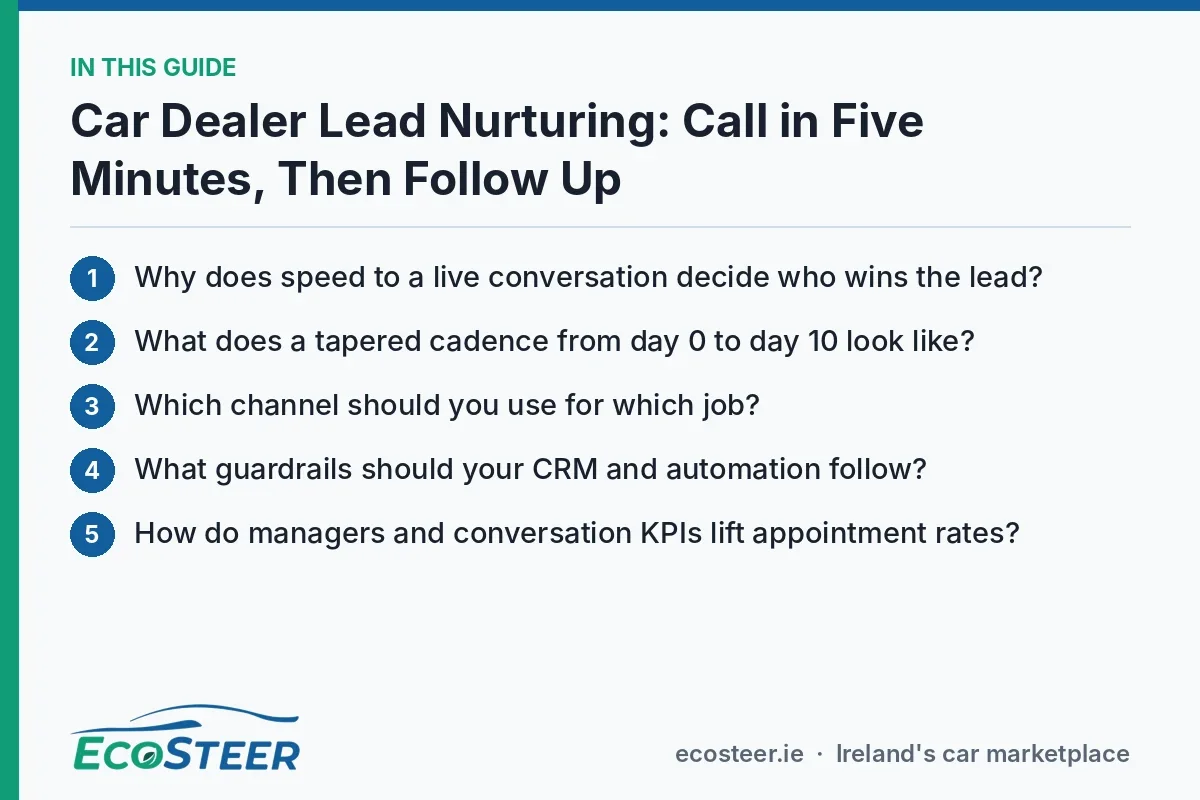
The most effective way to nurture car-sales leads is an immediate human response followed by a tapered, multi-channel cadence that always offers new, relevant value. The levers that move appointments are a clear appointment ask, a trade-in question, a timely manager touch and a mix of call, text, email and video. Keep it compliant with opt-outs and clean CRM records.
TL;DR:
- Aim for human contact within five minutes during business hours; assign every lead an owner, and call first, then text with a reason.
- Follow up on days 0, 1, 3, 7, and 14, then monthly, with each contact adding verified information rather than a generic check in.
- Asking for an appointment raised appointment rates by an average of 17 percentage points, yet reps skipped the ask in 60% of analyzed calls.
- Use calls to secure appointments, texts for brief confirmations, email for details, and 30 to 60 second videos to show the specific vehicle.
- Stop all messaging after opt outs, pause sequences during open replies, and route finance or valuation requests to named teammates through clear CRM handoffs.
Table of Contents
- Why does speed to a live conversation decide who wins the lead?
- What does a tapered cadence from day 0 to day 10 look like?
- Which channel should you use for which job?
- What guardrails should your CRM and automation follow?
- How do managers and conversation KPIs lift appointment rates?
- Which KPIs tell you the programme is working?
- What compliance steps are non-negotiable?
- What does this look like in a busy dealership?
- How does EcoSteer help you run this cadence and manage leads?
- FAQ
- Sources
Why does speed to a live conversation decide who wins the lead?
Most dealerships lose the lead before the first real conversation. A mystery shop of 53 dealerships found the average first response took more than nine hours, and many stores abandoned follow-up before reaching the recommended number of touches. The stores that performed best used structured multi-channel cadences and brought managers in early.
The average dealership in that study took over nine hours to respond to a lead. Your buyer has usually messaged two or three other sellers by then.
A fast text helps, but speed-to-lead that drives conversion is a live conversation, and a text cannot replace a call aimed at booking a visit. A personalised call that references the exact car the buyer viewed beats a generic automated reply, because it answers the real question and lets the rep ask for the appointment while interest is high. Our own guide on responding to car leads within five minutes covers the operational side in more detail.
In practice, set these service levels:
- Aim for a first human contact within five minutes of the enquiry during opening hours.
- Pair every call attempt with a short text so the buyer sees a name and a reason.
- Assign a named owner to every new lead, so nobody assumes someone else has replied.
- Route out-of-hours leads to a first-thing-next-morning call, not a delayed email.
What does a tapered cadence from day 0 to day 10 look like?
The cadence below is intensive early and lighter later. Experts recommend a tapered, value-led cadence, and warn that automated replies with no reference to earlier contact work against you. Load these steps into your CRM:
- Day 0, within minutes (sales rep): call, then send a text. If there is no answer, leave a voicemail and follow with an email containing the car’s details.
- Day 1 (sales rep): second call attempt at a different time of day, plus a short video of the car.
- Day 3 (sales rep or BDC): email with something new, such as a fresh photo, a confirmed availability check or an updated trade-in estimate.
- Day 7 (BDC or automation, with rep approval): message about similar or newly arrived stock that matches the stated interest.
- Day 14 (manager): a short personal call or text from the manager, offering to make the visit easy.
- Monthly (automation, paused on any reply): a light check-in tied to something real, such as a price change or new arrival.
Example scripts you can adapt:
- Initial text: “Hi Sarah, it’s Tom at [Dealership]. I’ve just tried to call about the car you enquired about. Is now or later better for a quick chat? Reply STOP to opt out.”
- Voicemail (under 30 seconds): “Hi Sarah, Tom from [Dealership]. I’m calling about the Golf. It’s here and ready to view. I’ll text you my number, and I can fit you in tomorrow or Saturday.”
- Day 3 email: “Hi Sarah, quick update: we’ve confirmed the Golf is still available and I’ve added three new photos of the interior. Would Saturday at 11 suit for a test drive?”
- Manager touch: “Hi Sarah, I’m Aoife, the sales manager. Tom mentioned you’re weighing up the Golf. If a trade-in valuation would help, I can have one ready when you visit.”
Anchor every message to something new and verified. Generic “just checking in” messages are what make follow-up feel annoying. For a wider rollout plan, see our 30 day plan to generate car sales leads.
Pro Tip: Stop the sequence the moment a buyer books, replies with a question or asks you to stop, and pass the conversation to a named person.

Which channel should you use for which job?
Each channel has one job. Mixing them up is where follow-up starts to feel repetitive.
- Call: use it for the appointment ask and for anything that needs a back-and-forth. Keep voicemails under 30 seconds, name the car and give one clear next step.
- Text: use it for quick confirmations, timings and “I’ve just tried to call” prompts. Keep messages concise, and put the opt-out line on the first one. Buyers often prefer SMS for short replies, and text-based dealer conversations have been reported to close faster than email.
- Email: use it for documents, finance details, links and anything the buyer may want to keep. Lead with the one useful fact in the subject line.
- Video: use it for walk-arounds of the exact car. Keep clips to 30–60 seconds, show the details a listing photo hides, and name the buyer at the start.
Sequence the channels in this order on day 0: call, then text, then email, then video on day 1. Each touch should add something the previous one did not, such as a time slot, a photo or an answer to a question.
Respect quiet hours and contact preferences. Do not text before mid-morning or after early evening, and honour a buyer who says they prefer email. When a car’s stock status changes, use that as your reason to get in touch again, particularly if the buyer is interested in a segment that is moving fast. Newly listed electric models are a good example, since EVs and market shifts are changing inventory patterns.
A well-prepared listing also gives your messages more to work with, so it is worth tightening your listing details first.
What guardrails should your CRM and automation follow?
Before any automated message goes out, the system should answer three questions: should this stop, pause or hand off? Automation needs immediate suppression on opt-out, pause conditions when a human reply is pending, and handoffs to named teammates for quotes or financing. Without those, you get repeat contact, awkward timing and compliance trouble.
Example states to build in:
- Stop: the buyer opts out, buys, or says they are no longer interested.
- Pause: a rep has an open conversation, or a reply is awaiting an answer.
- Hand off: the buyer asks for finance figures, a formal quote or a trade-in valuation.
Hygiene rules that keep those states reliable:
- Record each buyer’s preferred channel and best time to contact.
- Use outcome codes on every call, such as “booked”, “voicemail” or “wrong number”.
- Maintain one suppression list that every sequence checks before sending.
- Write notes in full sentences so the next person can pick up the thread.
Roll out in stages. Pilot on one lead source, watch delivery and reply rates for a while, then expand to the next source.
Pro Tip: Test your stop rules by entering a dummy lead and replying “STOP”. If any message still goes out, fix it before you scale.
How do managers and conversation KPIs lift appointment rates?
Two behaviours on calls do most of the work: asking for the appointment and asking about the buyer’s trade-in question. Call analysis shows these are the primary drivers of appointment-set lift, and the same study found that when reps asked for the appointment, appointment rates jumped an average of 17 percentage points.
The gap is in execution. The appointment ask was skipped in 60% of calls in the analysis, even though it is the biggest single driver of conversion.
Place the manager touch around day 14, when the buyer has gone quiet. Keep it low-effort and high-signal: a two-line text or a 60-second call that names the car, offers a trade-in valuation and proposes two times to visit. Our negotiation scripts guide has phrasing you can borrow.
A simple weekly coaching scorecard:
- Did the rep ask for a specific appointment time on the call?
- Did the rep ask about a trade-in?
- Was the next step agreed and logged in the CRM?
- Was the manager touch sent on schedule for stalled leads?
Which KPIs tell you the programme is working?
Track a small set of numbers weekly, not a wall of charts.
- First response time: the gap between the enquiry and the first human contact.
- Contact rate by channel: how often calls, texts and emails get a real reply.
- Appointment set rate: appointments booked as a share of leads worked.
- Show rate: booked appointments that actually turn up.
- Re-engagement rate: stalled leads that respond to a later touch.
- Opt-out rate: a rising figure signals too many or too generic messages.
For benchmarks, start with your own baseline for two weeks, then aim to improve on your baseline. Our response time benchmark and plan offers a starting point.
When a KPI lags, run one of two quick experiments. For a weak contact rate, run a speed test: route a portion of new leads to a rep alert with a faster response target and compare. For weak replies, run a channel mix test: swap the order of text and email on day 3 and compare reply rates over a fortnight.
What compliance steps are non-negotiable?
Treat compliance as part of the process, not an afterthought. Check official guidance and get appropriate advice on the rules for direct marketing and customer objections. Irish dealer privacy policies describe ways customers can contact the dealership about marketing preferences. Take legal advice for your own setup.
Operationally:
- Record the basis for contacting each customer and check that your process meets applicable requirements.
- Consider including clear opt-out wording in marketing messages, after checking the requirements that apply to your setup.
- Honour a stop request immediately and add the contact to your suppression list.
- Share the suppression list with every tool that can send a message.
- Keep to sensible quiet hours and the channel the buyer asked for.
What does this look like in a busy dealership?
Expect the first version to take time to set up and settle. Train the team on two things first: the appointment ask and the trade-in question. During the pilot, check that every lead has an owner, every message has opt-out wording and the stop rule works. Cheap tests beat big projects: mystery-shop your own response time, and A/B test the manager touch on half your stalled leads. Most dealerships I would expect to fix the first-response gap before anything else, because it costs nothing but discipline.
How does EcoSteer help you run this cadence and manage leads?
A cadence only works if your leads, templates and suppression records live in one place. We built EcoSteer so dealers can list vehicles, manage leads, communicate with buyers and close sales more efficiently. See how it fits your showroom on our Cars page, or browse the live listings to see how buyers find your stock, then get in touch.
FAQ
What makes the best car salesman?
The best salespeople respond quickly, listen before pitching and always ask for the next step. The data points the same way: asking for the appointment and the trade-in question drive appointment lift. Consistent follow-up with new information each time sets them apart.
How often should you follow up with a car lead?
Follow up most often in the first days, then taper. Our cadence calls for contact on days 0, 1, 3, 7 and 14, then a monthly check-in. Each touch should carry something new, such as a photo, a price update or confirmed availability.
Is a text or a call better for car leads?
Use both for different jobs. A call is best for booking the appointment, while a text suits quick confirmations and “I’ve just tried to call” prompts. A fast text cannot replace a live call aimed at booking a visit.
What should you do when a lead stops replying?
Send something genuinely new, such as a fresh photo, a confirmed availability check or a manager’s personal note. Avoid “just checking in” messages. If there is still no reply, move the lead to the monthly nurture and stop immediately on any opt-out.
Sources
- Follow Up Without Being Annoying: Sold & Unsold Car Buyers Playbook
- We mystery shopped 53 car dealerships. Here’s how they actually handle leads. | Clearline
- 3 Lead Follow-Up Strategies To Win Today’s Sales | CDK Global
Recommended
Ecosteer Editorial
Author