Plug-in Hybrid Cars for Sale in Ireland: Used PHEV Buyer's Guide (2026)
Thinking about plug-in hybrid cars in Ireland? How PHEVs work, who they suit, grants, VRT and BIK rules, battery warranties and the checks to make before you buy one used.
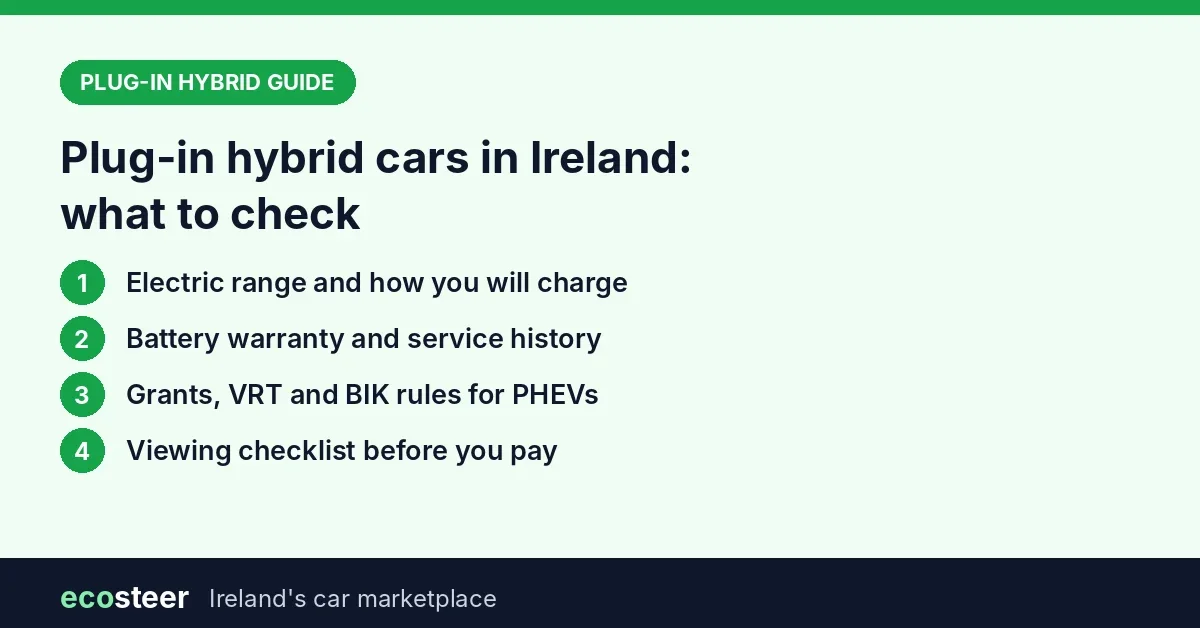
Looking for a PHEV? See used plug-in hybrid cars for sale in Ireland on EcoSteer, from dealers and private sellers around the country.
Quick Summary
- Plug-in hybrid cars in Ireland combine a petrol (or occasionally diesel) engine with a battery you charge from a socket or wallbox, so short trips can be done on electric power alone.
- A plug-in hybrid only saves fuel if you charge it. If you rarely plug in, a self-charging hybrid or an efficient petrol car may suit you better.
- There is no SEAI grant for plug-in hybrids any more: the grant was removed from 1 January 2022, and VRT relief for hybrids and plug-in hybrids ended on 31 December 2020.
- Battery warranties vary by brand. Kia covers its electrified cars and their battery for 7 years, and Toyota offers Hybrid Battery Extended Care of up to 15 years or 1,000,000 km on hybrids and plug-in hybrids, renewed after each Hybrid Health Check.
- Before you buy a used PHEV, charge it, check the electric range, make sure the charging cable is included and confirm the service and warranty history.
Plug-in hybrid cars in Ireland sit between a conventional hybrid and a fully electric car. You get a useful electric range for local driving, plus a petrol engine for long trips with no need to plan around chargers. For many drivers that is the right balance, and there is a growing choice of used plug-in hybrids (often shortened to PHEVs) from family hatchbacks to large SUVs. This guide explains how plug-in hybrids work, who they suit, which grants and tax rules apply in Ireland, how to choose the best plug-in hybrid for your driving, and what to check before you buy one used. When you are ready, compare plug-in hybrid cars for sale on EcoSteer.
What is a plug-in hybrid?
The RSA describes a plug-in hybrid as a hybrid car that provides a way to plug the battery into an electrical outlet for recharging while parked. In practice, a PHEV has three things a normal petrol car does not: an electric motor, a larger battery than a self-charging hybrid, and a charging socket. When the battery has charge, the car can drive on electric power alone for short and medium trips. When the battery runs low, it works like a regular hybrid, using the engine and recovering some energy when you brake.
That makes it different from the other electrified options you will see in listings:
- Mild hybrid: a small 48V system that assists the engine. It cannot drive on electric power alone and is never plugged in.
- Self-charging (full) hybrid: a bigger battery that charges itself while you drive. It can move on electric power at low speeds, but only for short distances, and you never plug it in.
- Plug-in hybrid: a much bigger battery that you charge from a socket or wallbox, plus a petrol or diesel engine for longer trips.
- Battery electric (EV): no engine at all. All driving uses the battery, which you charge from a socket, wallbox or public charger.
Our guide to buying a used hybrid in Ireland explains mild and full hybrids in more depth.
Plug-in hybrid vs hybrid vs electric: quick comparison
This table sets out the main practical differences for a buyer in Ireland.
| Type | Plug in to charge? | Drive on electric only? | SEAI purchase grant | Best suited to |
|---|---|---|---|---|
| Mild hybrid | No | No | No | Drivers who want a familiar petrol or diesel car with a small efficiency boost |
| Self-charging hybrid | No | Short distances at low speed | No | Town and mixed driving with no home charging |
| Plug-in hybrid | Yes | Yes, until the battery runs low | No (removed from 1 January 2022) | Daily trips within the electric range, with occasional long journeys |
| Battery electric | Yes | Always | Yes, new cars only | Drivers who can charge regularly and want the lowest running costs |
Who should buy a plug-in hybrid?
A plug-in hybrid works best when most of your daily driving fits inside its electric range and you can charge at home or at work. A typical example is a school run and a commute that add up to a modest distance each day, plus weekend trips to see family across the country. On weekdays the car runs mostly on electricity; on long trips the engine takes over and you fill up at a normal station.
It is a poor fit if you cannot charge regularly. With a flat battery, a PHEV carries the extra weight of its battery and motor around on petrol alone. The Department of Transport made this point when it refocused the SEAI grant scheme on fully electric cars, noting growing recognition that PHEV emissions in the real world are often higher than official figures. Put simply, the official economy figure assumes you plug in. If you will not, compare a self-charging hybrid instead, or read our guide to the best used hybrid cars in Ireland.
If you can charge every day and rarely drive long distances, a used electric car may cost even less to run. Our comparison of hybrid vs electric cars walks through the choice.
Grants, VRT and BIK on plug-in hybrids
Plug-in hybrids used to get several supports in Ireland. Most of those have ended, which matters when you compare older reviews or advice with today's rules:
- No SEAI grant. The SEAI purchase grant for PHEVs was cut from €5,000 to €2,500 in July 2021, and Citizens Information confirms it was removed from 1 January 2022. Today's SEAI purchase grant is only for battery electric cars, and only for new ones.
- No VRT relief. Revenue's VRT manual states that relief for hybrid and plug-in hybrid vehicles expired on 31 December 2020. The current VRT relief for electric cars only applies to vehicles powered solely by an electric motor. A used PHEV already registered in Ireland has paid its VRT, so this mainly matters if you are importing one.
- BIK for company car drivers. Revenue calculates benefit in kind on a company car from its original market value, its CO2 emissions category and the business kilometres driven. Plug-in hybrids often have low official CO2 figures, which can put them in a lower category, but always check the exact figures for the car with your employer or Revenue. Our Budget 2027 guide for car buyers covers the latest changes.
One support does still apply. The SEAI home charger grant of up to €300 is open to homeowners whether they own an electric vehicle or not, as long as the property has off-street parking and the conditions are met, and a home wallbox is the easiest way to keep a PHEV charged. See our guides to EV grants in Ireland and EV charging in Ireland for the details.
Charging a plug-in hybrid
Most plug-in hybrids charge through a Type 2 connector, the same socket used for home wallboxes and most standard public chargers. Many PHEVs cannot use rapid chargers at all, because their batteries are designed to be topped up slowly overnight or during the working day. Check the owner's handbook for the exact model before you rely on public charging.
Three practical points for buyers:
- Home charging matters most. A wallbox or a suitable socket at home is what turns a PHEV into a cheap car to run day to day.
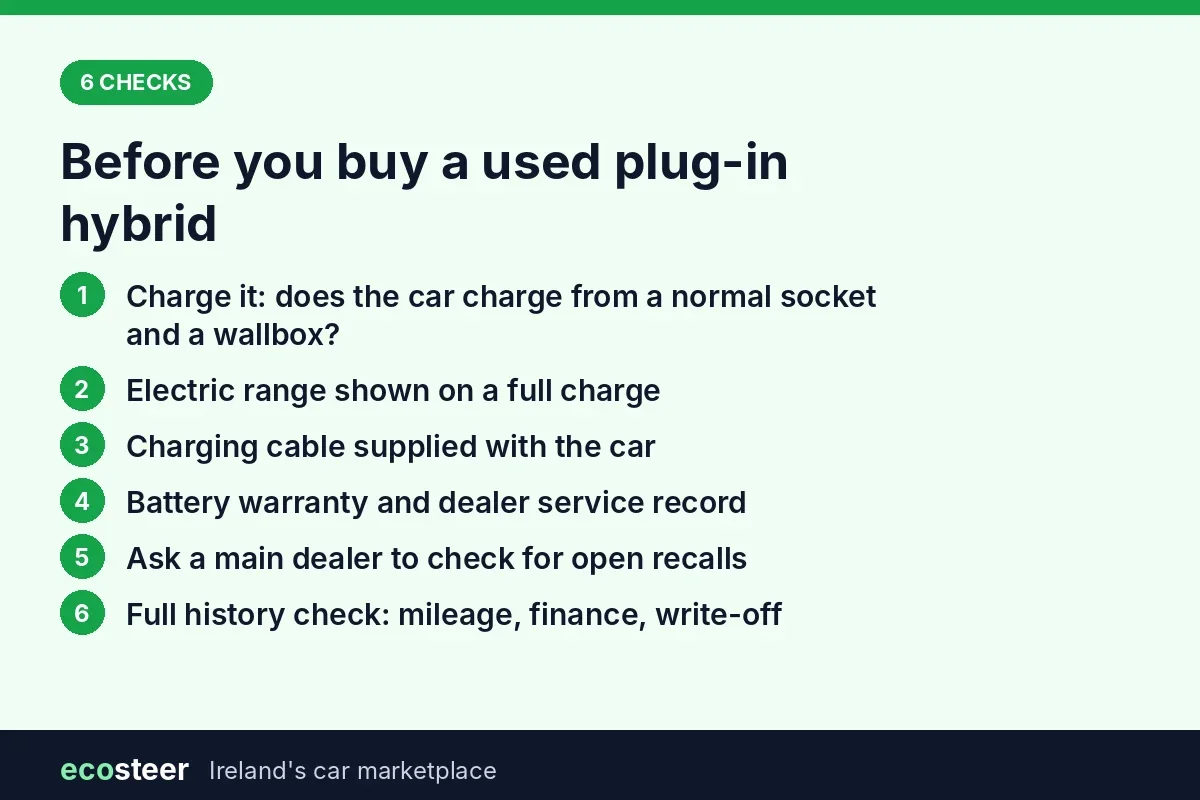
- Check the cable. Make sure the charging cable that came with the car is included in the sale and is in good condition.
- Charge before the test drive. Ask the seller to have the battery charged when you view the car, so you can try it in electric mode and see the range on the display.
Battery warranty and health on a used PHEV
A plug-in hybrid battery is smaller than an EV battery but still one of the most expensive parts of the car, so the remaining warranty is worth checking carefully. Terms differ by brand. Here are examples from official Irish manufacturer pages:
- Kia: Kia Ireland says its electrified vehicles and their battery are covered by its 7-year warranty, and that the warranty is transferable to later owners if the car was maintained regularly. Browse used Kia cars, including the Kia Sportage.
- Toyota: Toyota Ireland offers Hybrid Battery Extended Care of up to 15 years or 1,000,000 km on its hybrid and plug-in hybrid models. Cover is renewed for 1 year or 15,000 km each time the car passes a Hybrid Health Check, which comes as standard when the car is serviced in the Toyota network, so a gap in servicing can mean a gap in cover. Browse used Toyota cars, including the Toyota RAV4.
- Hyundai: Hyundai Ireland says its high-voltage batteries are warranty protected for 8 years or 160,000 km, whichever comes first. Confirm with a Hyundai dealer how this applies to the exact plug-in hybrid you are viewing. Browse used Hyundai cars, including the Hyundai Tucson.
For battery health, ask the seller whether a main dealer has checked the battery, and look at the electric range on a full charge compared with what you would expect for that model and the season. EcoSteer is preparing a Battery Health Badge for EV and hybrid listings, showing how healthy the battery is.
How to choose the best plug-in hybrid for you
There is no single best plug-in hybrid in Ireland: the right one depends on how you drive. Use these questions to narrow down the choice:
- What is your typical daily distance? Pick a car whose real-world electric range covers it with some margin, especially in winter when range drops. When SEAI still supported PHEVs, it required at least 50 km of official WLTP electric range, which is a useful reference point.
- Where will you charge? Home charging is ideal. If you can only charge at work or in public, check that the car's charging speed and socket suit the chargers you will use.
- How much space do you need? The battery can reduce boot space or remove the spare wheel well in some models, so compare the boot with the petrol version.
- Do you tow? Check the official towing limit for the plug-in hybrid version, as it can differ from the petrol or diesel version.
- How long is left on the warranty? Compare the first registration date and mileage with the brand's battery warranty terms.
On EcoSteer you will find plug-in hybrids from brands such as Mercedes-Benz, BYD (including the BYD Seal U) and MG (including the MG HS), as well as Kia, Hyundai, Toyota, Volkswagen and Ford. Many of these models are also sold as petrol, diesel or self-charging hybrids, so filter by fuel type and check the listing details. Prices move week to week, so compare current listings before you decide.
Used plug-in hybrid checklist
Take this list with you when you view a car:
- Charging: plug the car in during the viewing, or ask the seller to show it charging. Check the charging flap, socket and cable for damage.
- Electric range: check the range on the display with a full battery, and drive part of the test in electric mode.
- Engine: the engine may be used less than in a normal car, so make sure it starts smoothly and runs without warning lights when the battery is low.
- Service history: plug-in hybrids still need regular servicing, and some battery warranties depend on it.
- Recalls and software: ask a main dealer to check the VIN for open recalls and software updates.
- NCT: the RSA confirms that the NCT tests hybrid and electric vehicles. A pass shows the car was roadworthy on the day, not how healthy the battery is. See our guide to NCT rules in Ireland.
- History: run a full history check for mileage, previous owners, write-off records and outstanding finance. See how to check a car's history in Ireland.
Buying from a dealer gives you consumer rights that a private sale does not, so take extra care with a private seller. Our guides to questions to ask when buying a used car and safe payment for a car sale will help.
FAQ
Are plug-in hybrid cars worth buying in Ireland?
They can be, if you charge regularly and most of your daily driving fits inside the electric range. If you rarely plug in, a self-charging hybrid or an efficient petrol car is usually the better choice, because a PHEV with a flat battery carries extra weight on petrol alone.
Is there an SEAI grant for plug-in hybrids?
No. The SEAI grant for plug-in hybrids was removed from 1 January 2022, and today's purchase grant is only for new battery electric cars. The SEAI home charger grant of up to €300 is separate and is open to homeowners whether they own an EV or not, subject to its conditions.
Do plug-in hybrids get VRT relief?
Not any more. Revenue states that VRT relief for hybrid and plug-in hybrid vehicles expired on 31 December 2020. The current VRT relief only applies to cars powered solely by an electric motor.
Can you charge a plug-in hybrid at a rapid charger?
Many plug-in hybrids cannot use rapid chargers and are designed to charge through a Type 2 connector at home or at standard public chargers. Check the owner's handbook for the exact model before you rely on public charging.
What happens if a plug-in hybrid runs out of battery?
The car keeps going on its petrol (or diesel) engine and works like a normal hybrid, recovering some energy when you brake. You will use more fuel than when the battery has charge, so plugging in regularly is what keeps running costs down.
Ready to compare? See used plug-in hybrid cars for sale in Ireland on EcoSteer, or browse used hybrid cars and used electric cars.
Sources
- RSA: Electric and hybrid vehicles
- Citizens Information: Buying a new car
- Department of Transport: Electric Vehicle Grant Scheme to prioritise fully electric cars
- Revenue: VRT Manual Section 3 (reliefs)
- Revenue: How to calculate the taxable benefit (company cars)
- SEAI: Electric Vehicle Home Charger Grant
- Kia Ireland: 7-Year Warranty
- Toyota Ireland: New Car and Battery Warranty
- Hyundai Ireland: Warranty
Tags
Ecosteer Editorial
Author