Buying a Used Hybrid in Ireland: Mild, Full and Plug-in Hybrids Explained
Mild, self-charging and plug-in hybrids explained for Irish buyers: which suits your driving, motor tax, battery warranties, recalls and a used hybrid checklist.
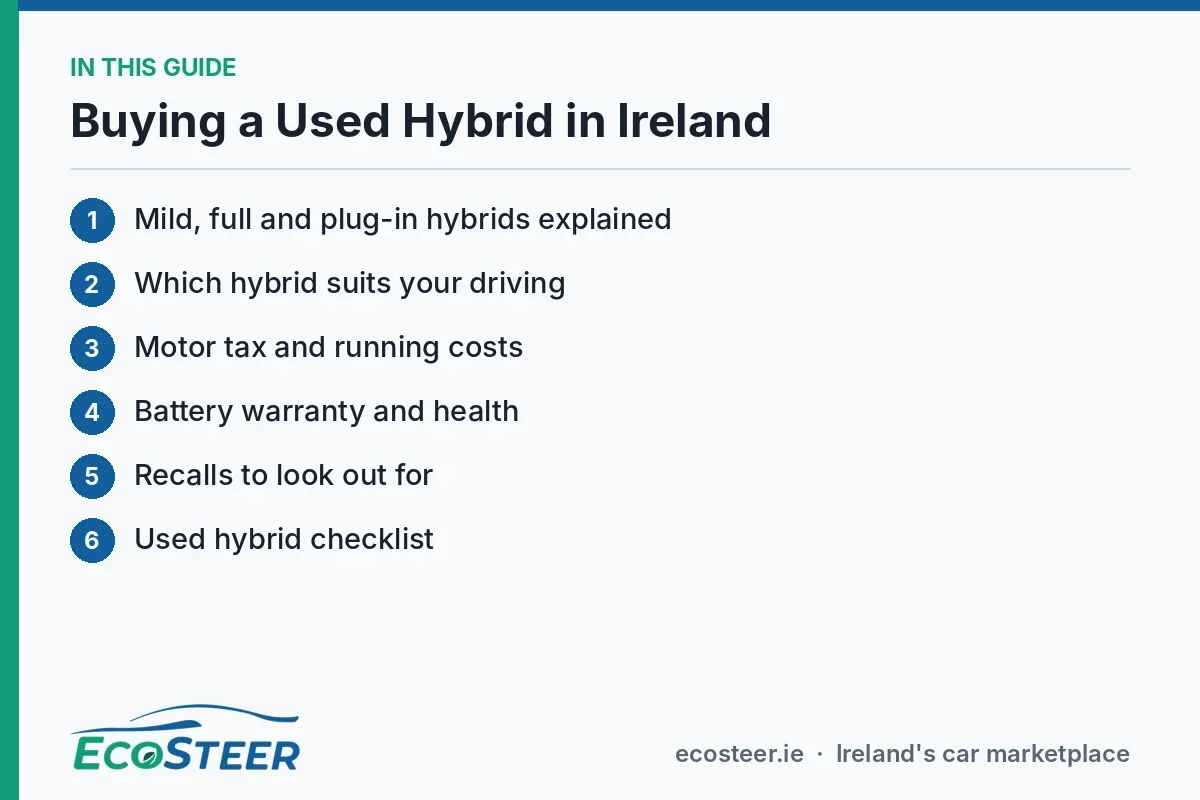
Hybrids are now among the most popular used cars in Ireland, but the word "hybrid" on an advert can mean very different things. This guide explains the three main types, who each one suits, and what to check before you buy a used hybrid in Ireland. You can browse used hybrid cars and used plug-in hybrids on EcoSteer as you read.
Quick Summary
- "Hybrid" covers three different technologies: mild hybrids (usually 48-volt), self-charging full hybrids and plug-in hybrids. Know which one you are looking at before you agree a price.
- Mild hybrids cannot drive on electricity alone, full hybrids can for short distances, and plug-in hybrids can cover longer distances on battery if you charge them.
- Many manufacturers give the high-voltage battery its own warranty. Hyundai Ireland, for example, covers it for 8 years or 160,000 km, whichever comes first.
- A plug-in hybrid only saves money if you plug it in regularly. Without charging, it carries a heavy battery for little benefit.
- Check recalls by VIN, service history, warning lights and, on plug-ins, the charging cable and a test charge.
The three types of hybrid
Mild hybrid (MHEV)
A mild hybrid uses a small battery, usually 48 volts, and a belt-driven starter generator to help the petrol or diesel engine. It smooths the stop-start system and recovers some energy when you slow down, but it cannot drive the car on electricity alone. Many recent Volkswagen Group, Hyundai and Stellantis models offer mild hybrid versions. To the driver, a mild hybrid feels almost exactly like a conventional car.
Self-charging full hybrid (HEV)
A full hybrid has a bigger battery and an electric motor that can move the car on its own at low speeds and for short distances. The battery is charged by the engine and by braking, so you never plug it in. Full hybrids are always automatic and are at their most efficient in town and suburban driving, where the electric motor does more of the work. Hyundai, for example, quotes 215 PS for the full hybrid version of its updated Tucson.
Plug-in hybrid (PHEV)
A plug-in hybrid has a much bigger battery that you charge from a wallbox or public charger. It can cover everyday distances on electricity alone, then switch to petrol for longer trips. Volkswagen says the plug-in hybrid versions of the updated Golf have an electric range of about 100 km and can use DC fast charging at up to 50 kW. Official CO2 figures for plug-ins are very low because the test assumes regular charging.
Which hybrid suits you?
- Mostly motorway and long trips: a mild hybrid petrol or diesel, or a full hybrid if you value smoothness.
- Mixed town and suburban driving, no home charging: a self-charging full hybrid is usually the best fit.
- Short daily commute with home charging: a plug-in hybrid can run on electricity most of the week, with petrol for weekends away. A fully electric car may suit you even better. Browse used electric cars.
- No home charging and mainly long drives: a plug-in hybrid rarely makes sense, because you would carry the weight of a large battery without using it.
Motor tax and running costs
For cars registered in Ireland from 2021, motor tax is based on WLTP CO2 emissions. Hybrids usually have lower official CO2 figures than equivalent petrol or diesel cars, and plug-in hybrids often have very low figures, which can put them in low tax bands. The exact rate depends on the car's CO2 figure and registration date, so always check it on motortax.ie before you buy.
Real fuel savings depend on how you drive. A full hybrid saves most in stop-start traffic. A plug-in hybrid saves most when it is charged every day. A mild hybrid usually gives a modest improvement over a conventional engine.
The battery: warranty and health
The high-voltage battery is the part buyers worry about most. Many manufacturers cover it with a separate warranty that lasts longer than the main warranty. Hyundai Ireland, for example, offers a five-year unlimited-mileage new-car warranty and covers the high-voltage battery for 8 years or 160,000 km, whichever comes first. Terms differ between brands, so ask the seller for the original registration date and check the manufacturer's warranty terms for that model.
When buying used, ask for:
- The full service history, ideally with a main dealer, because hybrid warranties may require servicing to schedule.
- A battery health report from a main dealer, if the brand offers one.
- Confirmation that any hybrid-system software updates have been carried out.
Recalls to look out for
Hybrids are generally simple to own, but like any car they can be recalled. A good example is a March 2026 Irish recall for certain Peugeot 208 and 2008 models with a 48-volt starter alternator, where a pipe may sit too close to the alternator's terminal cap and cause an electric arc in wet conditions. It covers 1,347 vehicles built between June 2023 and January 2026. The Road Safety Authority publishes recall notices by manufacturer, but the reliable way to check a specific car is to give its VIN to a main dealer for that brand. Recall work is free.
Used hybrid checklist
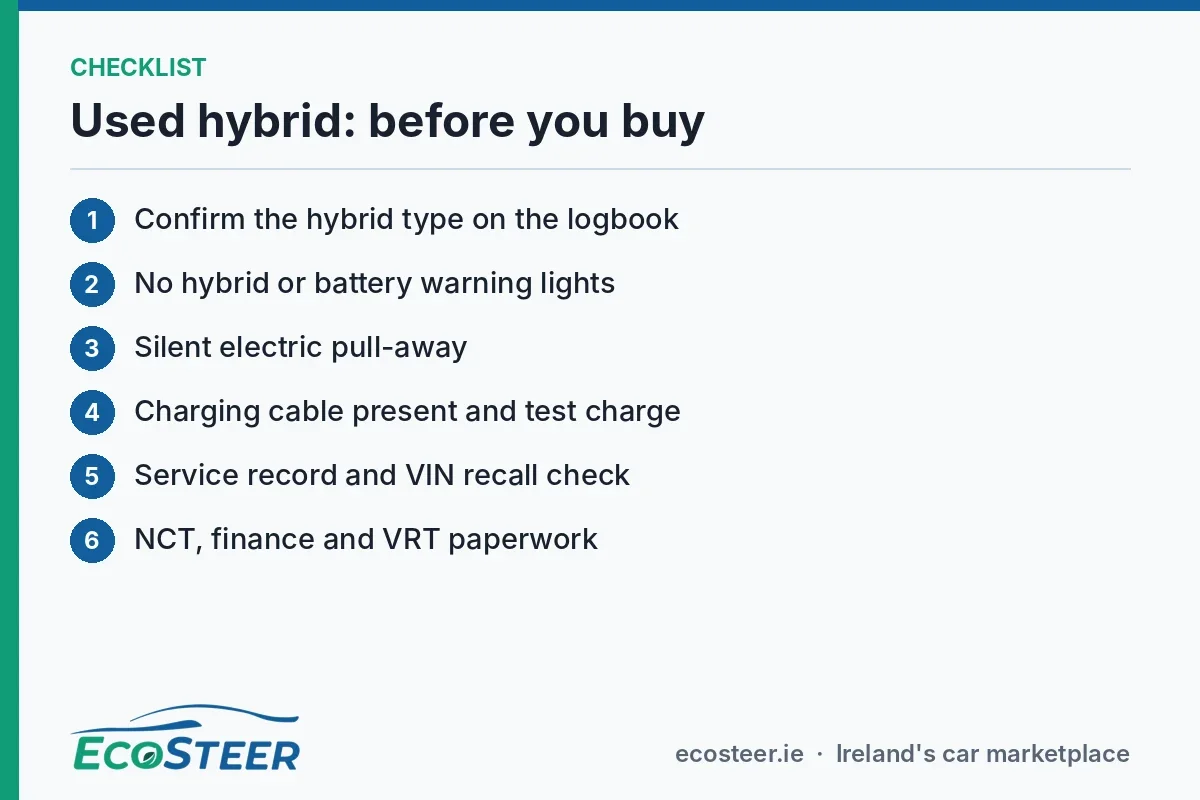
- Identify the type: check the logbook, the badge and the specification so you know whether it is a mild, full or plug-in hybrid.
- Warning lights: after a test drive of at least 20 minutes, there should be no hybrid system, engine or battery warnings.
- Electric running: on a full or plug-in hybrid, the car should pull away silently on electric power at low speed when the battery has charge.
- Charging (plug-ins): the charging cable should be with the car, and the car should accept a charge during your visit.
- Service and recall record: stamps or invoices every year, and a VIN recall check at a main dealer.
- NCT and paperwork: check the NCT certificate and advisory notes, outstanding finance and, for imports, that VRT has been paid.
Frequently asked questions
What is the difference between a mild hybrid and a full hybrid?
A mild hybrid uses a small 48-volt system to help the engine but cannot drive on electricity alone. A full hybrid has a bigger battery and motor and can drive short distances on electric power at low speeds.
Do I need to charge a hybrid car?
Only a plug-in hybrid needs charging. Mild and self-charging full hybrids charge their batteries from the engine and from braking.
Is a used plug-in hybrid worth it in Ireland?
It can be, if you can charge at home and most of your journeys are short. Without regular charging, a plug-in hybrid uses more fuel than its official figures suggest.
How long do hybrid batteries last?
Many manufacturers give the battery a long separate warranty. Hyundai Ireland, for example, covers it for 8 years or 160,000 km. Check the terms for the model and the car's registration date.
Are hybrids cheaper to tax in Ireland?
Often, because motor tax for cars registered from 2021 is based on CO2 and hybrids usually have lower CO2 figures. Check the exact rate for the specific car on motortax.ie.
Sources
Tags
Primary Admin
Author