Budget 2027 for Car Buyers in Ireland: VRT on Electric Cars, EV Grants and BIK
Budget 2027 extends VRT relief on electric cars to the end of 2028 and raises VRT for most petrol, diesel and hybrid cars from January. Here is what changes for car buyers in Ireland, including fuel tax dates, EV grants and BIK.
Shopping for an EV or hybrid? See used electric cars for sale in Ireland and used hybrid cars for sale in Ireland on EcoSteer.
Quick Summary
- Budget 2027 was announced on 6 October 2026, and the Finance (No. 2) Bill 2026 that puts the tax measures into law was published on 19 October 2026.
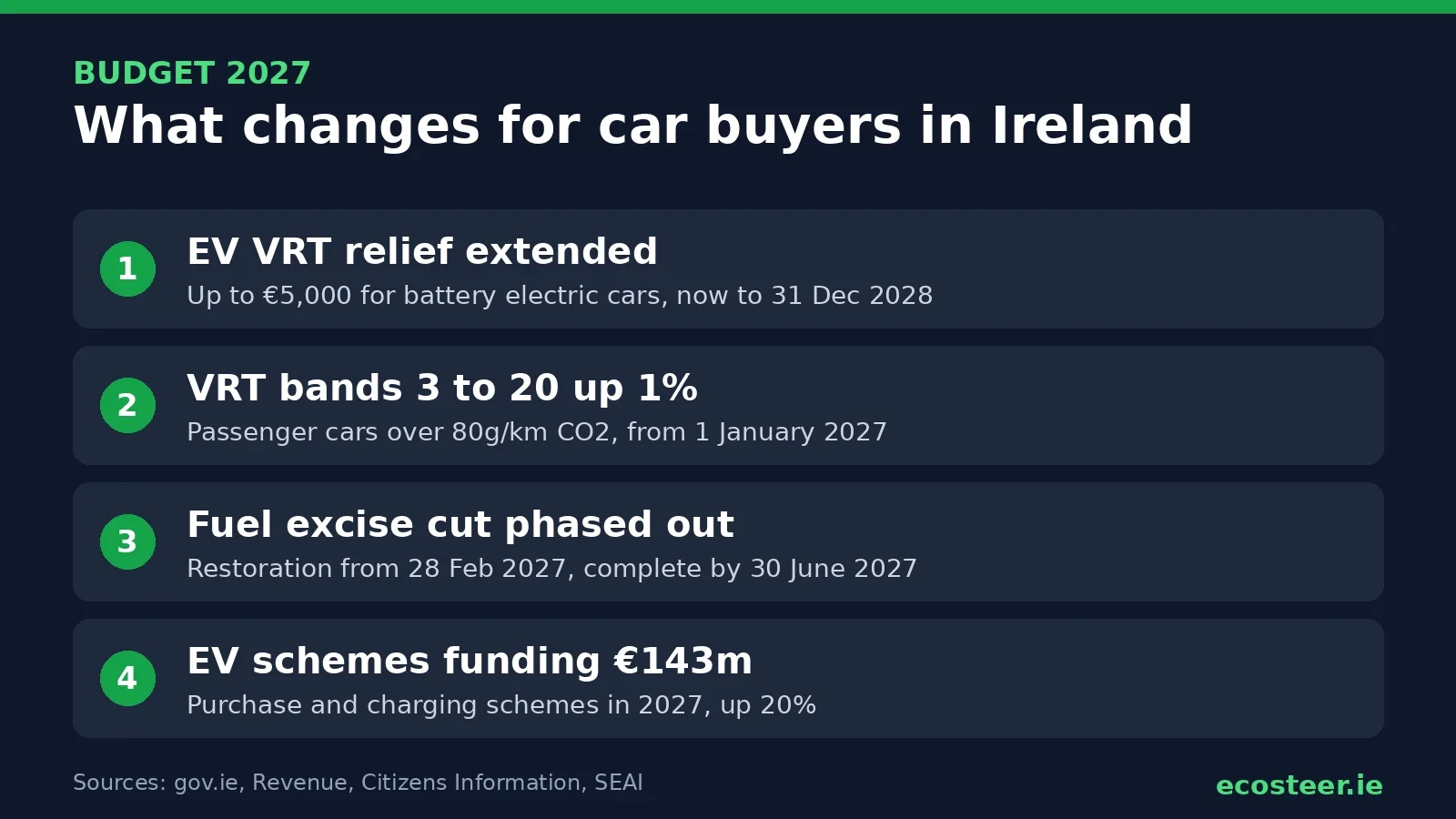
- VRT on electric cars: the relief of up to €5,000 for battery electric cars has been extended from the end of 2026 to the end of 2028. It still only applies to cars with a selling price below €50,000.
- VRT rates for passenger cars in bands 3 to 20 (cars over 80g/km of CO2) rise by 1% from 1 January 2027. Bands 1 and 2 are unchanged.
- The temporary cut in petrol and diesel excise stays until 28 February 2027 and is then phased out by 30 June 2027. The next carbon tax increase on motor fuels is deferred to 1 May 2027.
- Funding for EV purchase and charging schemes rises to €143 million in 2027. The Budget documents we checked list no new change to BIK on electric cars, so the existing Revenue rules continue.
Budget 2027 brings a handful of changes that matter if you plan to buy a car in Ireland over the next year, especially if you are weighing up an electric car, a hybrid or a petrol or diesel model. The biggest headlines are the extension of VRT relief on electric cars, a small VRT increase for most petrol, diesel and hybrid cars from January, and the timeline for fuel prices. This guide sets out what changed, what stayed the same, and what it means for new and used car buyers. Every figure below comes from official sources: gov.ie, Revenue, Citizens Information and SEAI.
Budget 2027 at a glance for car buyers
| Measure | What changes | Who it affects | When |
|---|---|---|---|
| VRT relief on electric cars | Relief of up to €5,000 extended (reduced relief between €40,000 and €50,000, none above €50,000) | Buyers of new battery electric cars and first registration of imported EVs | Now runs to 31 December 2028 (was 31 December 2026) |
| VRT rates, Category A | Rates for bands 3 to 20 rise by 1% | Passenger cars over 80g/km of CO2, which includes most petrol, diesel and many hybrid cars | From 1 January 2027 |
| Petrol and diesel excise | Temporary reduction kept, then restored in steps | All petrol and diesel drivers | Restoration starts 28 February 2027, complete by 30 June 2027 |
| Carbon tax on motor fuels | Increase to €78.50 per tonne deferred | All petrol and diesel drivers | 1 May 2027, then a further increase on 13 October 2027 |
| EV purchase and charging schemes | Baseline funding up 20% to €143 million | EV buyers, home and public charging | 2027 |
| Vehicle Adaptation Scheme | New €6.5 million scheme | Drivers and passengers who need an adapted vehicle | Details to follow |
VRT on electric cars: relief extended to the end of 2028
The most important Budget 2027 change for EV buyers is the extension of VRT on electric cars relief. Revenue's rules say a battery electric car with an open market selling price (OMSP) of up to €40,000 can get up to €5,000 off its VRT. Between €40,000 and €50,000 a reduced level of relief applies, and above €50,000 there is no relief. The relief was due to end on 31 December 2026. The Finance (No. 2) Bill 2026 extends it to the end of 2028.
A few points are worth knowing:
- Only fully electric cars qualify. Revenue's VRT relief applies to vehicles powered only by an electric motor. Plug-in hybrids and self-charging hybrids do not get it.
- It is built into the new car price. VRT is paid when a car is first registered in Ireland, so for a new car the relief is already reflected in the dealer's price.
- It matters for imports too. If you are importing a used electric car, VRT is charged when you register it here, so the relief applies to that first Irish registration if the car qualifies.
- Used cars already on Irish plates are not affected. VRT has already been paid on them, so the Budget does not change their price directly.
For buyers, the extension removes a deadline. Without it, many new EVs would have become more expensive from January 2027. If you would rather buy secondhand, prices of used EVs are set by the market rather than by VRT, so compare current used electric cars for sale before you decide.
VRT increase for petrol, diesel and hybrid cars from January 2027
From 1 January 2027, VRT rates for Category A vehicles (passenger cars) in bands 3 to 20 increase by 1%. According to Citizens Information, this covers cars with CO2 emissions above 80g/km. Bands 1 and 2, the lowest emission bands, do not change.
In practice, most new petrol and diesel cars and many hybrids sit above 80g/km, so their list prices may rise slightly from January. How much depends on the car's selling price, its CO2 band and whether the brand or dealer absorbs some of the increase. Battery electric cars produce no tailpipe CO2 and are not affected by this change.
If you are set on a new petrol, diesel or hybrid car, the timing of your purchase may matter: a car registered before 1 January 2027 is taxed at the current rates. Ask the dealer for the full on-the-road price, including VRT and delivery, and compare it with a car registered after the change. For a used car already registered in Ireland, this increase makes no direct difference. You can browse used hybrid cars, used plug-in hybrids, used petrol cars and used diesel cars on EcoSteer.
Fuel costs: excise and carbon tax dates
Running costs matter as much as the purchase price. The Department of Finance has confirmed the following for motor fuels:
- Excise: the temporary reduction in the non-carbon part of mineral oil tax on petrol and diesel continues until 28 February 2027. It is then restored in stages, with increases for petrol and diesel on 8 April 2027 and 1 May 2027, and full restoration on 30 June 2027.
- Carbon tax: the increase on motor fuels that was due on 14 October 2026 is deferred to 1 May 2027, when the rate rises from €71 to €78.50 per tonne of CO2. A further increase follows on 13 October 2027, putting the rate back on its path to €100 per tonne.
The Budget documents give the dates and rates, not the effect at the pump, because forecourt prices also depend on oil prices and retailers. What is clear is that the direction of travel for petrol and diesel tax in 2027 is upwards. If you cover a lot of kilometres, that is worth factoring into a petrol versus diesel versus electric decision. Our guide to hybrid vs electric cars can help.
EV grants in 2027: what Budget 2027 says
The Department of Transport says baseline funding for EV purchase and charging infrastructure schemes rises by 20% to €143 million in 2027. It also says ring-fenced funding will support a pilot grant scheme to help households without off-street parking install approved cross-pavement charging. The Budget announcement does not set new grant amounts, so the current SEAI rules are the ones to check:
- SEAI EV grant: up to €3,500 for a new battery electric car bought privately, or €2,700 for a demonstrator. The car's full price must be between €15,000 and €60,000, and it must stay registered as Private for six months.
- New cars only: SEAI states its grants are not available for used EVs.
- ICE2EV scrappage scheme: up to €5,000 extra if you scrap a petrol or diesel car (including hybrids) registered in 2013 or earlier that you have owned for at least 12 months. From 1 August 2026, the new EV must cost no more than €50,000 before the grant. The scheme closes when its budget is used, so check SEAI for its current status.
Grant rules change, so confirm the amount with SEAI and your dealer before you sign. For more detail, read our guide to EV grants in Ireland.
BIK on electric cars: the rules for 2027
If you drive a company car, benefit-in-kind (BIK) matters more than VRT. The Budget 2027 documents we reviewed list no new change to BIK on electric cars, so the existing Revenue rules continue. Under those rules:
- Partial BIK relief applies to electric cars made available between 1 January 2023 and 31 December 2027.
- The original market value (OMV) of an electric car is reduced by €20,000 for cars made available in 2026 and by €10,000 for cars made available in 2027.
- Separately, a temporary OMV reduction applies to all cars in categories A1 to D: €10,000 for 2023 to 2026, €5,000 for 2027 and €2,500 for 2028. The electric car relief is in addition to this.
- Hybrid cars do not qualify for the electric car relief.
- The lower limit of the highest business mileage band was cut from 52,001 km to 48,001 km in 2023, and Revenue says this has been made permanent from 1 January 2026.
In short, BIK on electric cars in Ireland becomes less generous in 2027 under the rules already in place. If you are choosing a company car, ask your employer or payroll team how the 2027 figures apply to the car you have in mind.
Should you buy now or wait?
- New electric car: there is less pressure to rush, because VRT relief now runs to the end of 2028. Grant rules are separate, so check SEAI before you order.
- New petrol, diesel or hybrid car above 80g/km: registering before 1 January 2027 avoids the VRT increase. Compare on-the-road prices before and after.
- Used car already registered in Ireland: the Budget has no direct effect on its price. Focus on condition, history and running costs, and compare used cars for sale across Ireland.
- Company car driver: check how the 2027 BIK figures change your monthly cost.
If you are financing your next car, our car finance guide explains the main options. You can also browse popular EV and hybrid brands such as Hyundai, Kia, Renault, Toyota and Volkswagen.
Related reading: if you are deciding when to buy, see buying a car before or after the 271 plate. If you plan to sell your current car first, our guide on how to sell your car for free in Ireland walks you through each step. You can also compare used electric cars and used hybrid cars for sale now.
FAQ
Is VRT relief on electric cars extended in Budget 2027?
Yes. The relief of up to €5,000 for battery electric cars, which was due to end on 31 December 2026, is extended to the end of 2028. Cars with a selling price above €40,000 get reduced relief, and cars above €50,000 get none.
Does the VRT increase apply to hybrid cars?
It applies to passenger cars in VRT bands 3 to 20, which means cars with CO2 emissions above 80g/km. Many hybrids fall into these bands, so check the CO2 figure of the exact car. Cars in bands 1 and 2 are unchanged.
Did Budget 2027 change BIK on electric cars?
The Budget 2027 documents we checked list no new BIK change for electric cars. The existing Revenue rules continue, with the OMV reduction for electric cars falling from €20,000 in 2026 to €10,000 in 2027.
Can I get an SEAI grant on a used electric car?
No. SEAI states that its EV grants are only for new vehicles. The VRT relief also applies only when a car is first registered in Ireland, so it does not reduce the price of a used EV already on Irish plates.
When will petrol and diesel prices go up?
The temporary excise cut stays until 28 February 2027 and is restored in steps until 30 June 2027. The next carbon tax increase on motor fuels is on 1 May 2027. Actual pump prices also depend on oil prices and retailers.
Ready to compare? See used electric cars for sale in Ireland and used hybrid cars for sale in Ireland on EcoSteer.
Updated November 2026. Some Budget measures depend on the Finance Bill being passed and may change as it goes through the Oireachtas.
Sources
- Citizens Information: Budget 2027
- Department of Finance: Finance (No. 2) Bill 2026 published (19 October 2026)
- Department of Finance: Budget 2027 Tax Policy Changes Summary
- Department of Transport: Budget 2027 transport measures (7 October 2026)
- Revenue: VRT on electric vehicles
- Revenue: BIK exemptions and electric cars
- Revenue: How to calculate the taxable benefit of a company car
- SEAI: Electric car grant amounts
- SEAI: ICE2EV scrappage scheme
Tags
Ecosteer Editorial
Author