May 2026 APRs: Car finance in Ireland, PCP, HP, credit unions
Compare May 2026 APRs and true costs for PCP, HP and credit union loans in Ireland. Includes a €20,000 worked example, application checklist and dealer...

PCP suits you if you want the lowest monthly payment and plan to trade in every three or four years; hire purchase suits you if you want to own the car outright with no balloon payment lurking at the end; a credit union or personal loan usually wins on APR if you’re already a member. Tools like the Odo calculator and rate pages from Bank of Ireland let you test all three before you commit. A marketplace like Ecosteer helps you line up dealer quotes alongside them.
TL;DR:
- PCP often results in lower monthly payments but carries a risk of negative equity if the car depreciates faster than forecasted.
- Hire purchase guarantees ownership at the end but involves higher monthly payments compared to PCP, with no balloon payment to worry about.
- Credit unions typically offer the lowest APR, especially for electric vehicles, but require membership and proof of savings or stable income.
- Green loans and EV-specific financing options usually come with lower APRs and may include 0% deals or additional grants, reducing overall costs.
- Always compare the total credit cost and check eligibility for cheaper options like credit unions before choosing your finance route.
Table of Contents
- Quick shortlist: when to try PCP, HP or a credit-union loan
- PCP vs HP vs credit union: what May 2026 rates actually look like
- How to apply for car finance: documents, timeline and questions to ask
- Working out your real monthly cost: a €20,000 car example
- Green car loans, 0% deals and the SEAI grant
- How Ecosteer helps you prepare for the finance step
- Do you need specific insurance to finance a car?
- Tax and registration costs when you’re financing a car
- What happens if you fall behind on payments
- Author perspective: the mistakes that cost buyers the most
- Find dealers and compare finance-ready quotes with Ecosteer
- Sources
Quick shortlist: when to try PCP, HP or a credit-union loan
Not every buyer needs the full comparison table before deciding where to start. If you already know your rough budget and how long you’ll keep the car, one of these three routes will usually stand out straight away.
- PCP: choose this if monthly affordability matters more than eventual ownership. Payments are lowest because a chunk of the car’s value, typically 30 to 50%, gets deferred as a Guaranteed Minimum Future Value (GMFV) or “balloon” payment. You’ll face mileage limits and condition checks at handback.
- Hire purchase: choose this if you want the car to be yours at the end with no final lump sum. Monthly payments run higher than PCP, but the outcome is simpler and there’s no balloon-payment gamble.
- Credit union or personal loan: often the cheapest route on APR if you’re a member with a savings history, and there’s no balloon payment to manage. Membership rules and affordability checks vary by branch, so confirm eligibility before you shop for a car. If you’re buying electric, ask about green loan rates specifically, since several credit unions and banks price EVs lower than petrol or diesel.
PCP vs HP vs credit union: what May 2026 rates actually look like
The three routes don’t just differ in structure. They differ in cost, and the gap can run into hundreds of euros over the life of the loan once you strip away the illustrative monthly figure lenders lead with.
PCP rates from mainstream lenders typically vary with vehicle type; electric or plug-in hybrid cars often receive lower APRs than petrol and diesel models, according to Bank of Ireland’s representative examples. Fixed-rate providers such as An Post advertise competitive fixed rates on sample amounts. Credit unions can undercut both: Kilcock Credit Union advertises a competitive headline rate, and some credit unions price EV loans more attractively.
| Finance route | Typical APR (May 2026) | Monthly payment shape | Ownership at term end | Best for |
|---|---|---|---|---|
| PCP | 6.5%–7.1% (lower for EVs) | Lowest | Balloon payment due, or hand back the car | Buyers who trade in every 3-4 years and want low monthly costs |
| Hire purchase | Broadly similar to PCP, often slightly higher | Higher than PCP | You own the car outright | Buyers who want certainty and plan to keep the car long term |
| Credit union loan | 4.95% and up (as low as 3.95% for EVs) | Higher than PCP, no balloon | You own the car outright | Members with savings history and stable income |
| Personal loan (bank) | Similar to credit union band, varies by profile | Higher than PCP, no balloon | You own the car outright | Buyers who don’t qualify for credit union membership |
The GMFV maths is where PCP catches people out. The balloon figure is set at the start based on the lender’s forecast of the car’s resale value, not what it will actually be worth. If the car loses value faster than the lender predicted, that’s the lender’s risk, not yours, and you simply hand the keys back. But if you’ve added optional extras or driven beyond the agreed mileage cap, you can end up with negative equity: owing more against the car than it’s worth, with nothing to put toward your next deposit.
Pro Tip: Run the same car and deposit through a calculator like Odo’s under PCP, HP and a credit-union loan before you visit a dealer. The total cost of credit figure, not the monthly payment, is the number that tells you which route actually costs less.
A comparison run through Odo’s calculator shows PCP can carry a lower monthly figure than HP on the same car, yet cost more overall once the balloon payment and its own interest are factored in. That’s the trade-off worth sitting with before you sign anything.
How to apply for car finance: documents, timeline and questions to ask
Applying online is now standard across Irish lenders, and the process moves faster than most people expect once your paperwork is ready.
- Gather your documents first: proof of identity, your PPS number, proof of address, recent payslips or proof of income, and bank statements. If you’re financing an EV and expecting a green loan rate, you’ll also need the dealer’s invoice or quote.
- Apply online or through the dealer: many lenders, including PTSB, offer approval within minutes for existing customers with documents in order. Dealers often act as credit intermediaries, submitting your application to a panel of lenders on your behalf.
- Ask the right questions before signing: What’s the APR, not just the flat rate? Are there documentation or completion fees? What are the early repayment terms? For PCP, what mileage cap applies, and what condition standard will handback assessors use?
Pro Tip: Get a formal quote rather than relying on a lender’s representative example. Those figures usually assume a strong credit profile, and your actual rate will depend on your own circumstances and existing commitments.
Working out your real monthly cost: a €20,000 car example
Numbers make the difference between routes obvious in a way percentages alone don’t. Take a €20,000 car with a €2,000 deposit over four years.
Reading a calculator output properly means checking three things beyond the headline monthly figure:
- The APR, not the flat interest rate quoted by some dealers, since APR includes fees and gives you a true comparison.
- The documentation fee, often a few hundred euros, added to the loan or charged upfront.
- The total cost of credit line, which adds every payment, deposit and balloon together, and is the only number that tells you which route is genuinely cheaper.
Bank of Ireland and other lenders are clear that their published examples are illustrative only. Your actual rate depends on your credit profile, deposit size and existing commitments, so treat any calculator output as a starting estimate rather than a firm offer.
Green car loans, 0% deals and the SEAI grant
Electric and plug-in hybrid buyers get a genuinely better deal on finance in Ireland right now. Green loan APRs from banks and credit unions typically sit below standard petrol and diesel rates, and manufacturer finance arms occasionally run 0% PCP promotions on selected EV models through dealer-arranged finance.
Before you sign, confirm exactly how the SEAI grant is applied. Some dealers deduct it from the price upfront; others expect you to claim it separately, which changes the amount you actually finance.
How Ecosteer helps you prepare for the finance step
Sorting your finance route is only half the job. Finding the right car at the right dealer, with a quote you can actually compare, is the other half.
Ecosteer’s dealer finder lets you search verified listings by county, price, mileage and fuel type, then contact dealers directly to request finance-ready quotes without chasing multiple showrooms. Buyer guides on the platform, including a step-by-step used car guide, walk you through vehicle checks and paperwork so you arrive at the finance conversation prepared, not guessing.
Do you need specific insurance to finance a car?
Every financed car needs comprehensive motor insurance for the full term of the agreement, and lenders will ask for proof before releasing funds. This isn’t optional, and it isn’t the same as the third-party cover some drivers carry on an older, unfinanced car.
The reason is straightforward: with PCP or HP, the finance company retains legal ownership of the car until the final payment clears, so they need it protected against write-off or theft to protect their asset. Comprehensive cover also protects you, since a fully financed car written off under third-party-only insurance would leave you still owing the lender with nothing to show for it.
Many buyers underestimate a related risk: if a financed car is written off early in the agreement, the payout from a standard motor policy may fall short of what you still owe, since cars depreciate faster than most loans amortise in the first year or two. GAP insurance exists specifically to cover that shortfall, and it’s worth pricing before you finalise your finance, not after.
Lenders don’t usually mandate GAP cover the way they mandate comprehensive insurance, but several will flag it as a recommendation at the point of sale, particularly for PCP agreements where negative equity risk is highest. Check your policy renewal date against your finance term too. A lapse in cover partway through a financed agreement can breach the loan terms, not just leave you exposed on the road.
Tax and registration costs when you’re financing a car
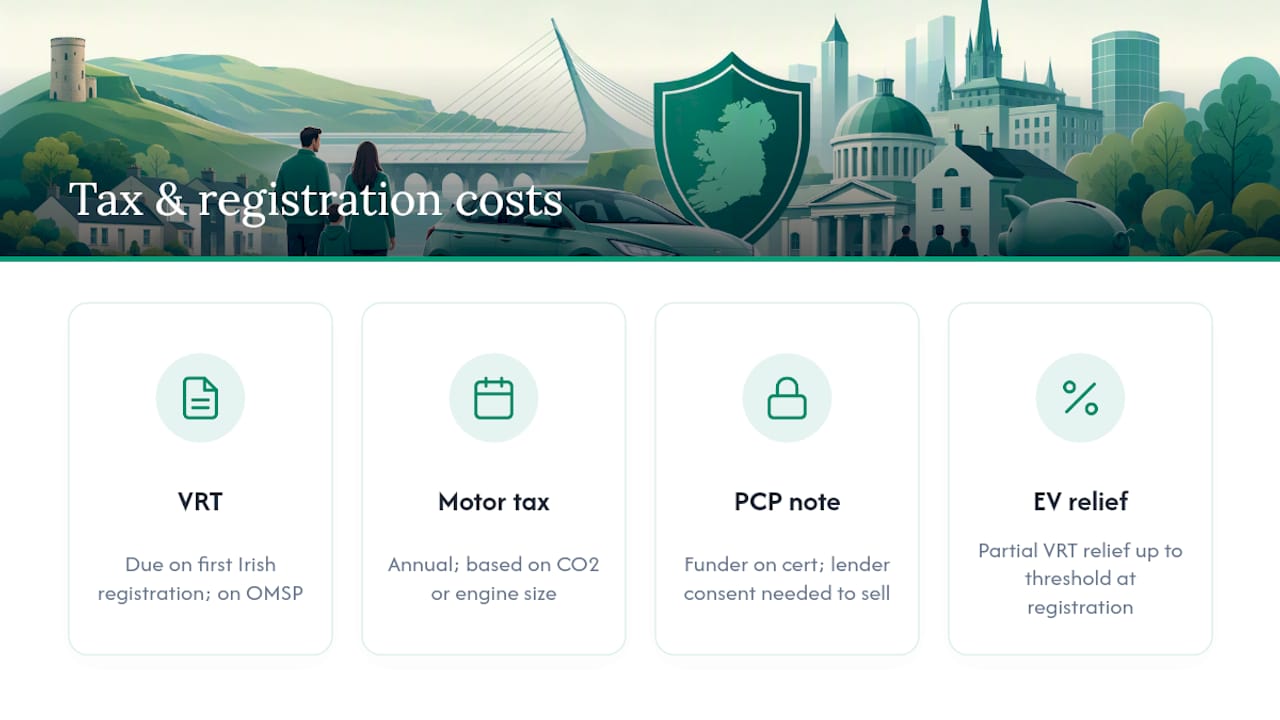
Financing a car doesn’t change what you owe Revenue or the National Vehicle and Driver File. Vehicle Registration Tax (VRT) is due on any car being registered in Ireland for the first time, whether you’re paying cash, taking out HP, or financing through PCP, and it’s calculated on the car’s Open Market Selling Price, not the amount you’re borrowing.
Motor tax, based on CO2 emissions or engine size depending on registration date, is a separate annual cost that continues regardless of how the car was financed. Neither VRT nor motor tax appears in a finance calculator’s monthly figure, so factor both into your real running cost before you commit to a repayment amount that already feels tight.
One detail catches out PCP buyers specifically: because the finance company holds legal ownership until the final payment, the vehicle registration certificate typically shows the finance company’s interest noted against the car. This doesn’t affect your right to drive or insure it, but it matters if you try to sell privately before the agreement ends. You’ll need the lender’s consent and a settlement figure first.
EV buyers get a partial offset here. Battery electric vehicles currently attract VRT relief up to a set threshold, which is separate from the SEAI purchase grant and applied at registration rather than at the finance stage. Confirm with your dealer which reliefs apply to your specific model year, since thresholds and eligibility have shifted over recent budgets.
What happens if you fall behind on payments
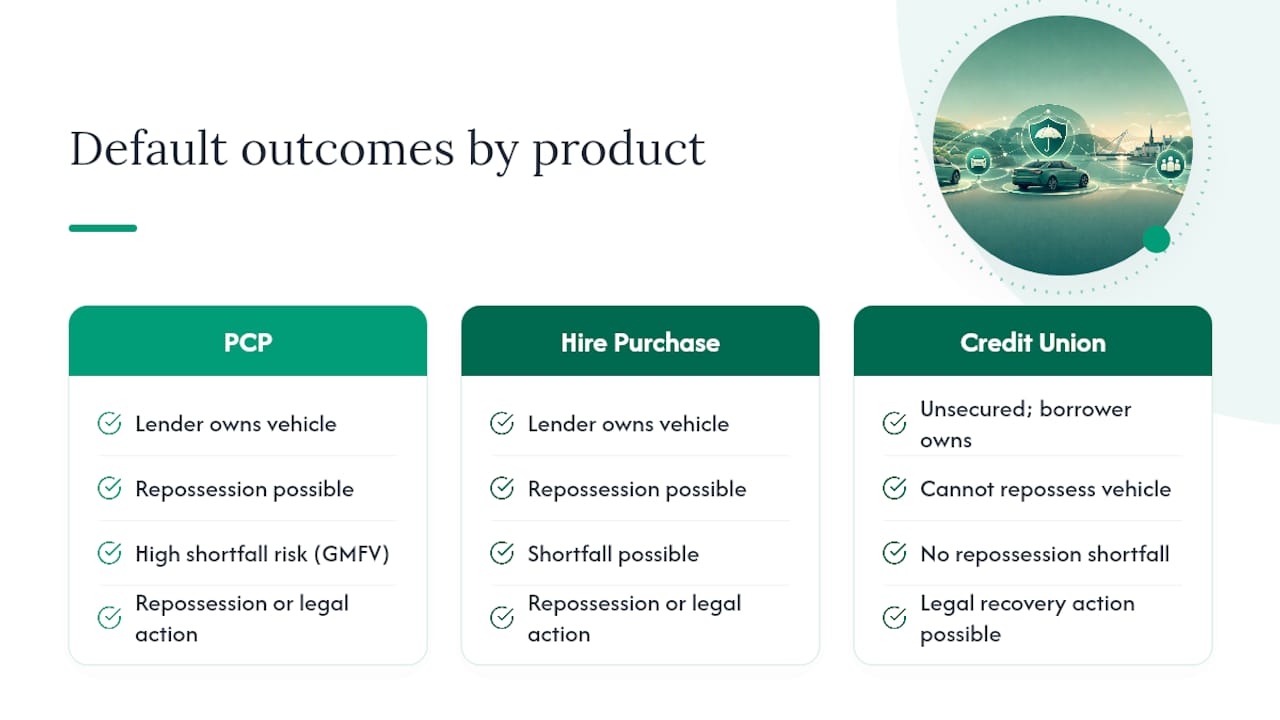
Missing a payment on car finance in Ireland doesn’t trigger repossession overnight, but the protections and the risks differ depending on which route you chose. Under the Consumer Credit Act, lenders must follow set arrears procedures, including written notice and an opportunity to address missed payments, before taking further action.
With PCP and hire purchase, the finance company legally owns the car until the final payment clears. Persistent default can lead to voluntary surrender or repossession, and you may still owe a shortfall if the car’s resale value doesn’t cover the outstanding balance. That risk is highest on PCP agreements carrying a large GMFV.
Credit union loans work differently, since the loan is unsecured against the car itself. Default still damages your credit record and can lead to legal recovery action, but the credit union can’t repossess the vehicle directly the way a PCP or HP provider can. The Credit Union Act sets out the obligations credit unions and members operate under, including affordability assessments designed to reduce default risk from the outset.
If you’re struggling, contact your lender before you miss a payment, not after. Most Irish lenders have arrears support options, including temporary restructuring, and acting early nearly always produces a better outcome than waiting for a formal default notice.
Author perspective: the mistakes that cost buyers the most
The GMFV trap catches more people than dealers admit. A low PCP monthly payment feels like a win until you realise the balloon payment was never designed to disappear, it was designed to be refinanced into your next car. If you keep the car past the agreement, you’re often paying more overall than HP would have cost.
Before you sign anything, check three things: the total cost of credit across all three routes, not just the monthly figure; whether your green loan rate reflects a genuinely lower price or a loaded one; and whether you’d actually qualify for credit union membership before assuming it’s your cheapest option.
— ibrahim
Find dealers and compare finance-ready quotes with Ecosteer
Ecosteer is the practical next step once you know which finance route suits you: a marketplace built specifically for Irish buyers to search verified listings by county, price, mileage and fuel type, then contact dealers directly rather than ringing round showrooms one by one.
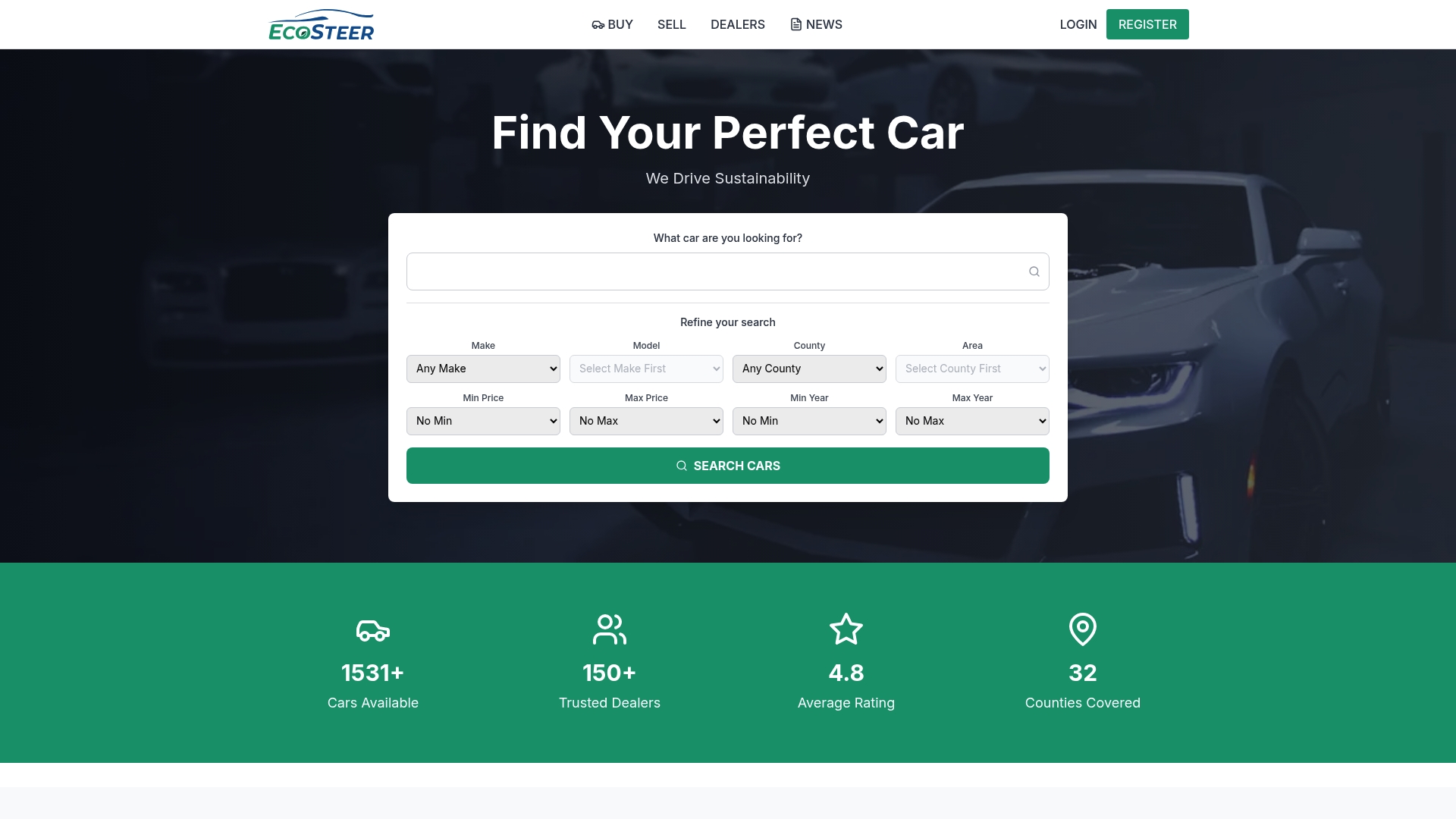
Unlike generic finance comparison sites, Ecosteer keeps you close to the actual cars on offer, so you can pull multiple dealer quotes against the same model and put them through a calculator side by side before you commit to anything. The platform’s dealer finder lets you request quotes from several dealers at once, and its buyer guides help you gather the documents lenders will ask for, from proof of income to the dealer invoice your green loan application needs. If you’re weighing up your next car and want quotes lined up alongside real listings, start by searching Ecosteer’s marketplace for models in your budget and county.
This article is general information, not a substitute for advice from a qualified financial advisor. Consult a qualified financial professional about your own circumstances before acting on anything here.
Sources
- Odo
- Car Loan | Car Loans - Bank of Ireland
- Car Loans Ireland, Best Fixed Rates for Car Finance from An Post
- Kilcock Credit Union | Car Loan 4.95%
- Car Loan | Permanent tsb / PTSB car loans (application info)
Recommended
Ecosteer Editorial
Author