Avoid a €2,500 Fine: NCT Rules in Ireland and Simple Prep Steps
Know when your NCT is due, avoid five penalty points or a €2,500 fine, and use a practical prep checklist to pass first time and cut re-test costs.

Most private cars in Ireland must hold a valid NCT from four years after first registration, with tests due every two years until the car turns 10, then annually after that. Skip it and you risk five penalty points, a fine of up to €2,500, and a vehicle Garda can seize on the spot. Book and manage your test through the official NCTS site.
TL;DR:
- Cars aged 10 and over must be tested annually, with most failures occurring due to worn tyres, faulty lights, or brake issues that can be prevented with routine checks.
- Vehicles imported from Great Britain or Northern Ireland generally require a full NCT after registration, unlike EU imports which may have mutual recognition for prior testing.
- Booking a test online or by phone requires early planning, especially in cities where appointment slots fill quickly, and canceling or rescheduling must be done at least five working days in advance.
- Failing to have a valid NCT can lead to a fine of up to €2,500, five penalty points, and vehicle seizure by Gardaí, with sinking penalties for dangerous failures requiring immediate towing.
- Preparation including checking tyres, lights, oil levels, and removing diagnostic equipment can significantly improve the chance of passing on the first try and avoid costly re-tests.
Table of Contents
- When is my car due? NCT test frequency explained
- How do I book, change or cancel an NCT appointment?
- What does the NCT actually inspect?
- What happens after the test: results, re-tests and fees
- What are the legal penalties for driving without a valid NCT?
- Are there exemptions from NCT rules?
- How should I prepare for my NCT?
- What if I lose my certificate or want to appeal a result?
- What EcoSteer’s guides add to your NCT prep
- Why the compliance conversation misses the point
- Sources
- FAQ
When is my car due? NCT test frequency explained
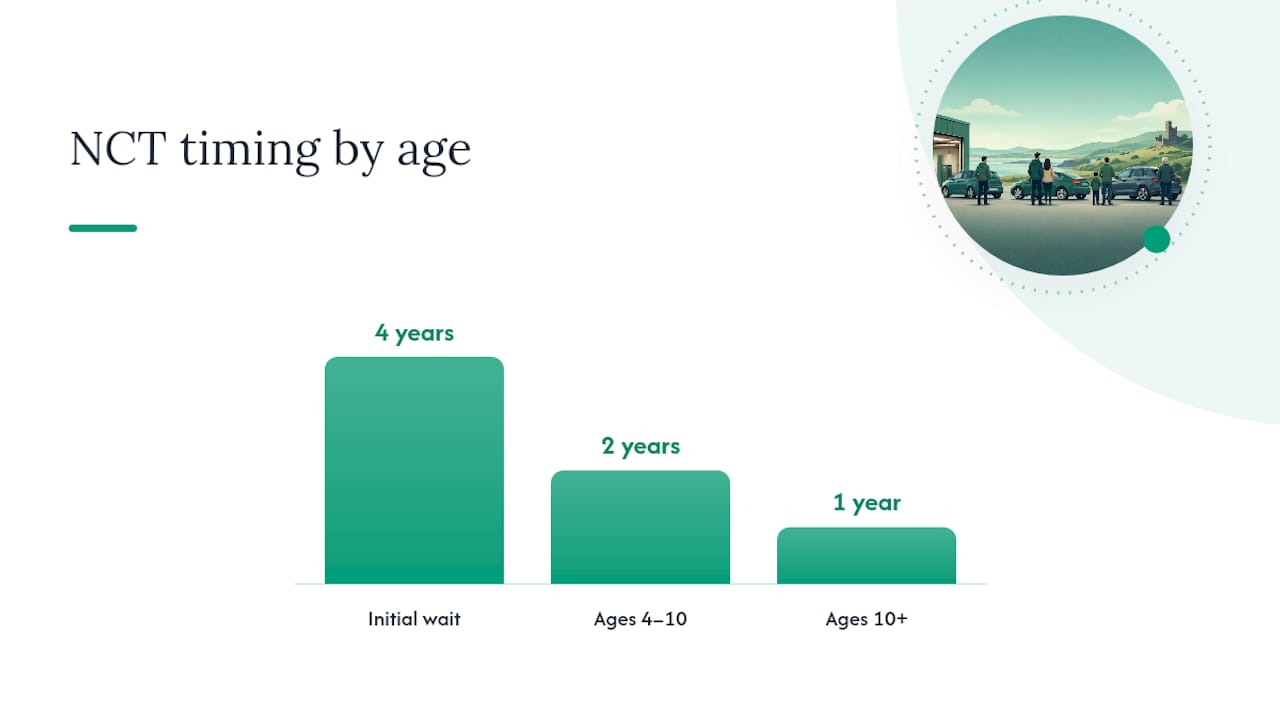
The NCT schedule follows a clear pattern, but the exceptions catch people out more than the rule itself. A private car needs its first test four years after the date of first registration, not the date you bought it. From there, testing runs every two years until the car reaches its 10th anniversary, after which it switches to annual testing for the rest of its life on Irish roads.
Vehicles aged 30 to 39 years fall into a slightly different bracket, and cars over 40 years old can qualify for an exemption, though this depends heavily on how the car is used. A vintage car kept for weekend shows sits in a different category to one used for daily commuting, so check your specific status with NCTS rather than assuming an exemption applies.
- Initial test: 4 years after first registration
- Ages 4 to 10: every 2 years
- Ages 10+: every year
- Ages 30 to 39: special rules apply, confirm with NCTS
- 40+ years: possible exemption depending on use
One rule surprises a lot of drivers: you can sit the test up to 90 days before your official due date through voluntary early testing. If you pass, your next due date is calculated from the date you passed, not your old due date. That can be useful if you are selling the car, or if your usual test date falls at an awkward time of year.
Imports add another layer. Cars brought in from within the EU may carry mutual recognition of certain prior testing depending on documentation, while vehicles imported from Great Britain or Northern Ireland generally need a full NCT booked promptly after registration in Ireland, since Brexit changed how UK test history is treated. If you’re bringing a car in from across the border, it’s worth reading up on how the import process itself works before you even think about test dates.
How do I book, change or cancel an NCT appointment?
Booking happens through one main channel: ncts.ie, by phone, or occasionally by email for specific queries. You’ll need your vehicle registration number and some basic owner details to hand.
- Go to the NCTS booking portal and enter your registration number.
- Choose an available test centre and time slot, ideally weeks ahead in busy regions.
- Pay the test fee online to confirm the booking.
- If your plans change, cancel or reschedule at least 5 working days before the appointment.
- Missing that window without notice can trigger a late cancellation fee.
Centres in Dublin and other cities fill up fast, especially around common renewal months. If you check online and nothing is available, don’t just keep refreshing the page.
Pro Tip: Call the NCTS call centre directly and ask to be added to a priority or cancellation list. Staff can sometimes slot you into an appointment that’s just opened up faster than the website updates.
Re-test bookings follow their own separate window, which matters if your car has already failed once. Keep that timeline in mind when you’re managing repairs, because a missed re-test slot means starting the fee and scheduling process again.
What does the NCT actually inspect?
An NCT test takes between 40 and 60 minutes and covers roughly 60 separate checks, moving through every major system that keeps a car safe and roadworthy. The NCT Manual 2023 sets out exactly how testers assess each category and what counts as a fail.
Testers work through ten broad areas:
- Brakes — pedal response, disc and drum condition, handbrake efficiency
- Emissions and OBD — tailpipe readings and onboard diagnostic fault codes
- Tyres and wheels — tread depth, damage, correct fitment
- Lights — headlights, indicators, brake lights, number plate lamps
- Steering and suspension — play, wear, alignment
- Chassis and underbody — corrosion, structural integrity, exhaust mounting
- Electrical system — battery, wiring, warning lights
- Glass and mirrors — cracks, chips, visibility
- Interior — seat belts, seat condition, horn function
- Transmission and fuel system — leaks, fittings, fuel cap security
Most of these get a visual inspection first. Brakes and emissions, though, go through instrument testing on lane equipment that measures actual performance rather than just appearance, and the OBD scan reads fault codes directly from the car’s computer, which is why a warning light you’ve been ignoring for months can suddenly become a real problem on test day.
Statistic Callout: Lighting faults, worn tyres, and brake issues are consistently among the most common reasons Irish cars fail their NCT, according to NCTS testing categories set out in the NCT Manual. A bulb that’s gone or tyres below the legal tread depth are entirely preventable failures, and they cost you a re-test fee for something a five-minute check at home would have caught.
Suspension wear and exhaust corrosion tend to catch out older cars especially, since underbody rust builds slowly and often goes unnoticed until a tester gets the vehicle up on a ramp. A local garage running a pre-test OBD scan can flag emissions and sensor faults early, and that kind of diagnostic check is often cheaper than paying for a re-test and losing another day to it.
What happens after the test: results, re-tests and fees
Your test result lands in one of four categories, and each one carries different consequences. A pass means the car is roadworthy and you get a certificate covering either one or two years, depending on the car’s age bracket. A minor fail flags small issues that don’t need an immediate re-test in most cases, though you should still fix them. A major fail means the car has a significant defect and needs repair and re-testing before it’s certified. A dangerous fail is the most serious: the NCT Manual categorises this as an immediate safety risk, and the car should not be driven from the test centre.
- Initial test fee is commonly around €60
- Re-tests involving equipment usage typically cost around €40
- Some minor visual re-tests may be free
- Re-tests should be booked and completed promptly following a fail
Certificate duration depends on your car’s age under the standard frequency rules, and if you used voluntary early testing, that new pass date becomes the anchor for your next due date, not your original schedule. This is worth remembering if you’re planning a sale, since a fresh certificate can make a car more attractive to buyers checking NCT history before they commit.
What are the legal penalties for driving without a valid NCT?
Driving without a valid NCT certificate is an offence under Section 18 of the Road Traffic Act 1961, and the current statutory detail sits in S.I. 4/2023, which implements EU delegated amendments to the testing regime.
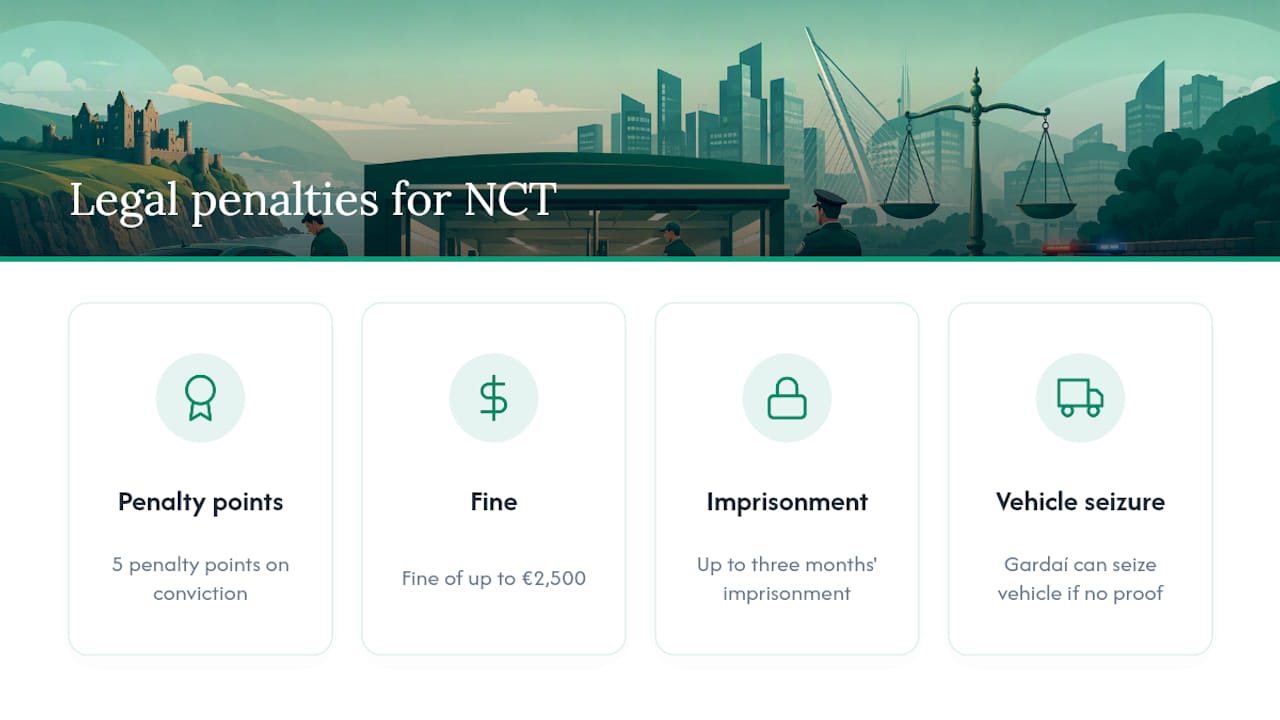
Statistic Callout: A conviction carries five penalty points, a fine of up to €2,500, and up to three months’ imprisonment. Gardaí also have the power to seize a vehicle used in a public place if the driver can’t produce proof of a valid roadworthiness test, which turns an admin oversight into a genuinely expensive afternoon.
There’s a stricter rule around a dangerous fail specifically. Once a vehicle gets a Failed Dangerous sticker, it is illegal to drive it away from the test centre at all, regardless of your existing certificate status. The car needs repair and re-inspection within 30 days, and the safest move is to arrange towing rather than risk driving it, even a short distance home.
Are there exemptions from NCT rules?
A handful of exemptions exist, though they’re narrower than most people assume. Vehicles first registered before 1 January 1980 fall outside standard NCT requirements entirely, and cars aged 40 years or more can qualify for exemption, but commercial use of an older vehicle can override that status.
- Vehicles registered before 1 January 1980: exempt from standard NCT
- Vehicles aged 40+: possible exemption, subject to use
- Certain island-based vehicles: separate arrangements may apply
- Public service vehicles: excluded from NCT, tested under separate PSV rules
- EU imports: may carry some mutual recognition depending on documentation
- GB/NI imports: generally require a full NCT test after registration in Ireland
If you’re unsure whether your imported car qualifies for any recognition of prior testing, it’s worth reviewing the import process itself before assuming either way.
How should I prepare for my NCT?
Most avoidable failures come down to five minutes of checking before you leave the driveway, not mechanical faults you couldn’t have spotted. NCTS itself publishes a preparation checklist worth following closely.
Documents to bring:
- Vehicle registration certificate or logbook
- Your driving licence or Public Services Card
- Existing NCT certificate or disc, if you have one
Vehicle checks before you go:
- Tyre tread depth and correct pressures on all four wheels
- All lights and bulbs working, including number plate lamps
- Oil and coolant levels topped up
- Seat belts visible and functioning, not tucked under seats
- Hubcaps removed if they obstruct wheel inspection
- OBD dongles or trackers removed from the diagnostic port
- Glovebox unlocked and boot cleared for inspection access
Pro Tip: If your car has any history of warning lights, an emissions issue, or brake pedal softness, get a garage to run a pre-test OBD scan and brake check a week before your booking. It typically costs less than a full re-test and gives you time to fix problems rather than discovering them on the day.
For anything involving brakes, emissions, or suspension, a garage visit beforehand is the better investment. Brake wear in particular gives early warning signs that are easy to catch if you know what to listen and feel for. Budget for the possibility of minor repairs on top of the €60 test fee, and you won’t be caught out.
What if I lose my certificate or want to appeal a result?
Lost your NCT certificate? You can request a replacement using the RF134 form, with a small administrative fee attached. This is the standard route if you need proof of a passed test for insurance, sale, or motor tax purposes.
Appeals are possible if you believe a tester made an incorrect call, though they succeed more often when there’s a clear procedural or technical error rather than a simple disagreement with the outcome. Contact NCTS directly to start that process.
- Lost certificate: apply using RF134 form, pay replacement fee
- Disagree with a result: raise a formal appeal with NCTS, citing specific grounds
- After any fail: book your repair and re-test within the allowed window
- After a dangerous fail: arrange towing, do not drive the vehicle under any circumstances
What EcoSteer’s guides add to your NCT prep
Passing first time isn’t just about knowing the rules, it’s about knowing where your specific car is likely to trip up. EcoSteer’s complete NCT checklist breaks down preparation by system, which pairs well with the official categories above.
Electric vehicles need a different lens entirely. Battery health and EV-specific diagnostic codes don’t show up on a standard petrol or diesel checklist, so if you’re running a used EV, EcoSteer’s EV battery health check guide covers the checks worth running before you book.
- A pre-test OBD scan at a local garage catches sensor and emissions faults early
- A brake check before the test is worth the small cost if you’ve noticed any softness or noise
- EV owners should confirm battery state and charging system health separately from the standard checklist
- Buyers checking a used car’s history should also review its NCT record as part of buying due diligence
- If you need a trusted local garage or dealer for repairs, EcoSteer’s dealer finder covers listings across Ireland
Why the compliance conversation misses the point
The official rules around NCT frequency, fees, and penalties are clear enough once you read the NCT Manual and the Road Traffic Act directly. What most advice gets wrong is treating the test date as the deadline that matters, when the real deadline is whenever your brakes, tyres, or lights actually start failing.
Conventional guidance tells you to prepare “a few weeks before” your test. That’s backwards. The cars that sail through are the ones where basic checks, tyre pressure, bulbs, fluid levels, happen as routine maintenance, not as a pre-test scramble. Treat the NCT as a checkpoint on work you should be doing anyway, not a hurdle you clear once every year or two.
If you’re buying a used car, the NCT history tells you more about the vehicle’s real condition than the seller’s description ever will. A car with a clean run of passes says something different to one that’s scraped through on minor fails every time. Prioritise that record over almost anything else in the listing, and use tools like EcoSteer’s dealer finder to connect with sellers who can show you the paperwork upfront rather than making you ask twice.
— ibrahim
Sources
- About the National Car Test (NCT) - NCTS
- Road Traffic (National Car Test) (Amendment) Regulations 2023 - Irish Statute Book
FAQ
Can I drive with an out of date NCT?
No. Driving without a valid NCT is an offence under Section 18 of the Road Traffic Act 1961, carrying up to five penalty points, a fine of up to €2,500, and possible imprisonment.
What are the new NCT rules?
The current framework runs under S.I. 4/2023, which implements EU delegated amendments to testing procedures, alongside the existing NCT Manual categories of Minor, Major, and Dangerous defects.
Can Gardaí seize a car for no NCT?
Yes. Gardaí have the power to seize a vehicle used in a public place if the driver cannot show proof of a valid, passed roadworthiness test.
What can a car fail an NCT on?
Common failure points include worn tyres, faulty lights, brake performance issues, and emissions or OBD fault codes, all inspected under the categories set out in the NCT Manual 2023.
Recommended
Ecosteer Editorial
Author