Put Paperwork First When Buying a Car Online in Ireland
An Ireland first roadmap to buying a car online. Verify seller and VIN, run independent history checks, secure payment, and register within 30 days.

The safest way to buy a car online in Ireland is to shortlist verified listings, confirm the seller’s legal status and paperwork, run an independent history check, inspect the car (in person or through a trusted inspector), then complete payment and registration in that order. Before anything else, get the car’s registration number or VIN and run a history check. Buying from a dealer gives you stronger statutory protection than buying privately, so factor that into your shortlist from the start.
TL;DR:
- Always verify the seller’s type, ensuring they are an authorized dealer to access statutory protections under Irish law.
- Cross-check all vehicle identification numbers, registration documents, and VRT receipts before paying a deposit or proceeding with the purchase.
- Conduct independent history and mileage checks to identify write-offs, clocked mileage, or frequent ownership changes that could signal potential issues.
- Prioritize document verification over physical inspection, as paperwork inconsistencies are common indicators of fraud or previous damage.
- Confirm registration, VRT, and insurance are completed within statutory timeframes to avoid fines and registration refusal.
Table of Contents
- Searching and shortlisting cars online in Ireland
- Verify the seller and essential paperwork before you commit
- Running independent vehicle history and mileage checks
- Inspecting and test-driving a car bought online
- Price negotiation, deposits and secure payment methods
- Finance and insurance steps to complete before collection
- Registering the vehicle, VRT and importing rules in Ireland
- Final checklist and immediate next steps after purchase
- Practical tips from EcoSteer
- What actually matters when buying a car online in Ireland
- Where EcoSteer fits into your search
- FAQ
- Sources
Searching and shortlisting cars online in Ireland
Before you open a single listing, work out your all-in budget. That means more than the asking price: add motor tax, insurance, likely repairs, and, if you are eyeing an import, Vehicle Registration Tax and possible VAT. Skipping this step is how a “bargain” import ends up costing more than a car sold here.
Once your budget is set, filter listings by county, price, year, mileage, fuel type, transmission and body type to narrow things down fast. Treat the presence of a clear registration number or VIN in the advert as a basic filter too: adverts without one are harder to verify and worth skipping.
- Set a complete budget, including VRT or VAT for imports, motor tax, insurance and a repair buffer.
- Filter by county, price, year, mileage, fuel and transmission to avoid wading through irrelevant stock.
- Favour adverts showing the VIN or registration number openly, since this lets you run checks before you even contact the seller.
- Give dealer listings some priority where strong protection matters to you, and reserve private listings for cases where you are confident doing your own verification.
- Prioritise sellers who list full documentation (NCT, service history, ownership history) upfront rather than “on request”.
Verify the seller and essential paperwork before you commit
Whether you’re buying from a trader or a private individual changes your legal position. Under the Consumer Rights Act 2022, a dealer sale gives you statutory protection that a private sale does not, so establishing seller status is your first real check, not an afterthought.
- Confirm whether the seller is a trader or a private individual, since this determines your legal protection if something goes wrong.
- Request the Vehicle Registration Certificate (VRC) and note its 10-digit number, the VIN, the NCT certificate or disc, the service book, and, for imports, the VRT receipt and RF100 or VPD forms.
- Cross-check every number against the advert and the car itself. A mismatched VIN, chassis number or VRC detail is a documented red flag according to the CCPC’s guidance on buying a car, which notes that inconsistent VRC numbers can indicate forged paperwork.
- Never pay a deposit before documents and identity are verified. A genuine seller will not object to waiting.
Pro Tip: Ask the seller to send a photo of the VRC alongside their own ID in the same shot. Genuine sellers rarely hesitate; reluctance is itself a signal.
Running independent vehicle history and mileage checks
Once documents check out, run an independent history check using a service such as MotorCheck, Cartell or MyVehicle, and cross-reference the result against NCT mileage records and a motortax.ie change-of-owner check. These checks surface write-offs, clocked mileage, frequent changes of ownership and recorded insurance claims, any of which should slow you down.
- Write-off history means the car was declared a total loss at some point, even if it has since been repaired and sold on.
- Clocked mileage shows up as a mismatch between the dashboard reading and prior NCT or service records.
- Frequent ownership changes in a short period can suggest an underlying fault that previous owners discovered and offloaded quickly.
- Recorded insurance claims are worth asking the seller to explain directly.
NCT mileage records are a reliable cross-check against the dashboard, according to Citizens Information’s guide to buying a new car, which notes that cars over four years old require an NCT, tested every two years from four to nine years and annually after ten. A mismatch between the recorded mileage and the dashboard is one of the clearest reasons to pause a purchase and insist on a professional inspection before you go any further.
Inspecting and test-driving a car bought online
A good inspection catches what paperwork cannot. Walk through it methodically, whether you’re doing it yourself or briefing someone else to do it for you.
- Check the bodywork for mismatched panel gaps, overspray or uneven paint, which can point to prior repairs.
- Check tyres and brakes for uneven wear, which often reveals alignment or suspension issues.
- Check fluids (oil, coolant, brake fluid) for colour and level, and look for leaks underneath.
- Test every electrical function, from windows to infotainment to warning lights on the dashboard.
- Take a test drive that reproduces real conditions: motorway speed, hill starts, tight parking manoeuvres, and a cold start if possible.
- Commission an independent pre-purchase inspection from a mechanic with no connection to the seller if you have any doubts.
When you cannot inspect in person, a trusted local inspector or a thorough video walkaround combined with an independent mechanical check is the next best option, never a substitute for scepticism.
Price negotiation, deposits and secure payment methods
Negotiate the complete out-the-door price, not just the headline figure. For imports, that means confirming who covers VRT and VAT before you agree anything. Get every term in writing, including what happens if the car fails inspection after a deposit is paid.
- Keep any deposit small and refundable, with a written receipt stating the conditions under which it is returned.
- Use payment methods that offer some recourse, such as a card payment where chargeback protections apply, rather than an unverified bank transfer to an unknown account.
- Confirm the account name matches the seller’s name on the VRC before transferring any money.
- Document every step: the receipt, the signed sale agreement and a clear plan for transferring the VRC into your name.
Pro Tip: If a seller pushes hard for a direct bank transfer and resists any other payment method, treat that as a reason to slow down, not speed up.
Finance and insurance steps to complete before collection
Compare a personal loan, hire purchase (HP) and personal contract plan (PCP) on total cost, not just the monthly repayment, since the cheapest-looking monthly figure can hide the most expensive deal overall. Getting pre-approved for finance before you shop gives you a realistic ceiling and stronger negotiating position, whether you arrange it yourself or through the dealer.
- Compare total repayable cost across loan, HP and PCP, including any balloon payment due at the end of a PCP term.
- Check that any credit intermediary arranging dealer finance is properly registered, rather than taking the offer at face value.
- Arrange insurance to start on your collection date, with temporary cover sorted in advance if there is any gap.
- Watch for finance disguised as a “service plan” or add-on that is not clearly itemised in the agreement.
Registering the vehicle, VRT and importing rules in Ireland
If you are buying from a dealer, confirm upfront whether registration and any VRT or VAT due are already included in the price, since this varies and should never be assumed.
For imported cars, you will need to book an appointment at the National Car Testing Service (NCTS) for VRT registration, bringing the European Certificate of Conformity or the V5C, and, for non-EU imports, the Master Reference Number from customs. Revenue requires registration within 30 days of the vehicle entering the State, and missing paperwork can see registration refused outright at the NCTS centre.
- Confirm who is responsible for registration before you commit to buying, dealer or yourself.
- Gather the e-CoC or V5C and MRN (for non-EU imports) ahead of your NCTS appointment.
- Register within 30 days of import to avoid penalties.
- Pay motor tax promptly once registered and keep proof of payment with your ownership documents.
Our guide to importing a car from the UK walks through this process in more detail if you are considering a UK-sourced vehicle.
Final checklist and immediate next steps after purchase
Once you have agreed the sale, work through a short, fixed sequence rather than improvising.
- Collect the signed receipt, VRC and keys at handover.
- Confirm NCT and VRT paperwork is complete before you drive away.
- Arrange insurance and motor tax so both are active from day one of ownership.
- Complete the online change of ownership where available and store every document safely.
- Contact the CCPC, Citizens Information, Revenue or the Road Safety Authority if anything about the sale does not match what was agreed.
Practical tips from EcoSteer
A few habits make online buying noticeably safer: photograph every document before you travel, write down your negotiation limits beforehand, and treat any listing that hides the VIN as a pass. Listings on a reputable marketplace show registration detail and dealer verification status upfront, which supports exactly this kind of checking and reflects best practices in AI for car dealerships and importers.

What actually matters when buying a car online in Ireland
The conventional advice on this topic spends too much time on finding the “best” website and not enough on the sequence of checks that actually prevents a bad purchase. Which marketplace you browse matters far less than whether you verify the seller, the documents and the vehicle history before any money changes hands.

The most overrated step, in our view, is the inspection itself. A thorough visual check matters, but it comes after document and history verification, not before. Plenty of buyers walk around a car checking paint and tyres while skipping the VRC cross-check that would have told them the seller wasn’t who they claimed to be.
If you take one thing from this guide, prioritise the paperwork and the history check first, inspection second, negotiation third. It is worth noting that even Consumer Reports’ international buying guidance flags that most online car purchases still involve some in-person step for contracts and registration, so treat “buying online” as doing the groundwork online and finishing the legal steps in person.
Where EcoSteer fits into your search
Once you know what to check, finding the right car becomes a filtering exercise rather than a gamble. Our listings on EcoSteer show registration and VIN detail, county-based search, and dealer verification status, so you can apply the checks in this guide directly as you browse.
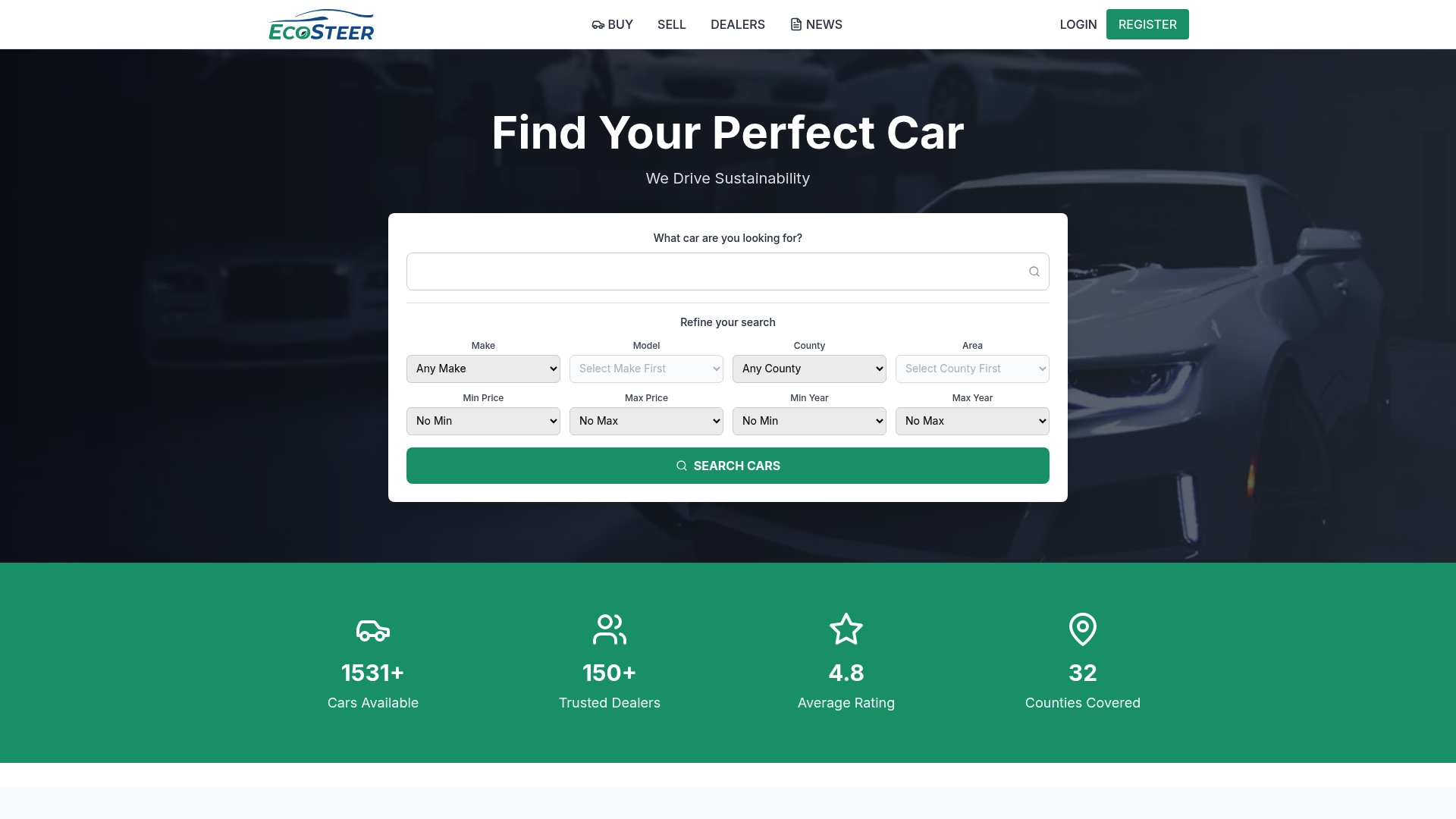
Search by county, from Carlow to Kildare to Louth, and use the filters for price, year, mileage and fuel type to build a shortlist that matches your budget. Pair that with the independent history and document checks covered above, and you are working from a position of information rather than guesswork. Start your search on our cars for sale page and shortlist a handful of listings to verify this week.
FAQ
What is the best website to buy a used car in Ireland?
The best choice depends on what you need: a marketplace is strongest for discovery and comparing stock across counties, while a verified dealer listing gives you stronger statutory protection under the Consumer Rights Act 2022 than a private sale does. Prioritise listings that show full documentation, including the VIN or registration number, regardless of which site you use.
What is the best online car purchasing website?
There is no single definitive answer, since the right platform depends on whether you want dealer protection, the widest selection, or the lowest asking price. Whichever site you use, the safety of the purchase depends far more on the seller verification and document checks described in the CCPC’s car-buying guidance than on the platform itself.
What is the cheapest way to buy a car in Ireland?
There is no fixed “cheapest route” that applies to every buyer, since price depends on the make, age, mileage and whether you are comparing against an import. A private sale can sometimes be cheaper than a dealer sale, but it carries less statutory protection, so weigh the saving against that reduced protection before deciding.
What’s the worst month to buy a new car?
There is no universal worst month to buy a new car in Ireland, and Citizens Information’s guidance is cautious about fixed seasonal rules, since dealer stock, targets and finance offers vary year to year. You are better off comparing price, available stock and finance terms at the time you are ready to buy than timing your purchase around a specific month.
Do I need an NCT certificate before buying a used car?
You should ask to see the current NCT certificate or disc before buying, since cars over four years old require one, tested every two years from four to nine years and annually from ten years onward under Citizens Information’s rules. The NCT record also gives you a mileage history to cross-check against the dashboard reading.
Sources
- Buying a new car | Citizens Information
- Buying a car | CCPC
- Vehicle Registration Tax (VRT) — procedure at NCTS centre | Revenue
- How to buy a car online | Consumer Reports
Recommended
Ecosteer Editorial
Author