Under 20,000 km in Ireland: Why Petrol Usually Beats Diesel in 2026
Using Irish 2026 pump prices, this guide gives clear rules by mileage: petrol typically wins under 20,000 km, diesel after 25,000 km, and home-charged EVs...
Most Irish drivers doing under 20,000 km a year are better off with a petrol car in 2026, unless they tow regularly, drive mostly motorway miles, or can charge an EV at home overnight. Diesel still earns its keep above roughly 25,000 km annually. Below that, higher purchase prices and maintenance risk outweigh its fuel-efficiency edge. Every figure below reflects Irish 2026 pump and electricity prices.
TL;DR:
- Diesel remains cost-effective mainly for drives exceeding 25,000 km annually, but the fuel cost advantage has significantly narrowed with current prices.
- For drivers under 20,000 km yearly, petrol typically offers lower overall costs due to higher diesel purchase prices and maintenance risks, especially with urban or mixed driving.
- Electric vehicles can be cheaper to own over five years if charged at home, with break-even points around 2 to 3 years compared to diesel, but higher charging costs impact public charger users.
- Diesel’s tax advantage has decreased due to revised CO2 bands and long-term policy shifts favoring zero-emission vehicles, impacting resale values and future costs.
- Short urban diesel drivers should regularly burn off soot with motorway runs or dealer cleans to avoid expensive DPF repairs, which can cost over €1,000 per incident.
Table of Contents
- Diesel vs petrol Ireland: comparing running costs
- How does motor tax affect diesel ownership in Ireland?
- What maintenance issues should you expect with diesel?
- Are diesel cars losing value faster than petrol in Ireland?
- Petrol, diesel or EV: what fits your driving pattern?
- Where do EVs and hybrids fit into the decision?
- Where do these figures and recommendations come from?
- Does diesel or petrol cost more to insure in Ireland?
- Diesel vs petrol in Ireland: which to buy
- Find your next car on Ecosteer
- Sources
- FAQ
Diesel vs petrol Ireland: comparing running costs
The fuel price gap between petrol and diesel has narrowed considerably, which changes the maths for anyone still assuming diesel is the automatic budget choice. At current pump prices, petrol costs around €1.82 a litre and diesel about €2.05, and that price difference matters more than most buyers realise once you factor in consumption.
A typical petrol hatchback burns between 6.5 and 7 L/100km, while a comparable diesel manages between 5 and 6 L/100km. Run the numbers and you get something like this:
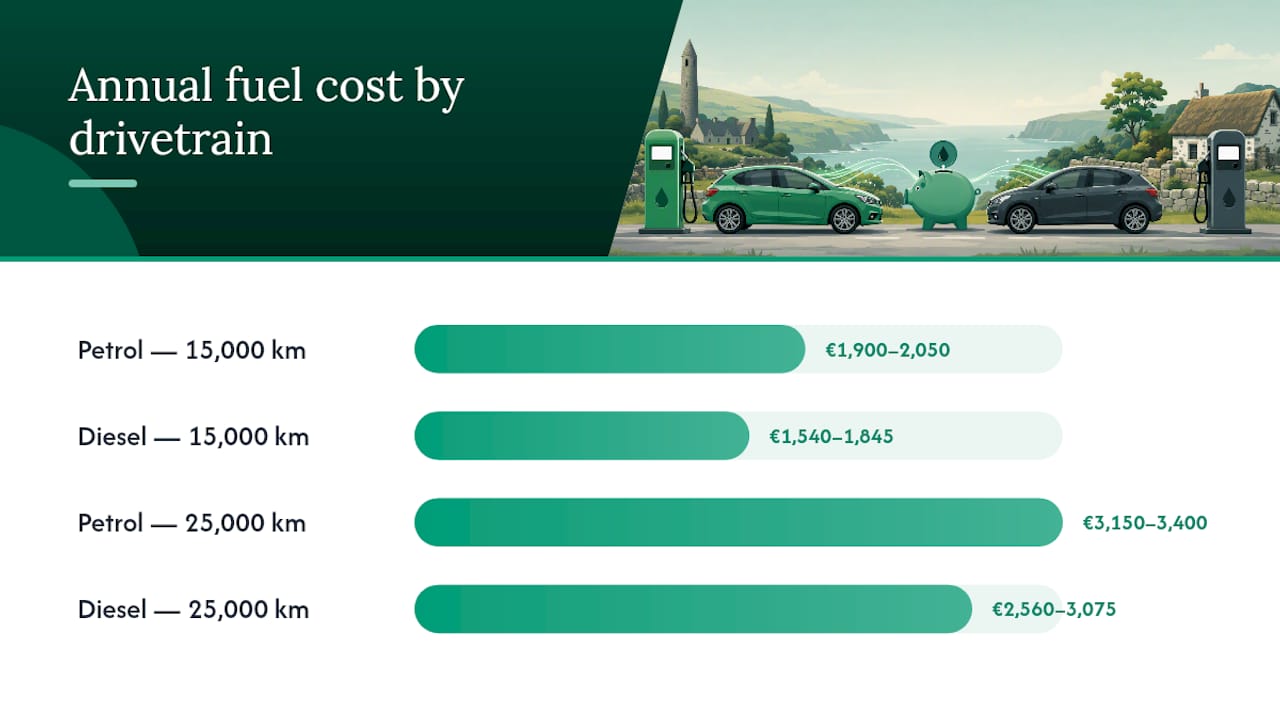
- Petrol at 15,000 km/year: roughly €1,900 to €2,050 in fuel
- Diesel at 15,000 km/year: roughly €1,540 to €1,845 in fuel
- Petrol at 25,000 km/year: roughly €3,150 to €3,400
- Diesel at 25,000 km/year: roughly €2,560 to €3,075
Diesel still wins on pure fuel cost per kilometre, but the gap has shrunk to a point where it rarely covers diesel’s extra purchase price and maintenance risk below 25,000 km a year.
Electric vehicles change the picture entirely if you can charge at home. On a night rate, an EV can cost as little as €0.016 per kilometre, saving a typical 15,000 km driver around €1,700 to €1,800 a year against petrol. For a fuller breakdown of how these three options stack up across a year of ownership, our diesel vs petrol vs EV guide walks through the maths model by model.
How does motor tax affect diesel ownership in Ireland?
Motor tax in Ireland is calculated on CO2 emissions bands for cars registered from July 2008 onwards, and diesel’s typically lower CO2 output used to give it a real tax advantage. That advantage has narrowed as bands were revised and as WLTP testing pushed some diesel models into higher brackets than their old NEDC figures suggested. The Department of Housing’s motor tax banding table sets out how these bands are structured, and you can check specific rates through our motor tax bands guide.
Policy direction matters as much as today’s tax bill. The Transport Minister has said diesel is “probably not” viable for the long term in Ireland, and the planned 2030 shift toward zero-emission new car sales is already shaping buyer sentiment.
- Higher emissions ratings push up VRT on import and new registrations.
- Diesel’s tax edge shrinks or disappears for many models under current bands.
- Used diesel values are softening partly because buyers are pricing in policy risk, not just running costs.
What maintenance issues should you expect with diesel?
Diesel engines carry two components petrol engines don’t: the diesel particulate filter (DPF) and, on many models, an AdBlue system for emissions control. Both work fine on regular motorway mileage but struggle with short, stop-start urban trips, where the exhaust never gets hot enough to burn off trapped soot.
A clogged DPF shows up as a warning light, reduced power, or a distinctive smell, and fixing it isn’t cheap.
- DPF cleaning or replacement can run from a few hundred euro to over €1,000 if the filter has to be replaced entirely.
- AdBlue top-ups are cheap, but a faulty dosing system can cost several hundred euro to repair.
- Petrol servicing consumables (oil, filters) tend to run lower annually than diesel equivalents once you factor in DPF-related risk.
Pro Tip: If you drive a diesel mostly around town, book an occasional 30 to 45 minute motorway run at higher revs to burn off the DPF, or get a dealer DPF clean before the warning light comes on. Independent garages can often do this more cheaply than a main dealer, and it’s worth comparing dealer versus independent servicing costs before booking either.
Are diesel cars losing value faster than petrol in Ireland?
Diesel residuals are softening across the Irish used market, and it’s not hard to see why. Buyers are increasingly wary of future tax changes, potential low-emission zone restrictions in cities, and the maintenance risk outlined above. Petrol and hybrid equivalents are holding value better in comparison.
Over a typical 3 to 5 year ownership period, a diesel model that once commanded a resale premium can now sell for roughly the same or even less than an equivalent petrol version, once you factor in the extra depreciation hit.
- Choose lower, more common trim levels. They’re easier to sell on than niche high-spec variants.
- Keep a full, documented service history. Diesel buyers scrutinise this more than petrol buyers do.
- Avoid cars with visible DPF or AdBlue warning history. It kills resale confidence fast.
Petrol, diesel or EV: what fits your driving pattern?
The right fuel type comes down almost entirely to how many kilometres you cover each year and whether you can charge at home.
- Under 15,000 km/year: petrol is usually cheapest overall once you weigh purchase price, servicing, and lower diesel-specific repair risk against the smaller fuel saving.
- 15,000 to 25,000 km/year: this is the grey zone. If most of your driving is motorway, diesel starts to close the gap; if it’s mixed urban and rural, petrol or a hybrid usually wins on total cost.
- Over 25,000 km/year, or regular towing: diesel typically becomes the more economical option, assuming you’re doing enough motorway mileage to keep the DPF healthy.
- Home charger available, any mileage: an EV usually beats both, given the running-cost gap shown earlier.
Here’s a worked example. A driver doing 20,000 km/year in a diesel saves roughly €400 to €500 annually on fuel versus petrol at current prices. That saving needs three to four years just to offset diesel’s typical purchase premium of €1,500 to €2,000 over an equivalent petrol model, before you’ve accounted for any DPF repair risk. Fleet and delivery operators covering very high annual mileage face a different calculation entirely, closer to the fuel-choice trade-offs commercial van operators weigh up.
Where do EVs and hybrids fit into the decision?
Home charging is the single biggest factor in whether an EV beats petrol or diesel on total cost, and Irish data backs this up clearly. A home-charged EV can be several thousand euro cheaper to own over five years than an equivalent diesel, with most of that saving coming from fuel and lower servicing bills rather than purchase price.
Break-even on an EV against diesel typically lands at 2 to 3 years when you’re charging at home overnight. That timeline stretches considerably if you’re relying on public fast chargers, which cost more per kWh and eat into the savings that make EVs attractive in the first place.
- No home charger but mixed urban and longer trips: a hybrid or plug-in hybrid often makes more sense than a full EV.
- Short urban commutes with occasional longer runs: a PHEV lets you run on electric power most days without range anxiety.
- Regular long motorway trips with only public charging access: petrol or diesel may still work out cheaper once charging costs are factored in.
Our Kia Niro buyer’s guide compares hybrid, PHEV and EV versions of the same model, useful if you’re weighing these options against a straight petrol or diesel purchase.
Where do these figures and recommendations come from?
The running-cost figures throughout this piece are drawn from Irish 2026 pump price data, SIMI market trends, and calculators built specifically for the Irish market, cross-checked against SEAI’s official comparison tools for EV energy use and range. Calculations assume standard L/100km consumption figures, current pump prices, and a typical Irish home electricity night rate.
This article was written by ibrahim, drawing on local listings data and published Irish fuel and tax sources. If you want figures for a specific model rather than a class average, search filters let you compare fuel type, mileage, and tax band side by side across live listings.
Does diesel or petrol cost more to insure in Ireland?
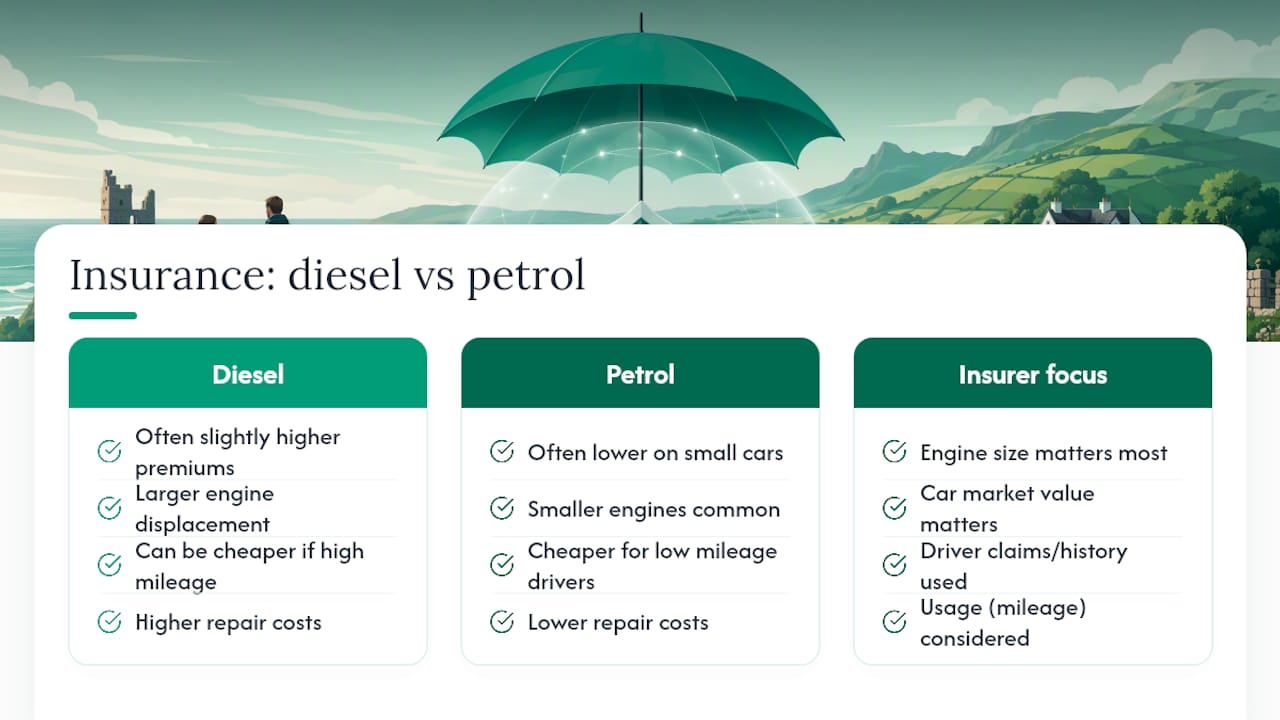
Insurance premiums in Ireland don’t split neatly along fuel lines. Insurers price risk based on engine size, car value, claims history, and driver profile far more than whether the car runs on petrol or diesel. That said, there are patterns worth knowing.
Diesel cars often carry slightly higher premiums for equivalent models, mainly because diesel engines tend to have larger displacement for similar power output, and repair costs (including DPF and injector work) run higher than petrol equivalents. A diesel estate or SUV with a 2.0 litre engine will often price above a petrol version with a smaller 1.4 or 1.6 litre unit, even where the two cars feel similar to drive.
Where diesel can come out ahead is with higher-mileage drivers. Some insurers factor in that diesel owners tend to do longer commutes or business mileage, and price policies around expected usage rather than fuel type alone. This rarely reverses the general pattern, but it can narrow the gap.
The bigger insurance lever, regardless of fuel type, is engine size and car value. A small petrol hatchback with a 1.0 litre engine will almost always insure more cheaply than a larger diesel equivalent, and that difference typically dwarfs any fuel-type effect on its own. If insurance cost is a major factor in your decision, get quotes on specific models rather than assuming diesel or petrol status settles the question.
Diesel vs petrol in Ireland: which to buy
The conventional advice on this topic hasn’t caught up with how much the fuel price gap has narrowed. Plenty of buyers still walk into a dealership assuming diesel is the sensible, money-saving choice by default, the way it genuinely was a decade ago. That’s no longer reliable advice on its own.
What actually matters now is mileage, not fuel type in isolation. If you’re doing under 20,000 km a year and mostly urban driving, petrol usually wins once you weigh purchase price against diesel’s maintenance risk. If you can charge at home, the EV case is stronger still, and the break-even period is short enough that it should be the first thing you check, not the last.
Where I’d push back hardest on generic advice is DPF risk. Too many guides treat it as a footnote when it should be a dealbreaker for anyone doing mostly short urban trips in an older diesel. Run the numbers for your actual mileage before you decide, not someone else’s average.
— ibrahim
Find your next car on Ecosteer
This platform offers a way to compare real, live petrol, diesel, and EV listings across Ireland, rather than relying on class averages to guess what suits your mileage. Filters are available by fuel type, mileage, motor tax band, and county, so the comparison you’ve just read through becomes a shortlist of actual cars for sale near you.
Two sensible next steps: search Ecosteer’s listings for comparable petrol, diesel, or EV models in your price range, and use Find a Dealer to contact a seller directly about servicing history or a viewing. If you want to see how these numbers play out on a specific used diesel, models like the 2011 Audi A4 2.0 TDI or 2015 Volkswagen Jetta 2.0 TDI are worth a closer look on the platform.
Sources
FAQ
Which is cheaper in Ireland, petrol or diesel?
Diesel is cheaper per kilometre on fuel alone, but petrol usually costs less overall below 20,000 km a year once purchase price and maintenance risk are included.
Should I buy a petrol or diesel car in 2026?
Choose petrol if you drive under 15,000 to 20,000 km a year with mostly urban trips; choose diesel if you’re doing over 25,000 km a year or regular motorway and towing work.
Should I buy a diesel car in Ireland?
Diesel still makes sense for high-mileage, motorway-heavy drivers, but weigh the DPF and AdBlue repair risk and softening resale values before committing.
Are diesel cars being phased out in Ireland?
Diesel isn’t banned outright, but Ireland’s Transport Minister has called its long-term viability into question, and the 2030 zero-emission new-car target signals a gradual shift away from it.
Recommended
Ecosteer Editorial
Author