Peugeot 3008 Ireland 2026: Hybrid or Electric, and the PureTech Trap
Hybrid or full electric? In Ireland that choice is worth 80 euro a year in motor tax alone. Real figures from Peugeot Ireland's own price list and Stellantis technical data - 121-125 g/km and 200 euro tax for the Hybrid 145, 513-526 km range and 120 euro for the E-3008 - plus the 1.2 PureTech wet belt fault that decides whether a used 3008 is a bargain or a write-off.
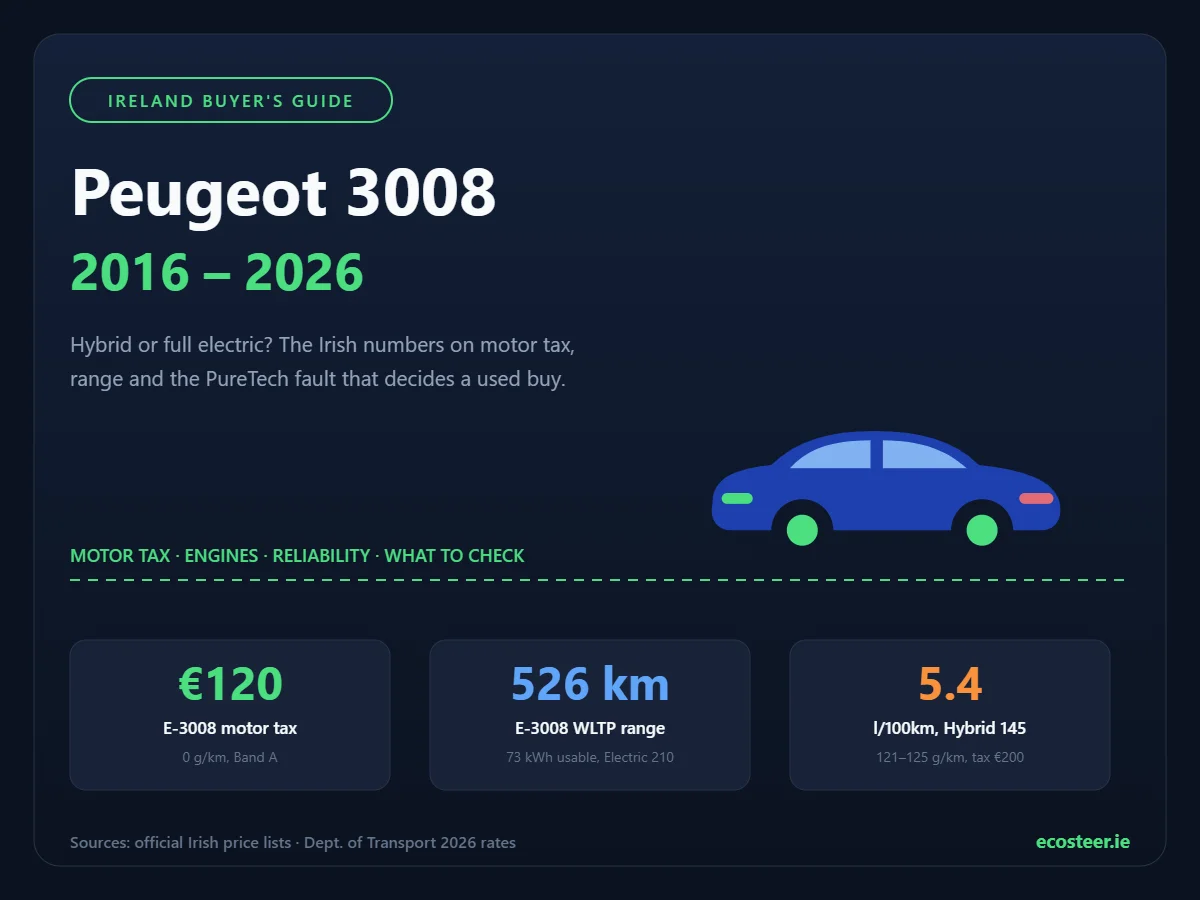
The 3008 is the car that taught Peugeot how to build an SUV people actually wanted, and it has been a fixture on Irish forecourts ever since. The current generation asks a sharper question than its predecessors, though: hybrid or full electric? In Ireland that choice is worth €80 a year in motor tax alone, and considerably more once you factor in what each one costs to run. Here are the real figures, taken from Peugeot Ireland's own price list and Stellantis technical data.
Overview: three 3008s, not one
The name has covered three quite different cars. The original 2009–2016 model was a tall crossover-MPV. The 2016–2023 second generation was the proper SUV that made the nameplate a genuine rival to the Qashqai and Tucson. The current car, launched in 2024, is a fastback-profile SUV on Stellantis's STLA Medium platform, and it is the first 3008 designed around an electric drivetrain from the outset.
Physically it is a mid-size family SUV: 4.542 m long, 1.895 m wide, on a 2.739 m wheelbase, with 520 litres of boot space behind the rear seats. That boot figure is identical across hybrid and electric versions, which is not something every manufacturer manages.
Engine and drivetrain options in Ireland
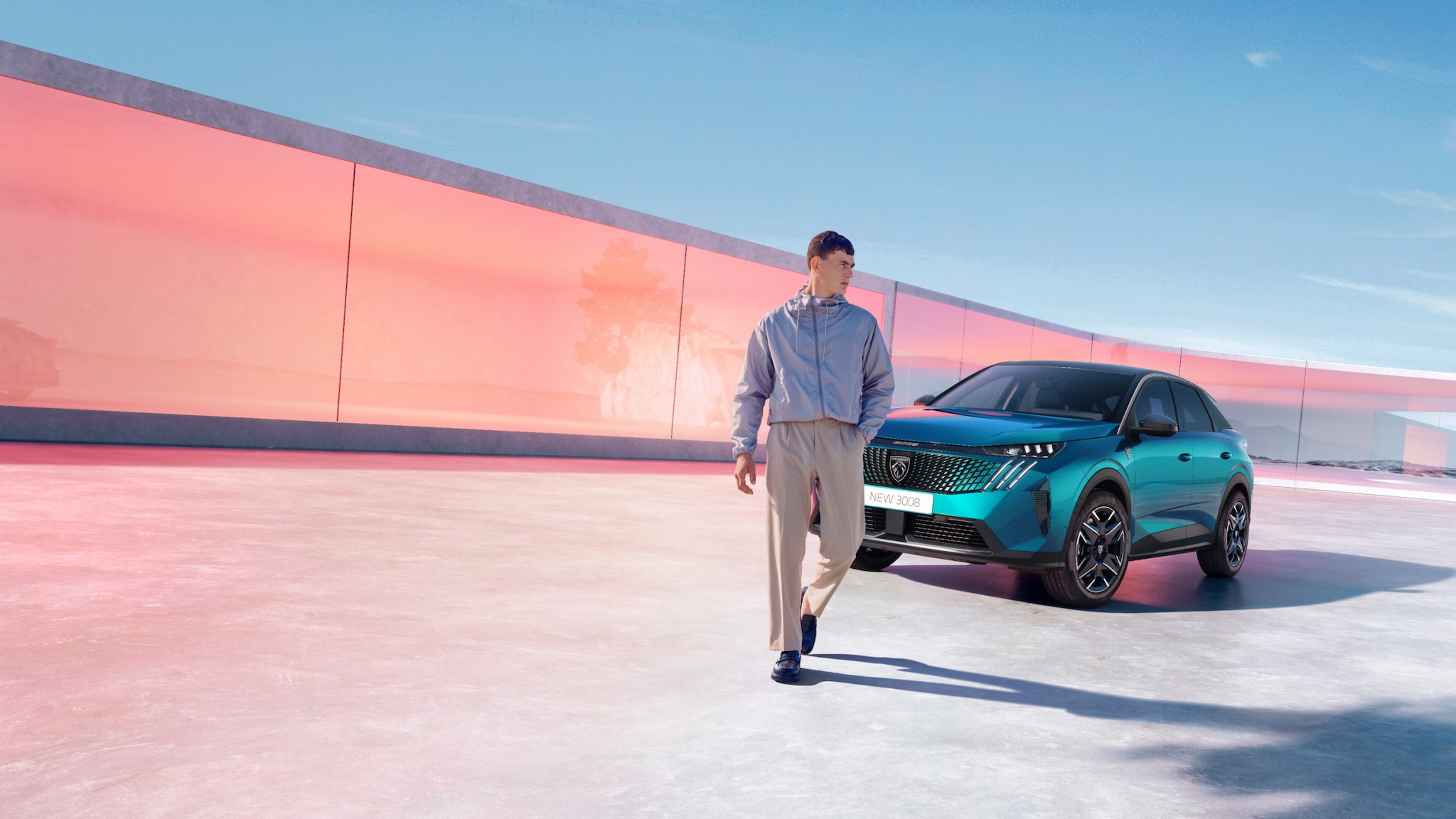
Peugeot Ireland's retail price list, effective August 2026, lists the following. Prices exclude dealer delivery charges, metallic paint and the tyre recycling levy.
| Version | Power | WLTP CO2 | Band | Motor tax | RRSP from |
|---|---|---|---|---|---|
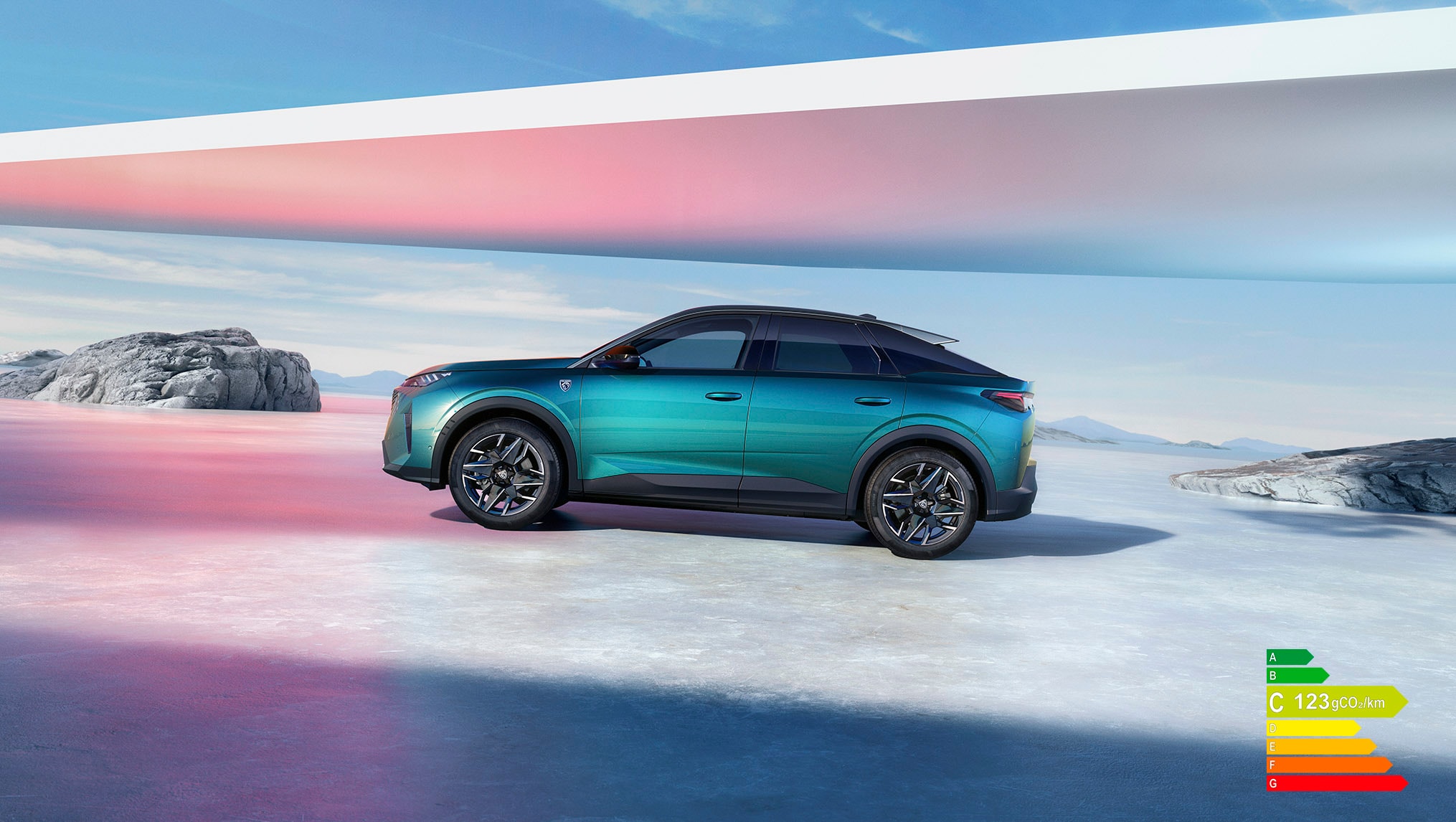
| Allure Hybrid 145 Auto | 107 kW / 145 hp combined | 121–125 g/km | B1 | €200 | €45,495 |
| GT Exclusive Hybrid 145 Auto | 107 kW / 145 hp combined | 121–125 g/km | B1 | €200 | €49,495 |
| Allure Electric 210 (73 kWh) | 157 kW / 213 hp | 0 g/km | A | €120 | €50,295 (€48,435 after State subsidies) |
| GT Exclusive Electric 210 (73 kWh) | 157 kW / 213 hp | 0 g/km | A | €120 | €54,295 |
| GT Exclusive Electric 325 Dual Motor AWD | 239 kW / 325 hp | 0 g/km | A | €120 | €59,995 |
The Hybrid 145 is a 48-volt system rather than a plug-in. A 1,199 cc three-cylinder petrol engine produces 100 kW (136 hp) and 230 Nm, assisted by a 21 kW electric motor drawing on a small 0.43 kWh battery, for a combined 107 kW (145 hp). Drive goes through a six-speed e-DCS6 automatic to the front wheels. Nothing to plug in, and no charging routine to build your life around — but equally, no meaningful electric-only range.
The E-3008 Electric 210 uses a 73 kWh usable battery and a single front motor rated at 157 kW (213 hp) and 343 Nm. There is also a 96.9 kWh Long Range version rated at 170 kW (231 hp), and the dual-motor 325 with all-wheel drive.
Strengths
- The electric range is genuinely long. The Electric 210 is rated at 513–526 km combined WLTP and 643–670 km on the urban cycle. For most Irish drivers that is a week of commuting between charges, and Dublin to Cork with margin to spare.
- Charging is quick. 160 kW DC peak takes the 73 kWh battery from 20% to 80% in about 30 minutes. On an 11 kW AC home or workplace charger the same window takes four and a half hours.
- Motor tax of €120 on every electric version. That is the lowest band in Ireland, and it applies equally to the 325 hp all-wheel-drive model.
- The hybrid asks nothing of you. 5.4–5.6 l/100km combined with no charging cable, no home wallbox and no range planning. For a rural buyer without off-street parking, that matters more than any WLTP figure.
- Boot space does not suffer. 520 litres whichever drivetrain you choose.
Weaknesses
- Entry pricing is high. €45,495 for the cheapest hybrid and €50,295 for the cheapest electric puts the 3008 above several direct rivals before options.
- The hybrid is not quick. 10.2 seconds to 100 km/h and a 201 km/h maximum. Adequate, and no more.
- The electric versions are heavy. The Electric 210 has a kerb weight of 2,108 kg, which shows in tyre wear and in a maximum braked towing capacity of 1,250 kg.
- The 1.2 PureTech engine carries real baggage on the used market. This is the big one, and it gets its own section below.
- i-Cockpit is still a love-or-hate layout. The small high-set steering wheel and raised instrument panel suit some drivers and genuinely do not suit others. Sit in one before you commit.
Fuel consumption and Irish motor tax
Ireland operates three parallel motor tax systems by first registration date. Cars registered from 1 January 2021 are taxed on WLTP CO2; cars from July 2008 to December 2020 use the older NEDC bands; anything earlier is taxed on engine size. The current schedule has been unchanged since January 2021 and still applies in 2026.
| Version | Consumption | Range | Annual tax |
|---|---|---|---|
| Hybrid 145 e-DCS6 | 5.4–5.6 l/100km | 55-litre tank | €200 |
| Electric 210 (73 kWh) | 16.8–17.3 kWh/100km | 513–526 km WLTP | €120 |
| Electric 230 Long Range (96.9 kWh) | 17.1–18.1 kWh/100km | 669–701 km WLTP | €120 |
| Electric 325 Dual Motor AWD | 17.7–17.9 kWh/100km | 485–490 km WLTP | €120 |
One detail worth knowing if you are comparing a late-2020 used 3008 against an early-2021 one: the WLTP table is cheaper band-for-band in the middle ranges. A car recorded at 125 g/km pays €270 under the 2008–2020 table but only €200 under the 2021+ table — the same emissions figure, €70 a year apart. Always confirm the recorded band for a specific registration on motortax.ie rather than assuming it from the model name.
Reliability and common issues in the Irish market
The 1.2 PureTech wet timing belt
If you take one thing from this guide, take this. The 1.2 PureTech petrol engine — fitted to enormous numbers of second-generation 3008s on Irish roads — uses a timing belt that runs inside the engine, bathed in oil, rather than a conventional dry belt behind a cover.
The design works when the oil is right and changed on time. When it is not, the belt degrades and sheds rubber particles into the oil. Those particles then clog the oil pump pickup, the vacuum pump and the variable valve timing solenoids. The result is oil starvation, and oil starvation ends engines. Peugeot issued a recall in 2021 covering wet timing belt degradation restricting oil flow.
Practical advice for an Irish buyer:
- The official replacement interval is 100,000 km or six years, whichever comes first. Treat that as a hard deadline, not a suggestion.
- Replacement is labour-intensive — roughly eight hours of work — so it is a four-figure job. Find out whether it has been done and get the invoice.
- Short urban journeys degrade the oil faster, which degrades the belt faster. A city car with a patchy oil-change record is a worse bet than a higher-mileage motorway car with a full history.
- Ask specifically about oil consumption and top-ups between services. Excessive use is a recognised symptom on earlier PureTech engines.
- Warning signs on a test drive: ticking or rattling from the engine, difficulty starting, rough idle, or a check engine light.
- Later Gen3 PureTech engines, from roughly 2023, are the safer used cut-off point.
Servicing intervals
Peugeot quotes 25,000 km or one year for the Hybrid 145, and 25,000 km or two years for the electric versions. The annual requirement on the hybrid is not optional given everything above — the oil change is what protects the belt.
If you are buying electric
On an E-3008, the mechanical worry list is much shorter, and the question shifts to battery condition. Mileage tells you very little about an EV's remaining value; state of health tells you a lot. Get a proper battery health report before you agree a price.
Service network and maintenance in Ireland
Peugeot has a well-established dealer network across the country, and because the 3008 shares its underpinnings and its engines with a wide spread of Stellantis models — Citroën, Opel, DS and others — parts availability is good and independent specialists are easy to find outside the main centres.
The one item to budget for specifically on any PureTech-engined car is the wet belt replacement. On the electric versions, servicing is simpler and less frequent, but factor in tyres: a 2,108 kg SUV on 19- or 20-inch wheels goes through them faster than a hatchback.
Verdict
The 3008 is a stylish, comfortable and genuinely practical family SUV, and the current generation's electric versions are the most convincing it has ever offered. If you can charge at home, the E-3008 Electric 210 at €120 motor tax with 513–526 km of range is the version that makes the numbers work, and the €48,435 post-subsidy figure narrows the gap to the hybrid considerably.
If you cannot charge at home, the Hybrid 145 is a perfectly sensible car at 5.4–5.6 l/100km and €200 a year — just not a fast or especially cheap one.
On the used market, be disciplined. A second-generation 3008 with a 1.2 PureTech engine can be a bargain or a catastrophe, and the difference between the two is a folder of oil-change receipts and a wet belt invoice. No history, no deal. That is not pessimism about Peugeot — it is the single highest-value check you can make on this particular car.
Buying or selling? Use Ecosteer
Ecosteer is Ireland's green car marketplace, covering all 32 counties.
- Browse Peugeots: used Peugeots for sale on Ecosteer
- Selling a car? Place an ad — private ads under €3,000 are completely free, with no commission.
- Buying from a dealer? Find a trusted Irish dealer near you.
- Before you pay: read our guide to checking a car's history in Ireland — finance, write-offs, mileage and identity.
External sources
- Peugeot Ireland passenger cars retail price list, August 2026 — Irish RRSP, WLTP CO2, tax band and annual road tax per version
- Stellantis Media — New Peugeot 3008 technical characteristics — power, torque, battery capacity, WLTP range, charging times, weights and service intervals
- Peugeot Ireland — New 3008 Hybrid
- Wheelbase Garage — 1.2 PureTech wet timing belt — failure mechanism, 100,000 km / six-year interval, 2021 recall
- motortax.ie — check the recorded band for any Irish registration
Vehicle photography courtesy of Peugeot, used for editorial purposes.
Tags
Primary Admin
Author