Use CCPC Rules and 5 Min Replies: Irish Dealership Discovery Online
Practical Ireland guide to finding dealers online. Use CCPC and RSA checks, keep records for €2,000 claims, with fast 5 minute replies.

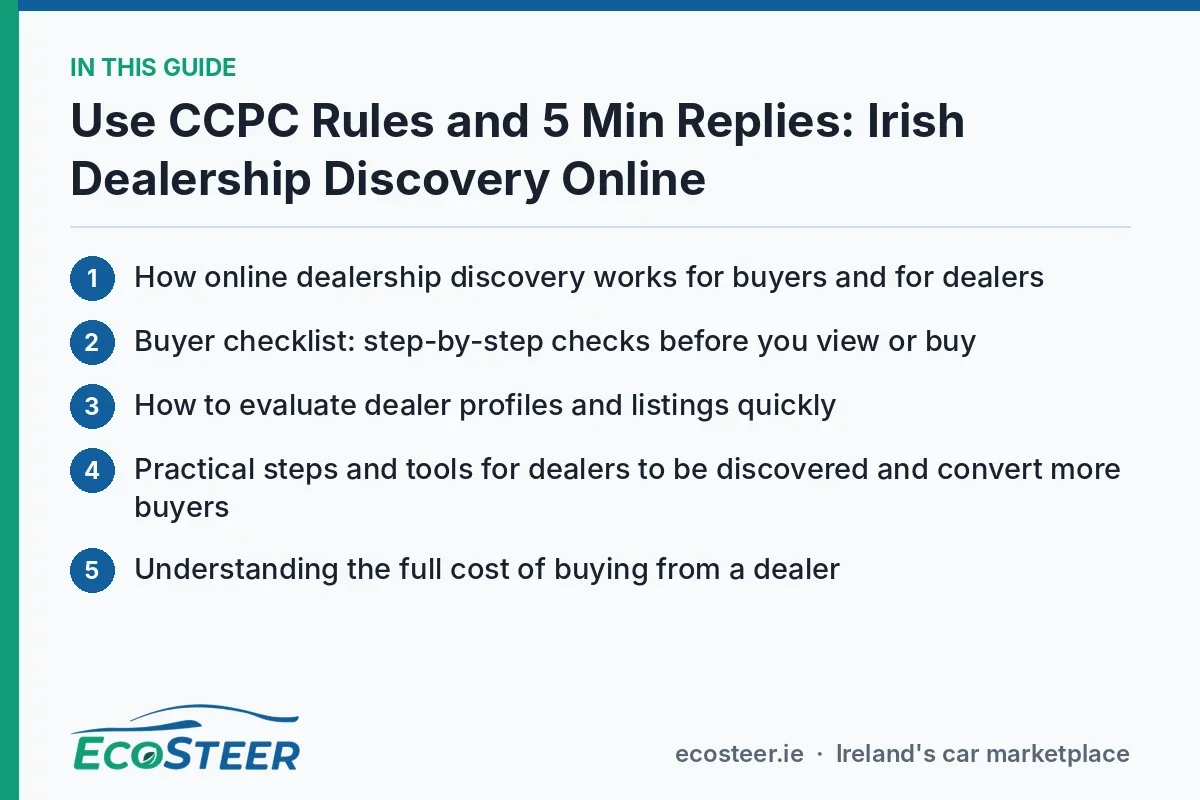
Dealership discovery online means finding verified dealer profiles and nearby inventories through marketplace filters and dealer locators. Before anything else, buyers should verify seller type, then run three checks: an independent inspection, a history check and a look at service records. Dealers get the biggest return from one change: responding to leads fast and stating their dealership status clearly. We built EcoSteer to make both sides of that process simple.
TL;DR:
- Buyers should verify that sellers are registered dealers by asking directly and confirming full business details, including a landline number and address.
- Conducting an independent inspection, running a comprehensive vehicle history check, and obtaining full service records are essential before committing to purchase.
- Responding quickly to inquiries within five minutes and providing clear, complete listings significantly improves dealer conversion rates.
- Dealers must clearly state their dealership status, include full documentation, and respond promptly to build trust and attract buyer inquiries.
- Always ask for a written breakdown of total costs, including dealer fees and additional expenses, and avoid paying deposits before inspecting the vehicle in person.
Table of Contents
- How online dealership discovery works for buyers and for dealers
- Buyer checklist: step-by-step checks before you view or buy
- How to evaluate dealer profiles and listings quickly
- Practical steps and tools for dealers to be discovered and convert more buyers
- Understanding the full cost of buying from a dealer
- Safe payment methods and avoiding scams
- Test drives and verifying the car in person
- Questions to ask a dealer before you commit
- Publisher perspective: what EcoSteer brings to dealership discovery
- Find a dealer or list your car with EcoSteer
- FAQ
- Sources
How online dealership discovery works for buyers and for dealers
When you search for a car online, you are not just browsing listings. You are using a set of tools, filters, location data and dealer profiles, that decide which dealers you even see. Marketplaces surface inventory by county, make, model, price, mileage and fuel type, then attach that inventory to a dealer profile carrying contact details and trading history.
A proper dealer profile should show you:
- The dealer’s registered business name, address and phone number.
- Whether the seller is trading as a business or selling privately.
- A service history or at least a statement on vehicle condition.
On the dealer side, visibility depends on the same mechanics working in reverse. Accurate inventory data, complete lead forms and linked location assets all feed into how discoverable a dealership is. Google’s own guidance on dealership locators confirms that linking location assets to a campaign is what allows a locator to surface nearby dealership locations in lead forms, up to 20 eligible locations at a time. Miss that step and a dealership can be invisible to buyers searching nearby, regardless of how good the stock is.
This matters beyond convenience. The CCPC notes that buying from a dealer carries statutory consumer protections that a private sale simply does not. Knowing whether you are dealing with a trader or an individual changes your rights from the moment you click “contact seller”.
Buyer checklist: step-by-step checks before you view or buy
Before you arrange a viewing or hand over a deposit, work through these steps in order.
- Confirm the seller is a dealer. Call and ask about “the car” without naming a specific vehicle or VIN. The CCPC notes that if the seller asks which car you mean, they are likely running multiple listings as a trade seller, even if the advert reads as private.
- Book an independent mechanical inspection and run a vehicle history check before you commit to anything. These checks can reveal write-offs, outstanding finance or tampered odometers that a visual inspection would miss entirely. Our guide to checking a car’s history walks through what each check should cover.
- Keep every piece of documentation. Save the original advert, all messages and any receipts. If a dispute arises, the CCPC small claims procedure can handle repair costs or disputes up to €2,000, but only if you can show what was agreed.
Statistic: The small claims procedure can handle car-related repair or dispute claims up to €2,000, a route only available when you have kept clear records of the transaction.
If you are weighing a private sale against a dealer purchase at all, our breakdown of private sale versus dealer trade-offs covers how protections differ between the two.
How to evaluate dealer profiles and listings quickly
Not every dealer profile deserves equal trust, and you can usually tell within a minute of reading one.
Look for these markers of a genuine, well-run dealership:
- Full business details, including a real address and a landline number, not just a mobile.
- Membership of a recognised trade body, such as SIMI, which Citizens Information points to as a practical way to check that a dealer follows a code of ethics.
- Reviews that stay consistent across more than one platform, rather than a single glowing star rating with no detail behind it.
- Vague descriptions, missing contact details, or mileage and pricing that shift between the listing and the phone call. Any of these is a reason to look elsewhere.
Use the search filters most marketplaces offer, county, make, mileage band, to narrow results down to dealers who provide full documentation up front. A listing with a complete service history and a clear price is worth more of your time than ten listings with neither.
Pro Tip: Cross-check the dealer’s phone number against their website or trade association listing before you call, it takes thirty seconds and rules out a surprising number of disguised traders.

Practical steps and tools for dealers to be discovered and convert more buyers
Being found online is only half the job. Converting that visibility into appointments depends on a handful of habits that cost nothing beyond discipline.
- Get the listing basics right. Write honest descriptions, use high-quality photos from several angles, publish full service records and state your dealership status clearly rather than letting buyers guess.
- Build a fast lead response workflow. Aim to reply to a new enquiry within five minutes, and keep lead forms short enough that buyers actually finish them. Our dealer lead generation guide sets out a working plan built around that five-minute follow-up.
- Use the platform features available to you. Tag inventory accurately, consider promoted listings for slower-moving stock, and respond to reviews rather than ignoring them.
- Measure what matters and adjust. Track median lead response time and your appointment conversion rate weekly. A dealership that moves its median response time down tends to see more appointments follow, so treat the number as a lever, not a report card.
Pro Tip: A five-minute reply window beats a perfectly worded one sent an hour later, buyers move on fast once they’ve messaged two or three dealers.
Understanding the full cost of buying from a dealer
The sticker price on a listing is rarely the final number. Dealer fees can include administration charges, delivery costs if the car is coming from another county, and sometimes a charge for preparing the vehicle for sale. Ask for a full, itemised quote in writing before you agree to anything, and treat any dealer who resists putting the total cost on paper as a warning sign, consistent with the written-receipt advice from the RSA-car).

Beyond the dealer’s own charges, you are responsible for motor tax, insurance and an NCT if the car is due one, none of which the dealer controls but all of which affect what the car actually costs you to run. If you are financing the purchase, ask for the total repayable amount, not just the monthly figure, since add-ons like extended warranties or paint protection packages are often bundled into finance quotes without being clearly broken out.
The safest approach is to ask for a single written breakdown covering the vehicle price, every dealer fee, and any finance or insurance extras, before you sign anything. A dealer confident in their pricing will give you this without hesitation.
Safe payment methods and avoiding scams
Never send a deposit by bank transfer to a seller you have only spoken to online, and never release full payment before you have seen the car in person and checked its documentation. A guide to verifying buyers and sellers in vehicle transactions sets out similar verification habits that apply just as well in reverse, when you are the one paying.
Bank transfer carries the least protection if something goes wrong, so reserve it, if you use it at all, for the final balance paid once you have physically inspected the car and confirmed the dealer’s identity. A banker’s draft or payment through a solicitor offers more of a paper trail for larger sums.
Be wary of any seller who pressures you to pay a deposit before you have viewed the car, who only communicates by text or messaging app, or who asks you to pay into an account under a different name to the one on the advert. These are classic signs of a scam listing rather than a genuine dealership. If a deal feels rushed, it probably is.
Test drives and verifying the car in person
Online discovery gets you to the right dealer. What happens next decides whether the car is actually right for you. Arrange the test drive for daylight hours where possible, and ask to see the vehicle before it has been freshly washed and detailed, since a quick clean can mask small paint or bodywork issues.
During the drive, check that the documents match the car in front of you: the registration number, the VIN stamped on the chassis, and the mileage on the odometer should all line up with what was advertised and with any history check you have run. Bring someone with you if you can, a second pair of eyes often catches something the first misses.
This is also the point to confirm the independent inspection the RSA recommends, either booking one before you commit or building the condition of that inspection into any agreement you sign.
Questions to ask a dealer before you commit
A short phone or in-person conversation before you buy can save you a difficult conversation afterwards. Ask the dealer directly:
- Is the car currently free of outstanding finance, and can you show documentation confirming that?
- Has the car been in an accident or declared a write-off at any point?
- Can I see the full service history, not just a summary?
- What warranty, if any, comes with the sale, and what does it actually cover?
- Are you willing to put the current odometer reading on the receipt?
A dealer who answers these without hesitation, and who is happy to put the answers in writing, is behaving the way the CCPC’s guidance on car problems expects a legitimate trader to behave. Reluctance to answer any of them plainly is worth treating as a reason to look elsewhere.
Publisher perspective: what EcoSteer brings to dealership discovery
We built EcoSteer as a digital marketplace that connects car dealers and buyers through a transparent, modern online process. For dealers, that means listing tools, lead management and filtering by county and model designed to put the right stock in front of the right buyer. For buyers, it means dealer discovery features, indicators of verified dealer status, and practical guides covering questions like private sale versus dealer, so the decision in front of you is an informed one rather than a guess.
Find a dealer or list your car with EcoSteer
Searching dealer profiles and managing listings works better when both sides use the same clear system. If you are buying, our dealer finder lets you browse verified dealer profiles directly, including local inventory such as cars for sale in Dublin or cars for sale in Kildare.
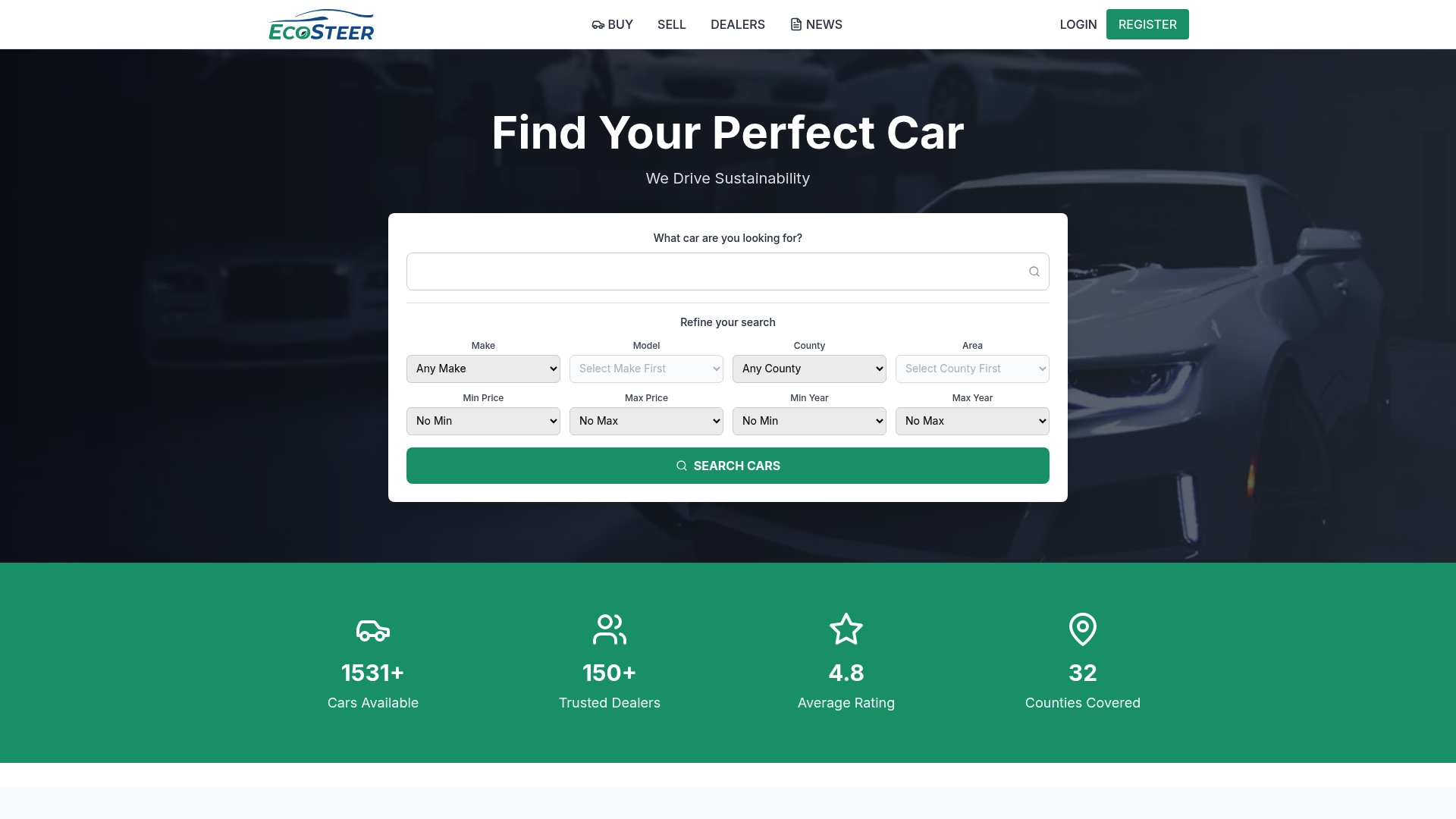
If you are a dealer, listing with us gets your stock in front of buyers filtering by county, make and price, with lead management built in so a new enquiry does not sit unanswered. Start browsing or list your first vehicle at Ecosteer.
FAQ
What does dealership discovery online actually mean?
It refers to the marketplace filters, dealer locators and dealer profiles that let you find nearby dealerships, see their inventory and get their contact details in one place. It covers both the buyer’s search experience and the dealer’s visibility in that search.
How do I know if I’m buying from a dealer or a private seller?
Ask about “the car” without naming a specific listing, and if the seller asks which one you mean, they are likely trading multiple vehicles rather than selling privately, according to CCPC guidance. A genuine dealer will also give you a full business address and landline number without hesitation.
What checks should I run before buying a used car online?
Get an independent mechanical inspection, run a vehicle history check and request full service records before you commit, as the RSA recommends. Walk away if the dealer will not write the current odometer reading on the receipt.
Can EcoSteer help me find a trustworthy local dealer?
Yes, our dealer finder lets you browse verified dealer profiles by county and model, alongside guides on what to check before you buy. Dealers using EcoSteer can also manage leads and listings directly, which tends to improve response times for buyers.
What should I do if a dealer refuses to put the mileage in writing?
Treat it as a serious warning sign and consider walking away from the sale, as the RSA advises. A legitimate dealer has no reason to avoid confirming the odometer reading on your receipt.
Sources
- What You Need To Know Before Buying a Car | CCPC
- Use the dealership locator in lead forms - Google Ads Help
Recommended
Ecosteer Editorial
Author