Car Prices by County: Ireland’s €201 Insurance Gap, VRT and Listings
Compare car prices by county in Ireland with insurance costs, CSO fleet data, Revenue VRT rules, motor tax, and EcoSteer listings to see the real cost.

Car prices do vary meaningfully by county in Ireland, but the listing price itself is rarely where the real gap shows up. Insurance alone can swing your annual cost by hundreds of euro: Kilkenny averaged the lowest premiums in the country at €584 in May 2026, while Longford averaged €785. Before comparing asking prices across counties, check insurance and tax-adjusted total cost first.
TL;DR:
- Chill’s May 2026 index put average annual insurance at €584 in Kilkenny and €785 in Longford, a €201 gap that can erase modest bargaining savings.
- Compare the same model, year, mileage, trim, and condition across counties, then obtain a personal insurance quote because county averages are not individual premiums.
- Imported cars incur VRT based on Revenue’s Open Market Selling Price, not necessarily the foreign invoice; annual motor tax depends on engine capacity or emissions.
- National EV grants and VRT reliefs do not vary by county, though local charging access and commuting patterns can affect demand for used electric cars.
Table of Contents
- County-level snapshot: how big are the real differences?
- What drives county differences in car prices
- Taxes and statutory charges that change the effective cost
- How to use county price data when buying or selling
- What EcoSteer’s listings show about county pricing patterns
- Do county grants or incentives affect car prices?
- Why county-aware pricing matters
- Search and compare county listings on EcoSteer
- FAQ
- Sources
County-level snapshot: how big are the real differences?
Vehicle licensing data from the Central Statistics Office gives us a sense of how fleet size and new registrations vary across the country, and that scale matters: counties with denser dealer networks and higher registration volumes tend to have deeper used car markets, which means more comparable listings and tighter pricing. Thinner markets, by contrast, can show wider asking-price spreads simply because there is less competition to anchor the price.
Insurance is where the county effect is clearest and best documented. The Chill pricing index ranks all 26 counties and tracks how premiums move year-on-year, which matters because a county that looks cheap today can shift rank within months as local claims patterns change.
A few things worth holding in mind when you read county figures:
- Kilkenny had the lowest average premium in the country as of May 2026, according to the Chill index.
- Longford topped the list as the most expensive county for insurance, creating a substantial gap compared to Kilkenny, purely on insurance.
- Rankings move year to year, so a county’s position is a snapshot rather than a fixed rule.
- Listing prices alone understate the real difference between counties once recurring costs are added in.
The €201 annual insurance gap between Kilkenny and Longford, on its own, can outweigh a modest discount on the car’s asking price. That single figure, drawn from Chill’s county data, is often more decisive than the few hundred euro you might haggle off a sticker price.
What drives county differences in car prices
A county-level price gap is rarely one thing. It is usually a mix of risk, supply and how the local fleet gets used.
- Insurance risk assessment: insurers price by claims history, theft rates and crash frequency at a local level, which is why premiums can diverge sharply between neighbouring counties, as shown in Chill’s index.
- Supply and demand: counties with more active dealers and denser listings tend to have more competitive, tighter pricing, while rural counties with fewer sellers can see wider swings.
- Usage patterns: higher average vehicle kilometres travelled in a county can mean cars arrive at resale with more wear, which tends to pull down local asking prices.
- Market depth: rarer trims, imports and less common fuel types take longer to sell in thin markets, and sellers often price them more cautiously as a result.
Pro Tip: Before assuming a county is simply “cheaper”, check whether the gap is coming from the car’s condition and mileage or from genuinely lower local demand.
Taxes and statutory charges that change the effective cost
Two government-set costs sit underneath every car price in Ireland, and neither one is set by the county you buy in, though they still shape how much a car really costs you to own.
Vehicle Registration Tax is calculated from the Open Market Selling Price, which Revenue determines using declared distributor prices or market guides, and by referencing foreign jurisdictions where needed. This is why an imported car’s effective cost can end up higher than its purchase invoice suggests: the OMSP calculation, not the price you paid abroad, sets the VRT bill.
Motor tax is the other recurring cost, charged according to government-set bands tied to engine capacity or CO2 emissions depending on the vehicle’s registration date. It is paid annually regardless of county, but it changes the total cost-of-ownership comparison between two similarly priced cars with different engines.
- A smaller-engine car in a lower motor tax band can cost noticeably less to run annually than a larger-engine equivalent, even at the same purchase price.
- An imported vehicle’s OMSP-based VRT bill can add a meaningful sum on top of the purchase price, separate from any county-level discount on the car itself.
- Checking the motor tax band before buying avoids a nasty surprise once the car is registered.
A car that looks like a bargain in one county can lose its advantage entirely once VRT and motor tax are factored in, which is why total cost, not sticker price, should guide the comparison.
How to use county price data when buying or selling
County data is only useful if you compare like with like. Here is a straightforward way to apply it:
- Match the basics: compare the same model, year, mileage band and trim level before drawing any conclusion about county pricing.
- Normalise for condition: adjust mentally (or on paper) for mileage and visible wear, since a higher-mileage car in a cheaper county may not actually be cheaper once adjusted.
- Add insurance: pull your own quote for the specific county, since Chill’s averages are a starting point, not a personal quote.
- Add motor tax: check the engine-capacity or CO2 band that applies to the car you are considering.
- Compare the total, not the listing price: this is the number that should guide your decision.
Reliable inputs are quick to find: the CSO’s licensing data, Revenue’s VRT guidance, Chill’s insurance index and current marketplace listings together cover almost everything you need.
Pro Tip: If a county shows a genuine total-cost advantage, use that as a starting point for negotiation rather than assuming every seller in that county will match it.
What EcoSteer’s listings show about county pricing patterns
Our search tools include county filters to help reflect how location can influence price. Browsing listings across different county pages tends to show demand concentrating around certain models in certain areas, with asking prices adjusting accordingly rather than following a flat national figure. The dealer finder tool also shows which counties have denser dealer coverage, which, in line with the market-depth pattern above, tends to correlate with tighter, more consistent pricing.
Do county grants or incentives affect car prices?
Ireland’s main purchase incentives, such as Electric Vehicle grants and VRT reliefs, are set nationally rather than by county, so they do not create the kind of local price gap you see with insurance. Where a county effect shows up is indirect: areas with stronger EV charging infrastructure or more EV-friendly commuting patterns tend to see higher demand for electric and hybrid models, which can push used EV asking prices up locally even though the underlying grant is identical everywhere. Local authority schemes, where they exist, tend to be small-scale and targeted (for example, parking or charging incentives) rather than price-moving in the way insurance or motor tax are.
For most buyers, this means a national incentive is worth checking regardless of county, but it should not be mistaken for a county-specific saving. The bigger county-level variable remains the combination of insurance, motor tax and local demand covered earlier.

Why county-aware pricing matters
A low asking price in one county can hide a higher true cost once insurance and tax are added. Check the full number, price plus insurance plus motor tax, and confirm it against live listings before deciding.
Search and compare county listings on EcoSteer
Once you know what to adjust for, the fastest way to test a county’s real pricing is to look at live listings. Our car search lets you filter by county, price, year, mileage, transmission and fuel type, so you can compare genuinely similar cars rather than guessing from averages.
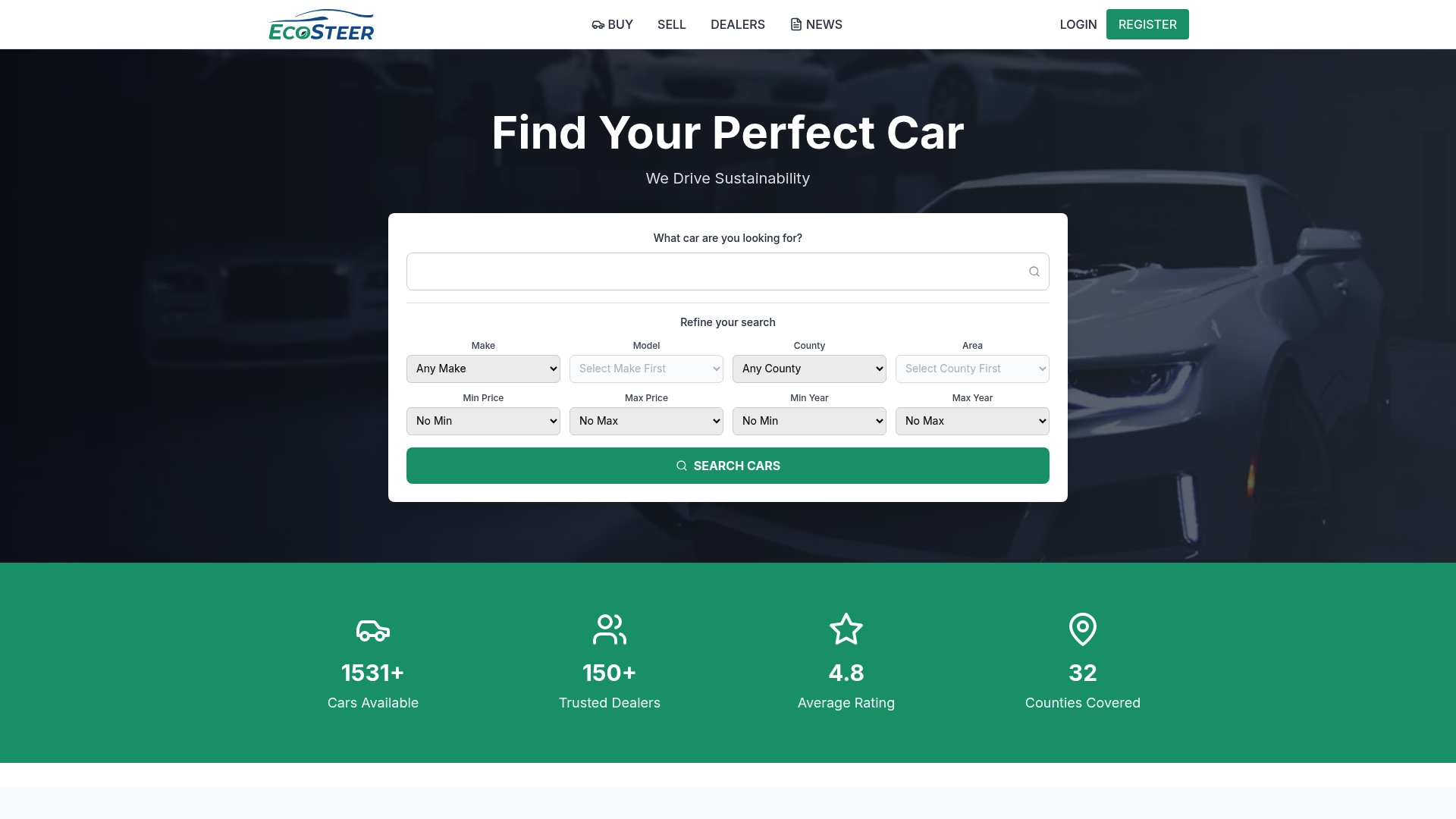
- County filters let you narrow results to the area you are actually buying or selling in.
- Dealer finder helps you locate dealers near you for a closer look or a trade-in.
- Detailed listing fields show mileage, trim and history so you can normalise before comparing price.
Start with our Ireland-wide car listings and narrow down by county from there.
This article is general information, not a substitute for advice from a qualified financial advisor. Consult a qualified financial professional about your own circumstances before acting on anything here.
FAQ
Which car is the cheapest in Ireland?
The cheapest cars in Ireland tend to be older, higher-mileage small hatchbacks and superminis, with entry-level budgets varying by year, mileage and condition, so browsing current listings in that price band gives a more accurate picture than any single average figure.
What are the car tax bands in Ireland for 2026?
Motor tax in Ireland is charged in bands based on engine capacity or CO2 emissions, depending on when the car was first registered, with the official schedule setting the annual amount for each band. Checking the exact band for a specific model before buying avoids underestimating annual running costs.
How can I determine the market value of my car in Ireland?
Market value is best estimated by comparing your car’s model, year, mileage and trim against similar live listings rather than relying on a single average figure. For VRT purposes specifically, Revenue assesses value using the Open Market Selling Price, which can differ from a private sale estimate.
What cars can I buy for €5,000 in Ireland?
Buyers typically find older superminis and small family hatchbacks with higher mileage at entry-level prices, though exact availability shifts with county and season. Reviewing current listings at that price point gives a clearer, up-to-date view than a fixed list of models.
Sources
- Car Insurance Pricing Index | Chill
- Assessing the value | Revenue
- Vehicles licensed for the first time — CSO
- Motor taxation rates (engine-capacity bands)
Recommended
Ecosteer Editorial
Author