Stop Overpaying: Used Car Prices in Ireland, Under €5,000 to €15,000+
See what used cars really cost in Ireland. Compare Cartell valuations with county-filtered Ecosteer listings, spot fair asking prices, and avoid common scams.

Most used cars in Ireland are frequently advertised within a mid-range price band, though the exact figure for your search depends heavily on model and age. Check the Cartell Car Price Guide for a registration-based valuation, then cross-reference against live marketplace listings for your exact model, year, and county to see where asking prices are actually landing this month.
TL;DR:
- Most used cars in Ireland are priced within a mid-range band, but prices vary significantly depending on model, age, fuel type, and region.
- Filtering listings by model, registration year, mileage, and location across multiple sources helps identify a realistic price range and negotiation margin.
- The three main price tiers are under €5,000 for older cars with high mileage, €5,000 to €15,000 for most family vehicles, and above €15,000 for newer, low-mileage, or electric models.
- Using Cartell’s registration-based valuation alongside local filtered market data provides a more accurate price expectation before viewing cars.
- Final costs beyond the asking price include VRT (if importing), registration fees, insurance, motor tax, and potential repair expenses, which should inform budgeting decisions.
Table of Contents
- Where to find live used-car prices in Ireland
- What each price band typically buys you
- Using Cartell’s Car Price Guide to check a valuation
- Checklist for vetting a listing before you call
- How Ecosteer and Cartell improve price transparency
- What buying a used car actually costs beyond the price tag
- How long buying a used car in Ireland actually takes
- Where to buy: dealers, private sellers and online marketplaces
- Spotting scams in the Irish used car market
- Paperwork you’ll need to complete the purchase legally
- When to buy now and when to wait
- Search, compare and contact sellers on Ecosteer
- Sources
- FAQ
Where to find live used-car prices in Ireland
Three distinct sources tell you three different things, and mixing them up is where most buyers get their budgeting wrong.
Dealer stock listings show you forecourt asking prices, which usually run higher than private sales because they include a warranty, prep work, and the dealer’s margin. Private ads, by contrast, reflect what an individual owner thinks their car is worth. That figure is often negotiable and sometimes optimistic. Aggregated price indices sit above both, pulling thousands of live adverts together to show median asking prices across a model range.
None of these three tells you the full picture on its own. A dealer listing without a private-sale comparison hides how much haggling room actually exists. A private ad without a valuation check leaves you guessing whether the seller is asking a fair price or fishing for more.
To get a genuinely comparable set of results, filter searches by:
- Same model and trim level (a 1.6 diesel and a 2.0 petrol of the same car are not comparable)
- Same registration year or a one-year window either side
- Similar mileage band (within 15,000km, ideally)
- Same county or region, since rural and urban asking prices can differ noticeably
Run the same filtered search across two or three sources and you’ll typically see a spread of a few thousand euros for what is nominally “the same car.” That spread is your negotiation window.
Pro Tip: Save three or four comparable listings before you contact any seller. Having real numbers in hand during a phone call carries far more weight than saying “I think it’s overpriced.”
What each price band typically buys you
The used-car market in Ireland splits fairly cleanly into three tiers, and knowing what’s realistic in each one saves you wasted viewings.
Marketplace data suggests the median asking price for a used car nationally sits in the low-to-mid teens of thousands of euro, though this shifts with fuel type, model popularity, and the time of year. Spring and early summer tend to bring more stock onto the market as people upgrade ahead of the new registration period, which can soften prices slightly.
Here’s roughly what to expect at each level:
- Under €5,000: Older cars, typically 10 to 15 years old, often with higher mileage (150,000km plus). Expect to budget for an NCT retest and some mechanical attention shortly after purchase.
- €5,000 to €15,000: The busiest segment of the market. Covers a wide range of family hatchbacks, saloons, and small SUVs from roughly 6 to 10 years old with moderate mileage.
- €15,000 and above: Newer used cars, low-mileage examples, and increasingly, electric and hybrid models where demand has pushed asking prices up faster than for equivalent petrol or diesel cars.
EV demand in particular has been reshaping this top band. Buyers chasing lower running costs have pushed asking prices for popular electric models noticeably closer to new-car territory than older combustion equivalents at the same age.
Using Cartell’s Car Price Guide to check a valuation
The Cartell Car Price Guide works by combining live advertised prices with a specific vehicle’s registration and history, rather than relying on generic model-year averages. That distinction matters: two identical-looking cars can carry very different valuations once accident history, mileage records, and import status are factored in.
The basic workflow is straightforward:
- Enter the vehicle’s registration number and current mileage.
- Review the current valuation figure alongside projected values at one and three years out.
- Check the linked sample adverts CPG uses to build that valuation, so you can see comparable real listings.
- Compare that CPG figure against live asking prices for the same model in your own search.
- Note the gap. Advertised prices and eventual sale prices are rarely identical, and CPG’s figure leans on advertised data.
Cartell’s methodology is used by insurance and finance companies for vehicle valuation, which gives its figures more weight than a rough asking-price average.
Pro Tip: Run the CPG valuation before you view a car, not after. If the seller’s asking price sits well above the three-year projection for a car that age, you already know your opening negotiation position.
Checklist for vetting a listing before you call
Before you pick up the phone or send a message, five checks separate a worthwhile viewing from a wasted trip.
- Registration and NCT status: Confirm the registration matches the advert and check how much NCT life remains. A car due its test within weeks is a negotiation point.
- Service history: Ask whether a full history is available and whether it’s stamped by an approved garage rather than handwritten.
- Mileage plausibility: Cross-check the current odometer reading against the vehicle’s history and previous NCT records for that registration.
- Number of previous owners: More than three or four owners on a car under ten years old is worth asking about.
- Photo consistency: Compare interior wear against the stated mileage. A “low mileage” car with a heavily worn steering wheel or driver’s seat is a red flag.
Refuse to proceed, or dig much deeper, if a seller has no documents at all, if photos look reused from a different advert, or if they push for unusual payment methods like wire transfers before you’ve seen the car in person.
Budget beyond the sticker price too. Even a well-vetted car often carries some combination of NCT costs, minor repairs, and a jump in insurance if you’re switching from a smaller engine to something larger.
Pro Tip: Ask for the Vehicle Identification Number (VIN) before viewing and run it through a history check. It takes minutes and can rule out a car with a poor history before you waste an afternoon on a viewing.
How Ecosteer and Cartell improve price transparency
Ecosteer operates as an Irish marketplace built around county and price-based search, letting you filter listings the way outlined above rather than scrolling through everything nationally. It also includes a dealer finder for buyers who’d rather deal with an established trader than a private seller.
Cartell’s CPG remains the reference point professionals use precisely because it ties valuation to a specific vehicle’s history rather than a blanket average. Combining the two, a county-filtered marketplace search plus a registration-based valuation, gives you a genuinely local, genuinely specific price picture rather than a national guess.
What buying a used car actually costs beyond the price tag
The advertised price is rarely the final number. Get this wrong and a “good deal” can end up costing more than a slightly pricier car elsewhere.
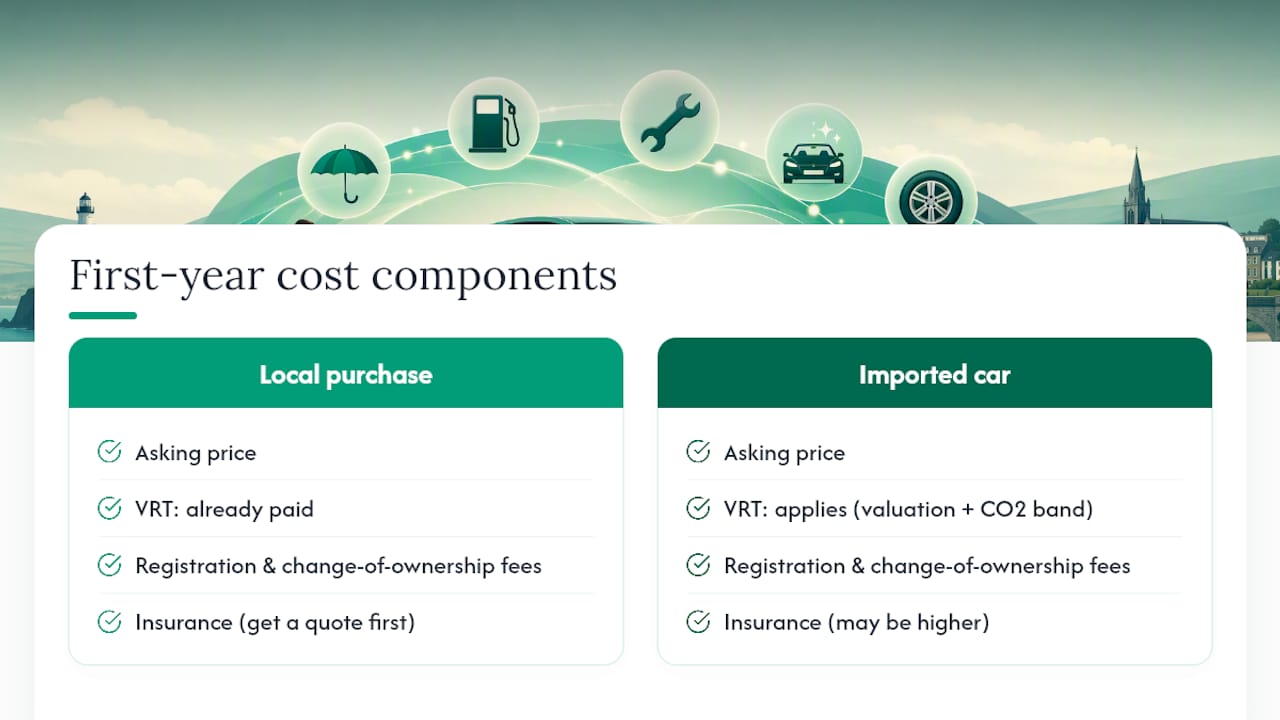
Vehicle Registration Tax (VRT) applies if you’re importing a car from outside Ireland, calculated against the Cartel-style valuation and the car’s CO2 emissions band. For a car already registered in Ireland and bought from an Irish seller, VRT has already been paid and isn’t your concern. This is one of the biggest cost differences between buying locally and importing from the UK or elsewhere.
Registration and change-of-ownership fees through the National Vehicle and Driver File are modest, but they’re not zero, and they’re easy to forget when budgeting.
Insurance varies enormously by driver history, car type, and where you live, but it’s worth getting a quote before you commit to a purchase, not after. A powerful or higher-value car can shift your premium substantially compared to what you were expecting.
Motor tax depends on engine size or CO2 emissions, and it’s paid annually or quarterly, so factor it into your running costs rather than treating it as a one-off.
Maintenance is the wildcard. A car with a thin service history or an NCT due soon should have a repair buffer built into your budget, typically a few hundred euro at minimum, more if the NCT report flags anything structural.
Add these together against the asking price before you compare two cars head-to-head. A cheaper car with poor history can easily cost more in year one than a pricier one with a clean record.
How long buying a used car in Ireland actually takes
Most buyers underestimate the timeline, then feel rushed into a decision they later regret.
Searching and shortlisting typically takes one to two weeks if you’re filtering properly by model, year, mileage, and county rather than browsing everything on offer. Viewings, ideally two or three comparable cars rather than just one, usually add another week, especially once you factor in seller scheduling and, where relevant, an independent mechanical inspection.
Negotiation and agreeing a final price can happen in a single conversation or drag out over several days, particularly with private sellers who want time to think. Once a price is agreed, the paperwork side, transferring ownership, arranging insurance, and sorting motor tax, generally takes a few days to a week depending on how quickly documents move between buyer and seller.
All told, a realistic end-to-end timeline runs from two to four weeks for a straightforward purchase. Rushing this compresses your ability to compare listings properly, which is exactly the stage where most overpaying happens.
Where to buy: dealers, private sellers and online marketplaces
Each route to buying suits a different kind of buyer, and the trade-offs are worth knowing before you commit to one.
Dealers typically charge more for a comparable car, but that premium buys a warranty, some legal protection, and a level of accountability a private seller can’t offer. If a dealer misrepresents a car’s condition, you have far more recourse than with a private sale.
Private sellers generally offer the lowest asking prices and the most room to negotiate, but you’re on your own for verification. There’s no warranty, no business behind the sale, and your only protection is the vetting you do yourself.
Online marketplaces, including Ecosteer, sit across both categories, listing dealer stock and private sales side by side with filters by county, price, year, mileage, and fuel type. That structure lets you compare the two routes directly rather than treating them as separate searches.
Which route suits you depends on how much time you want to spend vetting versus how much premium you’re willing to pay for peace of mind.
Spotting scams in the Irish used car market
A handful of scam patterns show up repeatedly in the Irish market, and they’re worth knowing before you start contacting sellers.
The most common is the too-good-to-be-true listing, a car priced well below comparable adverts, often supposedly located outside Ireland “for work reasons,” with a seller who won’t allow a viewing before payment. Never send money, even a deposit, before seeing a car and its documents in person.
Cloned registrations are another risk: a legitimate registration number copied onto a different, often stolen or written-off, vehicle. Running a history check against the VIN, not just the registration plate, helps catch this, since VINs are far harder to fake convincingly.
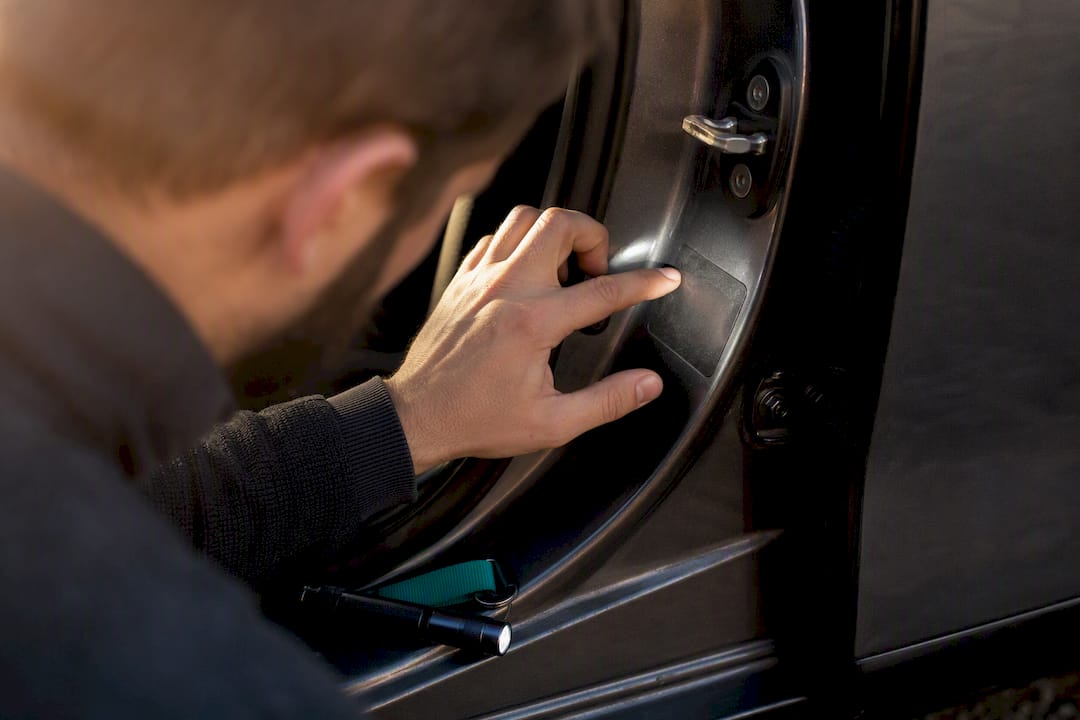
Watch for sellers who avoid phone calls entirely and communicate only through messaging apps, who pressure you to decide quickly, or whose photos appear across multiple unrelated adverts, a sign the images were lifted rather than taken of the actual car. Genuine private sellers are almost always happy to meet at their home address and let you see the car alongside its documents.
Paperwork you’ll need to complete the purchase legally
Buying a used car in Ireland involves a specific set of documents, and missing one can delay registration or leave you without proper cover.
You’ll need a valid NCT certificate if the car is over four years old, confirming that it passed its most recent test. Check the expiry date carefully rather than just confirming one exists.
The seller should provide the Vehicle Registration Certificate (the logbook), which you’ll need to transfer into your name through the National Vehicle and Driver File system. A sales agreement or receipt confirming the price paid, date, and both parties’ details protects both sides if a dispute arises later.
You’ll also need to arrange motor tax in your name promptly after purchase and confirm your insurance is active before you drive the car anywhere, since driving uninsured, even briefly, carries serious legal consequences. Ecosteer’s step-by-step buying guide walks through this transfer process in more detail if you want the full sequence.
When to buy now and when to wait
Acting quickly makes sense when a specific model is genuinely scarce in your price band, or when a comparable-listing search shows a car priced clearly below its Cartell valuation. That gap rarely stays open long once other buyers spot it too.
Patience pays off in the opposite situation: when a model has a refresh or new generation due soon, pushing current owners to sell ahead of it, or when a segment is oversupplied and asking prices are visibly softening week on week. If your shortlist keeps growing rather than shrinking, that’s often a sign to wait rather than settle.
Whichever way you lean, keep a repair and NCT buffer set aside. A slightly cheaper car with an imminent NCT rarely ends up being the bargain it first appears.
— ibrahim
Search, compare and contact sellers on Ecosteer
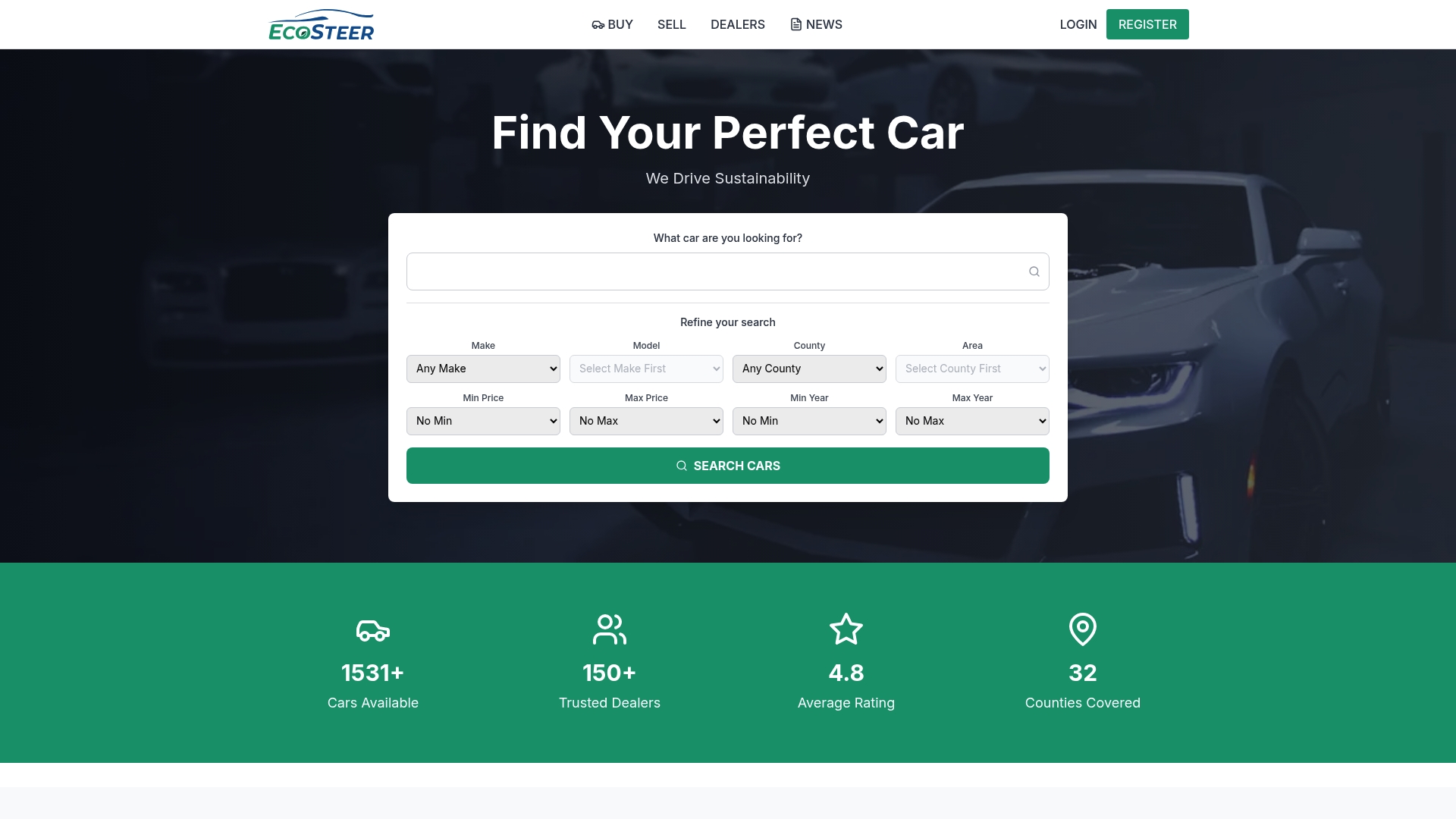
Ecosteer gives you one place to run every check this article has walked through, rather than juggling several tabs and a spreadsheet. As an Irish marketplace built around dealer and private listings side by side, it’s the practical next step once you know what a fair price actually looks like for your shortlist.
On the platform you can:
- Filter listings by county, price, year, mileage, transmission, and fuel type to build a genuinely comparable shortlist
- Use the dealer finder to locate established traders near you rather than relying solely on private ads
- Follow the buying guide and history-check guide to vet a listing before you commit to a viewing
FAQ
What is the average price of a used car in Ireland?
Marketplace data points to a median asking price in the low-to-mid teens of thousands of euro, though this varies by model, age, fuel type, and county, so always check a live filtered search for your specific shortlist.
What is the best second-hand car to buy in Ireland?
There’s no single best model. The right choice depends on your budget band, running costs, and how much you value low mileage versus a lower price; comparing a Cartell valuation against live listings for a few candidates is the most reliable way to decide.
What is the best site to find used car prices in Ireland?
A combination works best: use Cartell’s Car Price Guide for a registration-based valuation, then check a marketplace like Ecosteer for live, county-filtered asking prices to see where the market actually sits.
What can I expect from second-hand cars under €5,000?
Expect cars typically 10 to 15 years old with higher mileage, often needing an NCT retest or some mechanical attention soon after purchase, so budget for that alongside the purchase price.
Do I need to pay VRT on a used car bought in Ireland?
No. Vehicle Registration Tax only applies when importing a car from outside Ireland; a car already registered here has had VRT paid at first registration.
Recommended
Ecosteer Editorial
Author