Avoid a €2,500 Repair Bill: Used Car Warranties in Ireland
Learn what dealer warranties in Ireland actually cover, the common exclusions, your CCPC consumer rights, and an Ecosteer checklist to spot warranty gaps...

Most dealer-sold used cars in Ireland come with some form of commercial warranty, but the length, cover and exclusions vary hugely between sellers. That warranty is a private contract sitting on top of your statutory consumer rights, not a replacement for them. Before you sign anything, ask for the written warranty terms and get an independent pre-purchase inspection done.
TL;DR:
- Dealer warranties vary widely in length, cover, and exclusions, so it is crucial to request written terms and understand what is genuinely covered.
- Most warranties only cover mechanical failures on core components like engines and gearboxes, often excluding wear-and-tear parts and pre-existing faults.
- Buying from a registered dealer provides statutory protections that surpass warranty coverage, whereas private sales carry significantly fewer legal safeguards.
- Warranties typically exclude wear items, pre-existing issues, and non-transferable coverage, making a careful review of exclusions essential before claiming.
- An independent pre-purchase inspection and vehicle history check are more valuable than the warranty for avoiding future problems and ensuring true car reliability.
Table of Contents
- What does a used car warranty in Ireland actually cover?
- How long do used car warranties last, and what do they cost?
- Dealer warranty versus private sale: what are your legal rights?
- What do most warranties leave out?
- How do you make a claim, and how do repair networks work?
- Is an extended warranty actually worth paying for?
- Pre-purchase checks worth doing even with a warranty in place
- How do warranty providers decide if your car qualifies?
- How do you actually buy a used car warranty in Ireland?
- Do warranties cover known issues or previous repairs?
- What protection exists beyond a warranty?
- Publisher perspective: comparing warranty information when you shop
- Find dealers with clear warranty terms on Ecosteer
- Sources
What does a used car warranty in Ireland actually cover?
A typical dealer warranty covers mechanical and electrical failure on major components: the engine, gearbox, and core electrical systems. Some policies pay for parts and labour together, while cheaper ones cover parts only, leaving you to fund the mechanic’s time yourself. That gap catches out a surprising number of buyers who assume “covered” means fully covered.
Warranty packages often bundle in extras beyond the core mechanical promise:
- Roadside assistance and recovery if the car breaks down away from home
- Optional add-ons sold separately, such as GAP insurance or key replacement cover
- A defined claims limit per repair or per policy term
The real extent of cover rarely fits in a headline figure. Read the short warranty summary line by line, particularly the list of what is excluded, before you take the seller’s word for what “covered” means. MAWDY, one of the Ireland-based providers dealers use, structures its used car packages around mechanical and electrical failure backed by an approved repair network, which gives a reasonable benchmark for what a standard package looks like.
How long do used car warranties last, and what do they cost?
Standard dealer warranties often start at shorter durations, with longer periods also available as upgrades. Some dealers also sell multi-year extensions, usually priced higher and pitched at buyers of newer used stock.
Pricing tends to follow one of two patterns:
- A single upfront fee added to the sale price or paid separately at handover
- The warranty cost folded into a finance agreement, spread across monthly repayments
Dealers are under no legal obligation to offer a fixed warranty period. Length and scope are negotiable at the point of sale, so it is worth asking directly rather than assuming the printed term is fixed. Most policies also cap what they will pay per claim or per item. Motorcheck points to real examples of this in practice, including one provider that limits Car Protect cover to €2,500 per item, a cap that can leave you exposed on an expensive gearbox or turbo repair.
Dealer warranty versus private sale: what are your legal rights?
Buying from a registered dealer gives you statutory protections that a warranty simply adds to. Under Irish consumer law, goods sold by a trader must be of merchantable quality, fit for purpose, and reasonably durable given their age and price. The Competition and Consumer Protection Commission and Citizens Information both set out these rights clearly, and they exist whether or not the dealer offers a warranty at all.
Private sales sit on far shakier ground:
- No statutory quality guarantee applies between two private individuals
- Any warranty from a private seller is rare and entirely at their discretion
- Your main recourse if something goes wrong is proving misrepresentation, which is harder and slower than a straightforward warranty claim
A dealer warranty never removes your statutory rights. It runs alongside them as a separate, contractual layer, which matters if a warranty claim is refused but the fault genuinely breaches merchantable quality.
What do most warranties leave out?
Warranty documents read generously until you reach the exclusions list, where most of the real limits sit. Watch for these:
- Wear-and-tear items such as clutches, brake pads, and tyres, which are treated as maintenance rather than failure.
- Pre-existing faults, damage from an accident, or neglect that predates the policy start date.
- Non-transferable cover: most dealer warranties end with the original buyer, which matters if you plan to sell the car on before the term expires.
- Void triggers, including missed servicing, unauthorised repairs carried out by an unapproved garage, or evidence of mileage tampering.
Check the transferability clause specifically if resale value matters to you. A warranty that dies with you rather than travelling with the car is worth less on paper than it looks at the point of sale.
How do you make a claim, and how do repair networks work?
Most providers expect you to contact them before any repair work starts, not after. Skipping that step is one of the fastest ways to have a claim rejected outright.
- Contact the seller or warranty provider as soon as a fault appears
- Have your sales receipt and full service history ready. Gaps in servicing are a common reason claims get refused
- Get authorisation in writing before a garage touches the car, where the policy requires it
Many warranties, including those built on approved-repair-network models like Mapfre’s dealer warranty system, require you to use a listed workshop rather than any competent local garage. That keeps claims handling consistent but can mean a longer drive or a delay while a slot opens up. If a claim is refused, ask for the reason in writing. If you disagree, Citizens Information and the CCPC both offer escalation routes worth pursuing before you accept the knockback.
Pro Tip: Photograph the fault and keep every text or email exchange with the garage and the seller. A written paper trail is worth more than memory if a claim gets disputed later.
Is an extended warranty actually worth paying for?
It depends more on the car than the warranty. A model with a strong reliability record and cheap parts rarely justifies the extra spend. A hybrid or electric vehicle with expensive battery or drivetrain components is a different calculation entirely, where one big repair bill could easily outweigh years of warranty premiums.
Before buying an extension, check for overlap:
- Does the car still have manufacturer warranty months remaining?
- Is roadside assistance already included through your insurer or breakdown membership?
- What is the per-claim cap, and does it actually cover the repair you are most likely to need?
If the car’s reliability record is strong and the warranty’s caps are tight, self-insuring by setting the premium aside often beats paying for cover you may never use.
Pre-purchase checks worth doing even with a warranty in place
A warranty is a safety net, not a substitute for knowing what you are buying. The CCPC’s own guidance is blunt about this: pre-purchase checks matter more than the warranty itself, because a policy cannot undo the hassle of a breakdown, only soften the bill.
- Book an independent mechanical inspection rather than relying on the dealer’s own assessment.
- Run a full vehicle history check, cross-referencing NCT records, recorded mileage, and service history for inconsistencies.
- Ask for a written warranty summary and clarify the repair-network rules and claim caps before you commit.
- Compare listings and dealer pages to see which sellers state warranty length and inclusions upfront.
Ecosteer’s step-by-step buying guide and vehicle history guide both walk through this process in more detail if you want to slow down and do it properly.
Pro Tip: Ask the dealer who underwrites the warranty. A policy backed by a recognised insurer such as Mapfre tends to be more reliable at claims time than a scheme run entirely in-house by a small garage.
How do warranty providers decide if your car qualifies?
Eligibility criteria filter out cars that providers see as too risky to insure profitably, and understanding them helps explain why two similar-looking cars can get very different quotes. Age is the first filter: most providers set an upper limit, often somewhere between 8 and 15 years old depending on the policy, beyond which cover either disappears or comes with heavy restrictions.
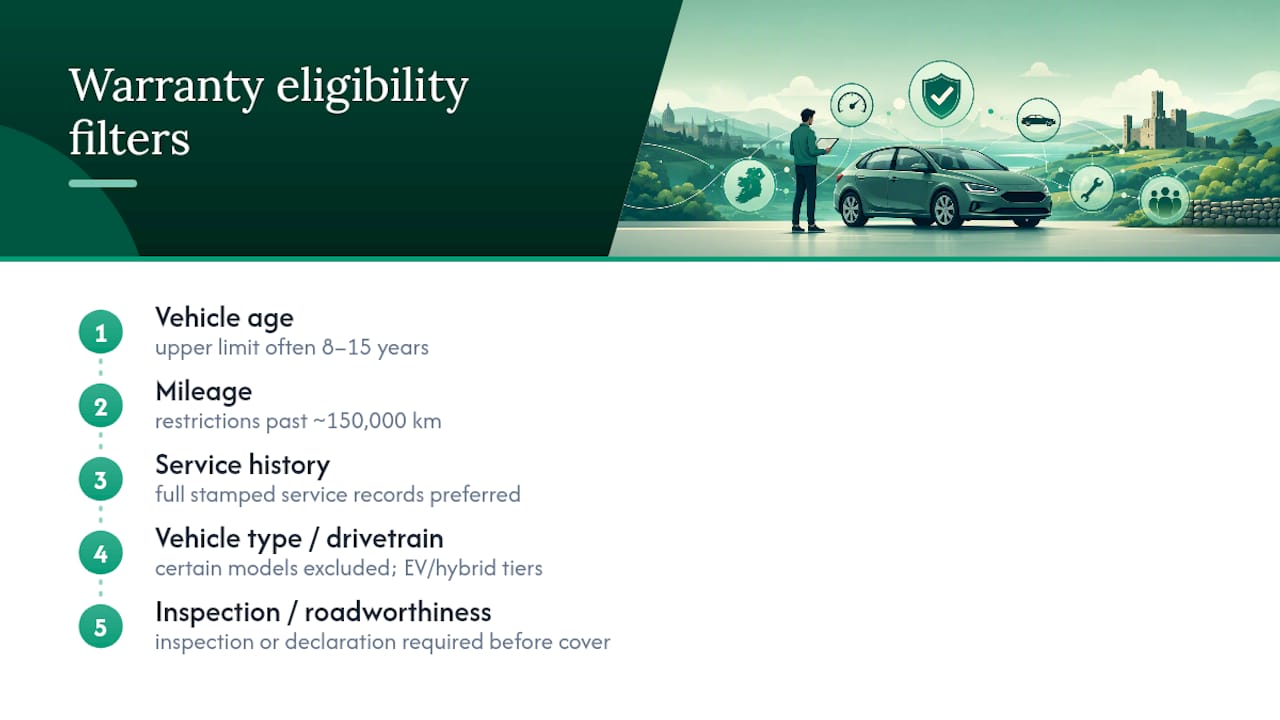
Mileage works the same way. High-mileage cars, particularly anything well past 150,000 kilometres, tend to attract narrower cover or higher premiums because component wear becomes statistically more likely. Providers also look closely at service history. A car with full, stamped service records is a much easier risk to underwrite than one with gaps, and some providers will decline cover outright if servicing cannot be verified.
Vehicle type and drivetrain matter too. Performance models, some imports, and certain commercial variants sometimes fall outside standard eligibility because parts and labour costs run higher than average. Electric and hybrid vehicles increasingly get their own eligibility tier, reflecting the different failure patterns and repair costs of battery and motor components compared with a conventional engine.
Finally, most providers require the vehicle to pass an inspection, or at minimum a declaration of roadworthiness, before cover starts. This is where the line between “warranty eligible” and “warranty declined” often gets drawn, and it is one more reason an independent check before purchase pays for itself.
How do you actually buy a used car warranty in Ireland?
The process is more straightforward than the terms and conditions might suggest, but the documentation matters as much as the decision itself. Start by deciding whether you want the warranty bundled into the dealer’s own offering at the point of sale or bought separately from a specialist provider after purchase.
If buying through the dealer, the warranty is usually presented alongside the sales contract. Read it before signing, not after, since some dealers treat the warranty as an opt-out add-on rather than something you actively chose. Ask specifically what documentation you need to keep to make a future claim valid: the original sales invoice, the warranty certificate itself, and proof of the vehicle’s mileage at the point of sale.
If buying independently from a specialist provider, you will typically need to supply the car’s registration, current mileage, service history, and sometimes proof of a recent inspection before the provider will quote. Providers use this information to set both eligibility and price, so incomplete records can either raise the quote or narrow what is covered.
Once cover starts, keep every document together: the warranty certificate, the sales receipt, and ongoing service records as you use the car. Missing servicing paperwork is one of the most common reasons a otherwise valid claim gets challenged months or years later. Set a reminder for the renewal or expiry date too, since letting cover lapse without noticing is an easy way to lose the safety net just when you might need it.
Do warranties cover known issues or previous repairs?
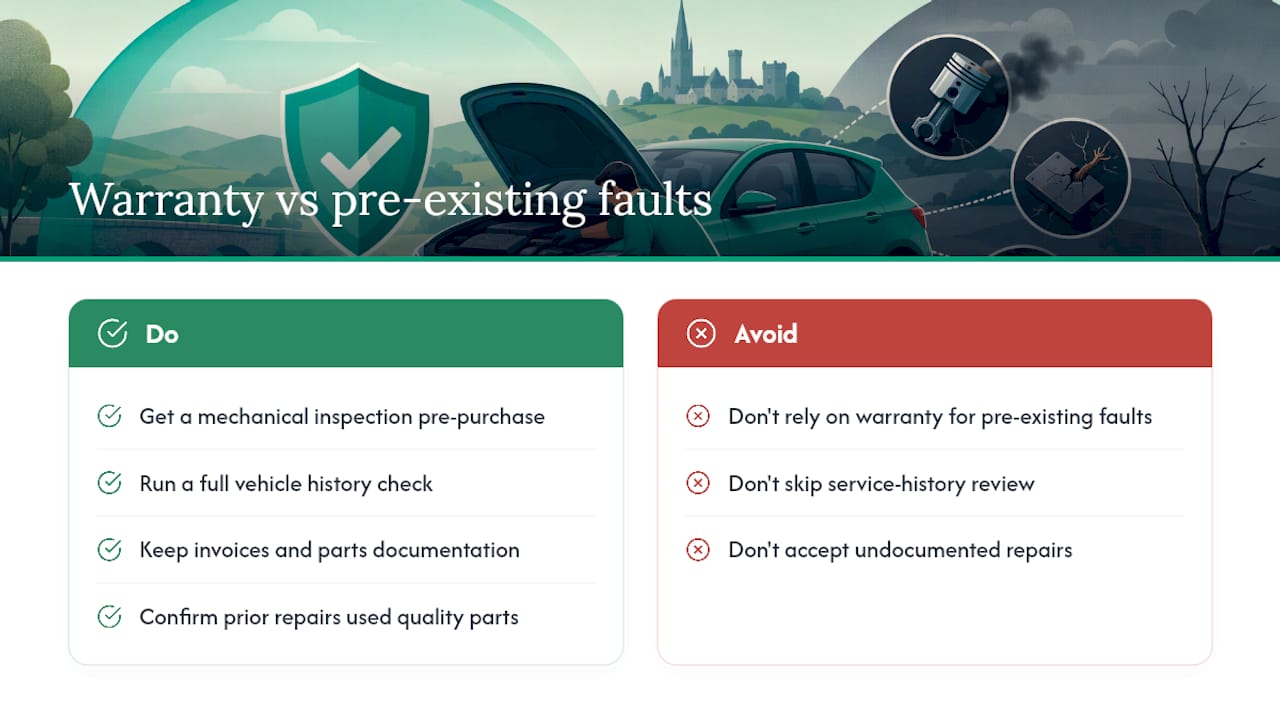
Generally, no. Warranties are designed to cover failures that occur after the policy starts, not faults that already existed at the point of sale. Any issue disclosed on a pre-purchase inspection report, or visible in the service history before the warranty began, is treated as a pre-existing condition and excluded from cover.
This is where the gap between a warranty and your statutory rights becomes genuinely useful. If a dealer sold you a car with an undisclosed fault that existed before the sale, that is a question of merchantable quality under Irish consumer law, not a warranty claim. The remedy path is different: a repair, replacement, or refund claim against the dealer directly, rather than a warranty payout.
Previous repairs carried out correctly and documented rarely cause a problem, provided they used quality parts and were done by a competent garage. What does cause trouble is a poorly executed repair that later fails again. Providers will often argue the repeat failure stems from the original repair rather than a new fault, which can put you in a dispute between the warranty provider and whoever did the earlier work. Keeping detailed records of any repair carried out before you bought the car, including invoices and parts used, gives you a much stronger position if this happens.
This is also why a full vehicle history check before purchase matters as much as the mechanical inspection itself. Spotting a poorly recorded prior repair before you buy is far easier than untangling a warranty dispute about it afterwards.
What protection exists beyond a warranty?
A warranty and your statutory rights are not the only protections available if a used car purchase goes wrong. The Motor Ombudsman scheme, more established in the UK market, offers a model of independent dispute resolution that some Irish dealers affiliated with UK-based groups may reference, though it is not a universal Irish scheme in the way the CCPC framework is.
For most buyers in Ireland, the more relevant escalation routes sit with the CCPC and Citizens Information, both of which can advise on next steps if a dealer refuses to honour statutory rights or a warranty claim gets unfairly denied. The Small Claims Court is also worth knowing about for disputes under its financial limit, since it is designed to be used without a solicitor and keeps costs low relative to the amount typically at stake in a used car dispute.
Third-party mechanical breakdown insurance is a separate product from a dealer warranty, bought independently and sometimes offering broader terms or a different claims process. It is worth comparing against whatever the dealer offers rather than assuming the dealer’s warranty is automatically the best available option. GAP insurance and payment protection cover different risks entirely, financial rather than mechanical, and are worth understanding as distinct products rather than folding them mentally into “the warranty.”
None of these replace doing the groundwork before you buy. They exist for when something has already gone wrong, not as a reason to skip the inspection in the first place.
Publisher perspective: comparing warranty information when you shop
Some platforms list dealer-provided warranty summaries directly on vehicle listings, with links through to full dealer terms where they are published. That lets you filter for dealers who state warranty length and core inclusions upfront, rather than digging through separate paperwork after you have already shown interest in a car. It is a starting point for comparison, not a substitute for it: always verify the written warranty with the seller directly before you complete a purchase.
— ibrahim
Find dealers with clear warranty terms on Ecosteer
Some platforms offer an alternative to trawling classified sites one listing at a time: warranty summaries appear directly on vehicle listings where dealers provide them, so you can compare cover and duration before you ever pick up the phone. Search by location, filter by the details that matter to you, and shortlist dealers who are upfront about what their warranty actually includes.
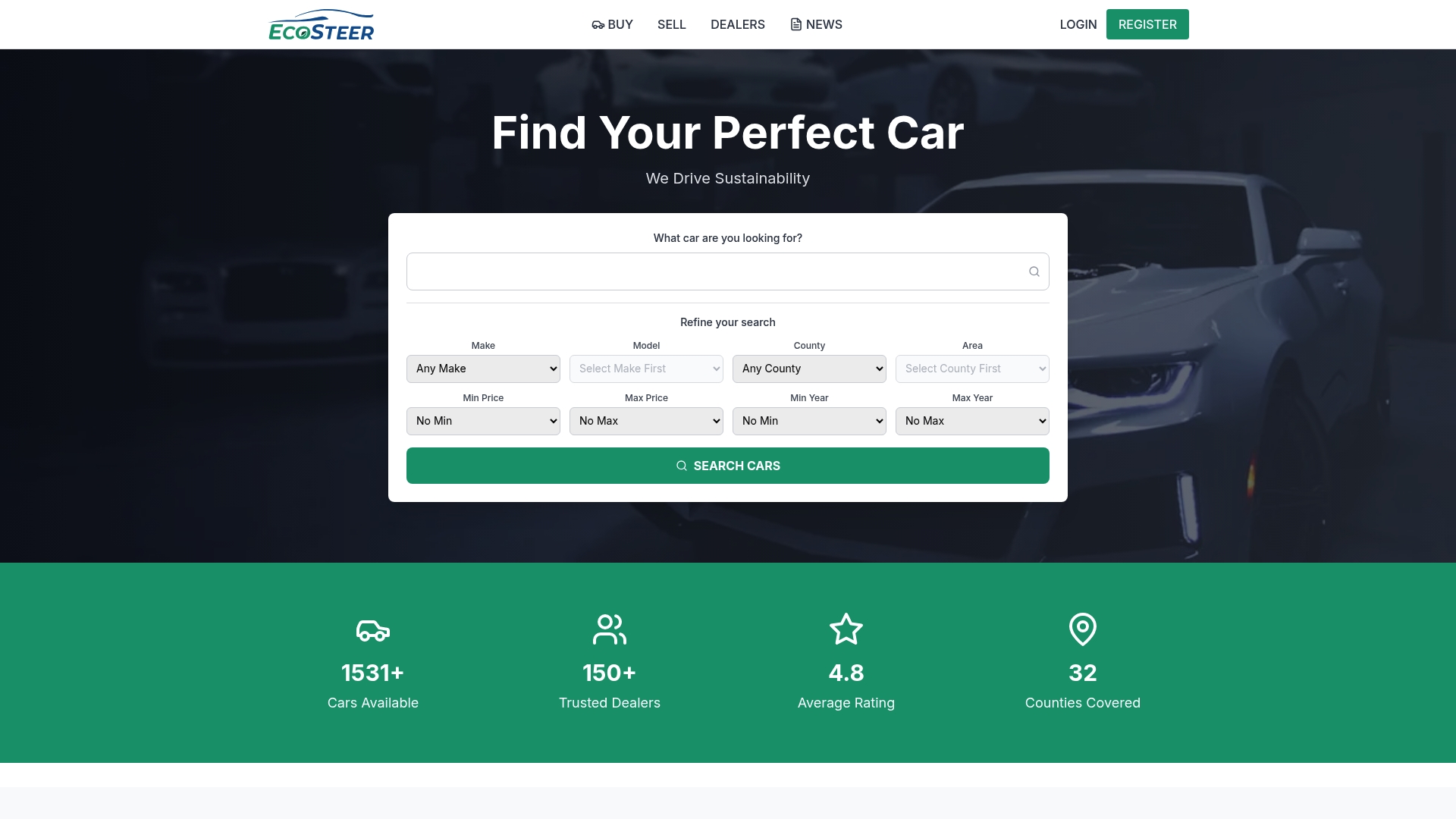
If you already know roughly where you want to buy, Ecosteer’s dealer finder lets you search by area and see which sellers publish warranty terms alongside their listings. Buyers closer to the midlands can also browse live stock directly through used cars in Offaly to see how listings and warranty details appear in practice. Start your search on Ecosteer and compare a few dealers side by side before you commit to a viewing.
Sources
- CCPC — consumer advice on buying goods
- Problems with a used car — Citizens Information
- What does a used car warranty cover? — Motorcheck
- Used Car Warranty — MAWDY
Recommended
Ecosteer Editorial
Author