Sell an EV in Ireland Fast: List SoH, WLTP and Insurance Details
A seller focused Irish checklist that speeds enquiries. List WLTP range, kWh, SoH report, charger and insurance details buyers and underwriters expect.

List the WLTP range with a real-world caveat, battery capacity in kWh, AC/DC charging speeds, connector type, and a battery state-of-health report alongside a valid NCT. With electric vehicles now making up 4.0% of Ireland’s licensed fleet, some marketplaces see complete listings convert to enquiries faster and attract fewer lowball offers.
TL;DR:
- Listing a battery state-of-health report and charging specs at the top of an EV listing significantly increases inquiry quality and buyer trust.
- A verified SoH percentage, test date, and provider name are crucial for proving battery condition and reducing price negotiation friction.
- Proper documentation, including NCT, full service history, and import VRT papers, accelerates sale and reassures buyers of vehicle legitimacy.
- Actual EV worth now depends on having detailed maintenance and battery information, with overall prices stabilizing after the end of the SEAI grant.
- Insurance premiums are driven mainly by battery replacement costs and repair complexity, which vary based on model, mileage, and crash history.
Table of Contents
- What EV listing fields actually get you a phone call?
- How do you prove battery health to a sceptical buyer?
- What paperwork do you need before handing over the keys?
- How much is your EV actually worth right now?
- What insurance rules apply to EVs listed for sale in Ireland?
- Why do EVs and petrol cars price differently for cover?
- Which providers cover EVs in Ireland, and what’s typically included?
- Does battery replacement cost push up your premium?
- How much do driving habits and mileage change your quote?
- What happens when you need to make an EV insurance claim?
- Ecosteer’s practical view from marketplace data and dealer feedback
- List your EV where Irish buyers are actually looking
- Sources
- FAQ
What EV listing fields actually get you a phone call?
Buyers checking an EV listing behave differently to petrol or diesel buyers. They already know the standard basics matter, but they’re scanning for technical reassurance first, and if it isn’t there, they move to the next listing. Dealer guidance from Car Spot puts WLTP range, battery capacity, charge speeds and a battery check at the top of that priority list, and listings that skip these details consistently see weaker engagement.
Here’s what belongs on every EV listing, in the order buyers actually look for it:
- WLTP range, with a real-world note. State the official figure, then add a short line such as “expect roughly 15 to 20% less in winter or on motorway runs.” Buyers trust honesty over marketing numbers.
- Battery capacity in kWh, plus how much of the manufacturer’s battery warranty term remains. This tells a buyer what they’re actually protected against.
- State-of-health (SoH) percentage or report availability, with the diagnostic provider and test date named. A figure without a source looks invented.
- AC and DC charging specs: maximum kW for each, and supported connector types (Type 2 for AC, CCS2 for DC, CHAdeMO where relevant on older Asian imports).
- Charging kit included and wallbox ownership. Say clearly whether the granny cable, Type 2 cable, or home wallbox transfers with the car, and whether any SEAI home-charger grant was already claimed by the current owner.
- Software and OTA update status, including any known range-limiting features that were enabled or disabled by a manufacturer update.
- Standard basics: current NCT status, full service history, verified mileage, VIN and registration number.
Photos matter as much as the numbers. Include a labelled shot of the charging port, a clear image of the dashboard showing current range and battery percentage, and, if you can, a screenshot of a representative trip log showing consumption on a real journey.
Pro Tip: Don’t just say “great range”. Buyers researching EVs, as Carwow’s Irish buying guide confirms, weigh charging access and battery condition above almost everything else, so lead your listing with those two facts rather than burying them in the description.
How do you prove battery health to a sceptical buyer?
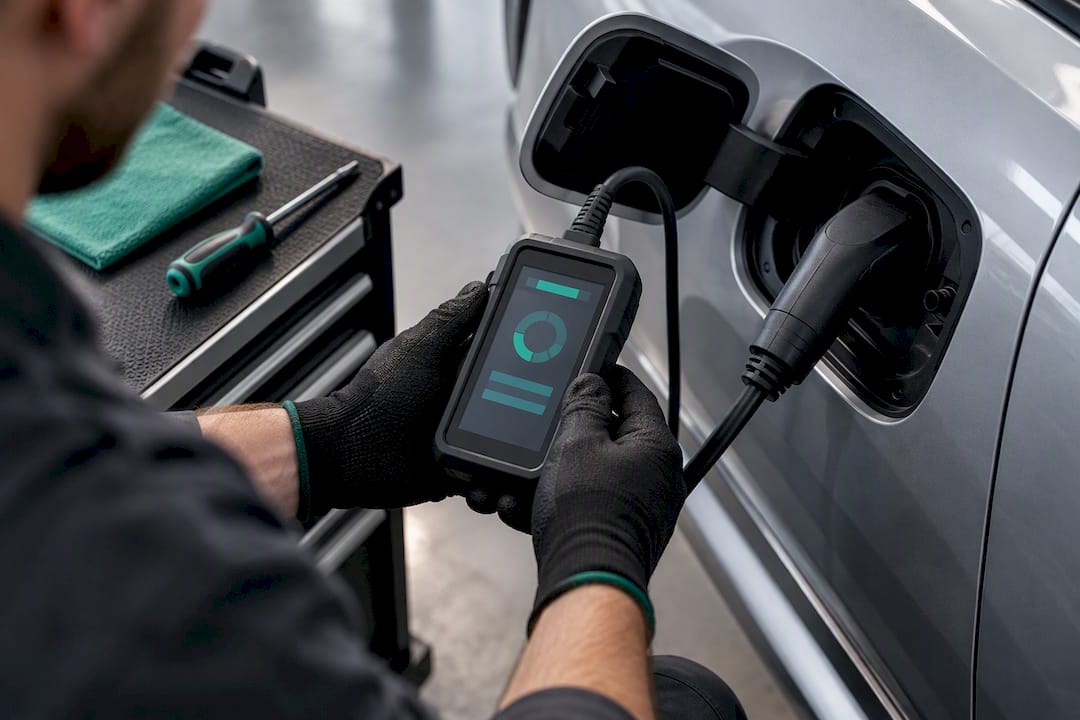
A battery SoH report is the single strongest piece of evidence you can attach to a used EV listing. It states the battery’s remaining capacity as a percentage of its original specification, tested against a manufacturer or third-party diagnostic tool rather than guessed from dashboard range estimates. Irish buyers have learned to ask for one, and a listing without it now reads as slightly evasive.
Getting the documentation right takes four steps:
- Book a diagnostic test before you list, not after an enquiry. Independent EV specialists and some dealer networks can run a SoH check in under an hour.
- Record the test date and provider name directly in the listing. “SoH 91%, tested by [provider], August 2026” carries far more weight than “battery in great condition.”
- Add charging history context. Note roughly how often the car was DC fast-charged versus charged overnight at home, since frequent rapid charging is one of the first questions technical buyers ask.
- Photograph the cables and adapters included in the sale. A missing Type 2 cable or CCS2 adapter is a common post-sale dispute, so settle it in the listing itself.
Sellers who commission a pre-sale battery check ahead of listing tend to see fewer aggressive negotiating tactics, because the buyer’s biggest unknown has already been answered. Ecosteer’s own battery health check resource walks through what a credible certificate should contain if you’re arranging one for the first time.
If you genuinely don’t have a SoH report, say so plainly: “No formal SoH report available; battery shows [X]% on dashboard estimate and I’m happy to facilitate an independent check.” That’s a far better line than silence, which buyers read as something to hide.
Pro Tip: Car Spot’s research found that a printed SoH figure, paired with a Cartell or Motorcheck provenance report, does more to firm up your asking price than almost any other single document you can attach to a listing.
What paperwork do you need before handing over the keys?
Getting the transfer right protects both sides and avoids the calls that come three weeks later when something’s missing.
- Complete the Vehicle Registration Certificate (VRC). Sign the change-of-ownership section with the buyer and notify motortax.ie within the required window, whether you’re a private seller or trading in stock.
- Have a current NCT on hand. A fresh NCT certificate is one of the most persuasive documents in a private sale, and if there are advisory notices rather than a fail, disclose them upfront rather than letting the buyer discover them at the test centre.
- For imported EVs, keep VRT paperwork visible. Attach the Revenue VRT receipt and, ideally, a Cartell or Motorcheck report confirming import history and mileage consistency.
- Bundle the supporting documents with the listing. NCT cert, full service history, the SoH report, and any remaining manufacturer battery warranty evidence should travel together, either as listing attachments or ready to hand over at viewing.
Buyers who see this paperwork assembled before they even ask tend to move faster to an offer, because the usual post-viewing hesitation, waiting for documents, chasing signatures, doesn’t happen.
How much is your EV actually worth right now?
Ireland’s used EV market has shifted meaningfully in the past two years, and pricing off last year’s comparables will cost you money either way. EVs now account for 24.1% of new private vehicles licensed in the first half of 2026, a sharp jump from where the market sat only a few years ago.
New private EV registrations rose 57% in August 2026 against August 2025, with EVs taking a 27% year-to-date share of new private cars for the January to August period.
That growth curve matters for used-car sellers because it means more informed buyers entering the market, not fewer. The SEAI purchase grant for new EVs wound down in mid-2024, which removed the artificial price anchor that used values had been chasing downward. Since 2025, used EV prices have settled rather than continued sliding, giving sellers a firmer footing to price against.
Certain listing features move the achievable price more than others:
- A documented SoH report, which buyers treat as close to a guarantee of battery condition.
- A wallbox included in the sale, particularly where SEAI’s home-charger grant hasn’t already been claimed.
- Full service history with no gaps, especially covering any high-voltage system checks.
Check live comparables on Irish marketplaces before you set an asking price, and if your car is better presented than the norm, meaning it has the SoH report, the full paperwork, and the charging kit intact, price into the upper end of that comparable band rather than defaulting to the average. Presentation, not just condition, is what buyers are actually paying for.
What insurance rules apply to EVs listed for sale in Ireland?
Every EV on Irish roads needs at least third-party motor insurance before it moves, exactly as with a petrol or diesel car; there’s no separate legal category for electric vehicles under Irish road traffic law. What changes is what insurers ask for during underwriting. Expect questions about battery capacity, whether the car has a home charging point, and where the vehicle is normally parked overnight, since off-street charging access tends to lower assessed risk.
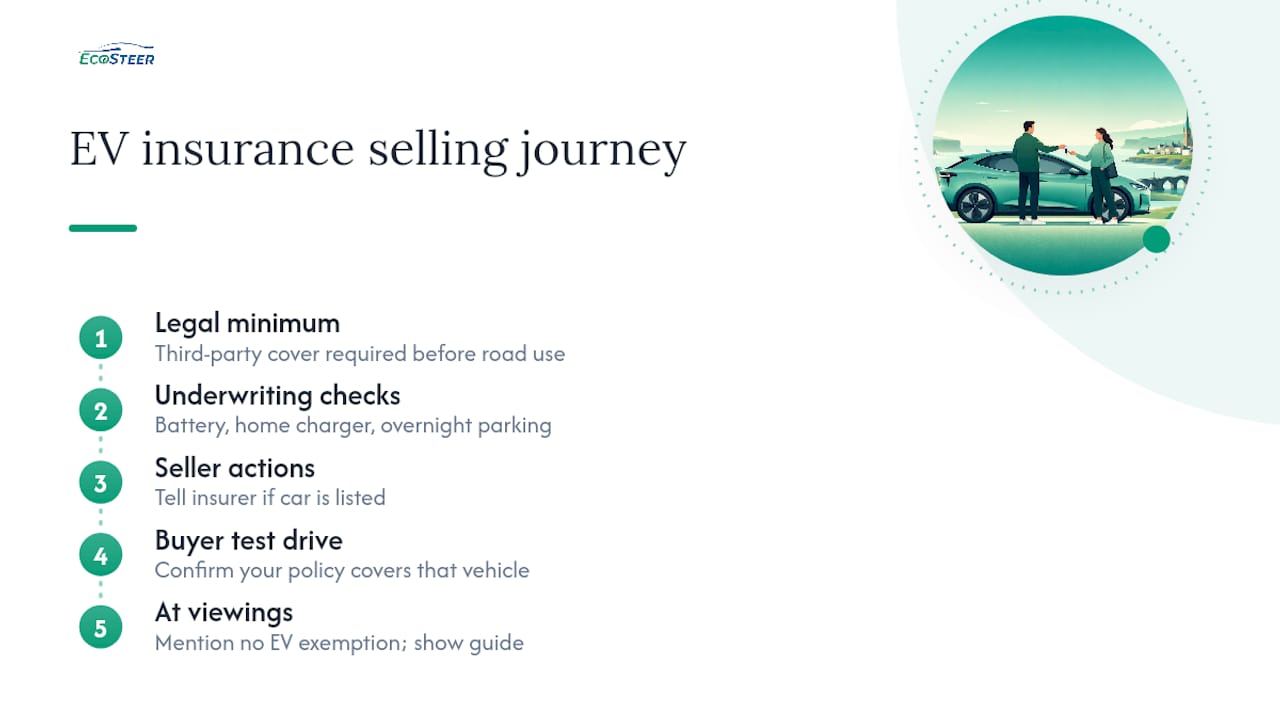
For dealers and private sellers, this matters at the point of sale, not before it. A buyer test-driving a used EV needs to confirm their own cover extends to that specific vehicle, and a seller keeping a car insured while it’s listed should tell their insurer it’s up for sale, since some policies restrict use once a vehicle is actively being marketed. None of this changes what you put in the listing itself, but it’s worth flagging to buyers who ask, since first-time EV buyers often assume electric cars carry some special exemption. They don’t.
If a buyer raises insurance questions during a viewing, pointing them toward a general guide on comparing car insurance routes in Ireland answers the question without derailing the sale conversation.
Why do EVs and petrol cars price differently for cover?
Underwriters weigh a handful of EV-specific factors that don’t apply, or apply differently, to combustion cars. Battery replacement cost sits at the top of that list: a full pack replacement runs into the thousands, and insurers price that risk into premiums even though outright battery failure remains rare within a normal ownership period.
Repair complexity is the second factor. EVs need technicians trained on high-voltage systems, and Ireland has fewer approved EV-certified body shops than conventional garages, which can push parts and labour costs higher after a collision. Specialist components, sensors integrated into bumpers for driver-assist systems, battery cooling lines built into the chassis, cost more to source and fit than equivalent petrol-car parts.
Working the other way, EVs often qualify for lower breakdown-related claims, since they have fewer moving parts to fail mechanically, no timing belts or exhaust systems to develop faults. Some insurers factor that reliability profile into pricing, though it rarely offsets the battery and repair-cost premium entirely. The net effect varies by model, by where the car is parked overnight, and by the driver’s own claims history, so quoting general percentage differences without a named source would be guesswork rather than fact.
Which providers cover EVs in Ireland, and what’s typically included?
Most Irish motor insurers now write policies for electric vehicles as standard, rather than treating them as a niche product requiring separate underwriting teams. Cover typically follows the same three tiers as combustion vehicles: third-party only, third-party fire and theft, and comprehensive, with comprehensive being the tier most EV owners choose given the value tied up in the battery pack.
What differs is what sits inside comprehensive cover. Some policies specifically include home wallbox charging equipment, either as a standard inclusion or a named add-on, since that hardware sits outside the vehicle but represents a real replacement cost if damaged or stolen. Charging cable cover, protection against damage to the cable itself or the socket during charging, appears on some policies but not all, so it’s worth checking rather than assuming.
Courtesy car provisions are worth checking too. Because EV repairs sometimes take longer, given fewer specialist body shops, confirming how long a replacement vehicle is provided during repair matters more for an EV than for a mainstream petrol model. None of this is unique to any single provider; it’s a feature-by-feature comparison worth doing directly with insurers rather than assuming standard terms carry across from a combustion policy.
Does battery replacement cost push up your premium?
Battery replacement cost is the single largest component pricing into EV premiums, and it’s worth understanding why. A battery pack represents a substantial share of a used EV’s total value, sometimes close to half on older models, and insurers calculate premiums against that replacement exposure rather than just the car’s overall market price.
This is exactly why a documented SoH report matters beyond the sale itself. A battery already showing wear, but with a verified state-of-health percentage, gives an insurer (and a future owner) a realistic baseline rather than an unknown risk. Cars with no diagnostic history force insurers toward more conservative, and often higher, premium assumptions, because they’re pricing against the worst plausible case.
Parts availability plays a role too. Newer EV models with limited numbers on Irish roads can face longer waits for specific battery modules or drive components, which insurers factor into repair-time and total-loss calculations. A well-established model with strong Irish dealer network support, versus a low-volume import, can price differently for exactly this reason. Sellers who can point to a manufacturer battery warranty still running, and a recent SoH check, are handing a future insurer, and a future buyer, real evidence rather than assumptions.
How much do driving habits and mileage change your quote?
Mileage and driving behaviour affect EV premiums the same way they affect any other vehicles, through exposure. More kilometres driven means more time on the road and statistically more opportunity for a claim, so annual mileage bands remain one of the standard questions on any EV insurance application in Ireland.
Where EVs diverge slightly is in usage pattern. A car doing mostly short urban commutes with regular home charging often profiles as lower risk than one doing frequent long motorway journeys reliant on public rapid charging, partly because motorway driving carries different accident-severity statistics generally. Telematics-based policies, which track real driving behaviour rather than relying purely on declared mileage, are becoming more available to EV owners in Ireland and can lower premiums for drivers with genuinely cautious habits.
For dealers advising a buyer at the point of sale, this is a useful conversation to have honestly. A buyer switching from a low-mileage petrol runaround to an EV they plan to use for a longer commute should expect their insurance costs to reflect that change in usage, not the fuel type itself. It’s exposure that drives price, not the badge on the boot.
What happens when you need to make an EV insurance claim?
Filing a claim on an EV follows the same basic process as any motor policy: report the incident to your insurer promptly, provide the policy number, registration, and a description of what happened, and cooperate with any assessor sent to inspect the vehicle. Where it diverges from a combustion car claim is in the assessment stage.
Battery damage assessment often takes longer than mechanical damage assessment on a petrol car, because insurers typically require a specialist inspection to confirm whether the battery pack itself needs replacement or whether damage is limited to bodywork and cosmetic components. This can extend claim timelines, particularly after any incident involving impact near the underbody or wheel arches, where battery housings sit on most EV platforms.
Approved repairer networks matter more here than with conventional cars. Because EV-certified body shops remain less numerous across Ireland than general garages, your insurer may direct you to a specific approved repairer rather than letting you choose freely, particularly for anything involving the high-voltage system. Confirming your policy’s approved repairer list before you ever need it, rather than during a stressful claim, is worth the ten minutes it takes.
Ecosteer’s practical view from marketplace data and dealer feedback
The pattern is consistent: listings that skip battery SoH and charging specs lose the most enquiries, not the ones with a slightly higher asking price. Buyers researching used EVs have already read enough to know what questions matter, and a listing that dodges them looks evasive rather than simply incomplete.
Ecosteer’s own EV charging guide and battery-check resources exist because sellers kept asking the same question: what actually convinces a buyer to enquire rather than scroll past? The answer, from what we see across Irish EV listings, is unglamorous but consistent. Put the SoH figure and full charging specs at the top of every EV listing, before the description, before the price. That single change moves more enquiries than any amount of polished copywriting.
— ibrahim
List your EV where Irish buyers are actually looking
Some car marketplaces have listing fields built around WLTP range, kWh, AC/DC charge speeds, connector type, and space to attach or reference your battery SoH report, so you’re not fighting a generic car-listing template to show buyers what they actually need to see. Dealers benefit from consistent structured fields across every EV in their stock, which matters when listing many cars.
If you’re a dealer weighing up where to list, Ecosteer’s dealer page covers how onboarding works. Private sellers and dealers alike can go straight to Ecosteer’s cars section and publish a listing today. Try one EV listing with the full technical fields filled in, SoH included, and compare the enquiry quality against whatever you’ve used before. Charging equipment questions come up often enough that it’s worth a browse through Swift Charging’s blog too, particularly if you’re fielding buyer questions about wallbox installation you can’t yet answer confidently.
Sources
For ongoing market context, the CSO’s vehicle licensing statistics track EV fleet growth, SIMI covers industry commentary for dealers, and Ecosteer’s EV grants guide explains current SEAI support.
- Composition of Ireland’s vehicle fleet 2026 — CSO
- How to sell electric cars as a dealer in Ireland — Car Spot
- Carwow
FAQ
Does an EV listing need different insurance disclosure than a petrol car?
No separate legal category exists for EVs under Irish motor insurance law, but insurers do ask about battery capacity, charging location, and parking arrangements during underwriting. Sellers don’t need to disclose this in the listing itself, only buyers arranging their own cover need to raise it with their insurer.
What’s the single most important document to attach to an EV listing?
A battery state-of-health (SoH) report is the document buyers trust most, since it gives a verified percentage figure rather than a dashboard estimate. Pairing it with a current NCT and full service history covers the three documents Irish buyers ask for most often.
Why do EV insurance quotes sometimes come in higher than petrol equivalents?
Battery replacement cost and specialist repair requirements are the main drivers, since EV parts and EV-certified body shops remain less widely available across Ireland than conventional equivalents. This varies significantly by model and by the driver’s own mileage and claims history, so it isn’t a fixed rule across every EV.
Can I list an EV on Ecosteer without a battery SoH report?
Yes, though listings with a SoH report and date included tend to draw stronger, faster enquiries based on the fields buyers search for. You can state honestly that no report is available yet and offer to arrange one, which Ecosteer’s battery health check resource explains in more detail.
How has the SEAI grant change affected used EV pricing?
The purchase grant for new EVs wound down in mid-2024, which removed the price anchor that had been pulling used EV values downward. Since 2025, used prices have stabilised rather than continued falling, giving sellers firmer ground for setting an asking price.
Recommended
Ecosteer Editorial
Author