€1,000 Gap: Irish County Car Prices Can Change Your Offer
Compare Irish county asking prices, see where Dublin, Wicklow, Galway, Cork, Mayo, and Donegal tend to sit, and use a 3% to 7% buffer when negotiating.

The current used-car market sits broadly in the €19,500 to €21,500 band, so a county gap at that scale can mean a real difference of €1,000 or more. The practical move is simple: filter by county before you judge a price, and build in a negotiation buffer of 3 to 7% on dealer deals.
TL;DR:
- Dublin and Wicklow usually price above the national median, while Mayo and Donegal trend lower; smaller county samples can swing when unusual listings appear.
- A county premium of 8% to 10% can lift a €15,000 hatchback to €16,300 to €16,500, but year, mileage, and trim matter more.
- Compare three or four listings with matching year, mileage, and trim before blaming county location; those details can move prices more than county alone.
- Private sellers typically settle 2% to 4% below asking, so value a car against comparable local listings rather than treating its listed price as final.
- A neighboring county’s 10% lower asking prices may justify a trip only after fuel, time, and inspection costs are deducted from the savings.
Table of Contents
- National snapshot: where the Irish car market stands in 2026
- How to read county-level price data and common county patterns
- Typical price bands by vehicle segment and how counties shift them
- Drivers of county differences: supply, demand and fuel mix
- How to use county pricing data when buying or selling
- EcoSteer evidence and tools that back this guidance
- Historical trends and seasonal variations in car prices by county
- Impact of local factors on car prices: demographics, income and rural versus urban
- Publisher perspective: when county shopping actually pays off
- Search county listings and verified dealers with EcoSteer
- FAQ
- Sources
National snapshot: where the Irish car market stands in 2026
Ireland’s used-car market in early 2026 centres on an average asking price generally in the range of typical mid-tier values, with segment and condition driving most of the spread around that midpoint. City cars and older diesels sit at the bottom of that range, while nearly new SUVs and premium saloons push well above it.
Dealer-verified listings show segment medians and days-to-sell vary widely, according to the Autoza Irish Used Car Index for Q2 2026, which draws on 18,400 verified-dealer listings taken on 1 May 2026. This kind of snapshot matters because asking prices are not transaction prices. Dealers and private sellers alike expect to settle below their listed figure, and days-to-sell figures confirm that cars priced close to their segment’s realistic median move faster than those left sitting above it.
Keep that distinction in mind as you read county figures elsewhere in this guide: every number quoted is an asking price, not a confirmed sale.
How to read county-level price data and common county patterns
The Autoza Q2 2026 dataset tracks this deviation for counties including Dublin, Wicklow, Galway, Cork, Limerick, Donegal and Mayo, giving a consistent basis for comparison.
A few patterns recur across quarters:
- Dublin and Wicklow tend to sit above the national median, reflecting higher incomes, denser dealer networks and stronger demand for nearly new stock.
- Galway, Cork and Limerick typically track close to the national median, varying mainly by segment rather than by a consistent county premium.
- Mayo and Donegal more often run below the median, a pattern tied to lower dealer density and a different mix of older, higher-mileage vehicles in local listings.
Treat any single county figure with some caution. Smaller counties generate fewer listings, so a handful of unusual cars (a rare low-mileage import, or a batch of ex-fleet returns) can shift the local average more than it would in a high-volume county like Dublin. The same dataset applies a 3-sigma outlier filter for this reason, and it is worth doing the same informally: ignore the cheapest and dearest listings in a county before drawing conclusions from the rest.
Typical price bands by vehicle segment and how counties shift them
Segment matters more than county for most buyers, so it helps to start with rough national bands before layering a county adjustment on top.
- City cars (Up to 1.2L, older models): roughly €6,000 to €11,000.
- Small family hatchbacks (2017 to 2021): roughly €12,000 to €18,000.
- Family SUVs (2018 to 2022): roughly €20,000 to €30,000.
- Premium saloons (executive brands, 2019 onwards): roughly €28,000 to €45,000.
- Used EVs (2019 to 2022): roughly €18,000 to €27,000.
- Light commercials (vans, 2017 to 2021): roughly €14,000 to €22,000.
A county running 8 to 10% above the national median, per the Autoza Q2 2026 index, can push a €15,000 family hatch toward €16,300 to €16,500 for an identical spec, while a county running below the median might bring the same car closer to €13,800. Always compare like-for-like: year, mileage and trim level move a price far more than county alone, so line up three or four comparable listings before treating a gap as a genuine county effect.
Drivers of county differences: supply, demand and fuel mix
County price gaps usually trace back to a handful of structural causes. Dealer density is one: counties with more forecourts see more competitive pricing and faster turnover, while thinner markets can hold prices either higher (less competition) or lower (older average stock). Import patterns and fleet returns play a role too, since counties that absorb more ex-lease or ex-fleet vehicles often see a short-term dip in local medians.
Demand factors matter just as much. Higher average incomes and longer commuting distances push up demand for newer, larger cars in counties like Dublin and Wicklow. Fuel mix adds another layer: counties with higher EV registrations, tracked in CSO vehicle licensing data, tend to have a deeper used-EV market and more competitive used-EV pricing, while counties with lower EV uptake see thinner choice and less price pressure. Seasonal fleet disposals can distort any county’s figures for a month or two, so a single quarter’s snapshot is a guide, not a guarantee.

How to use county pricing data when buying or selling
Turning county statistics into a result takes a short, repeatable process.
- Filter by county first, then narrow by year, mileage, trim and fuel type so you are comparing truly similar cars.
- Check the national segment band for your car type, then see whether your county is running above or below it.
- Apply a negotiation buffer: dealer transactions typically settle 3 to 7% below asking, and private sales 2 to 4% below, according to EcoSteer’s guidance on negotiating car prices in Ireland.
- Weigh travel against savings: if a neighbouring county’s listings run 10% cheaper, work out whether that gap still covers fuel, time and any inspection costs before committing to the trip.
- Build a short checklist before you buy or list: confirm NCT status, service history, mileage consistency and photos against the asking price, whichever side of the deal you are on.
Pro Tip: Screenshot three comparable listings from your own county and one neighbouring county before you negotiate. A dealer takes a documented comparison far more seriously than a verbal estimate.
EcoSteer evidence and tools that back this guidance
This guide draws on the Autoza Irish Used Car Index for Q2 2026, the CSO’s TEA26 vehicle dataset and our own analysis of price tiers and best-selling models. For a deeper breakdown of price bands under €15,000, our piece on used car prices in Ireland works through specific examples, and our roundup of the best-selling cars in Ireland shows which models turn up most often in county listings. Our find a car dealer tool lets you check verified dealers by county.
Historical trends and seasonal variations in car prices by county
Used car prices in Ireland have softened since the sharper highs of 2023, and that trend has not landed evenly across counties. Dublin and other high-demand areas have held their premium better than smaller rural counties, where asking prices have drifted down more noticeably as older stock accumulates on forecourts for longer.
Seasonality adds a predictable rhythm on top of that longer trend. Demand typically firms up in the first quarter as households replace cars ahead of the new registration plate change, which can tighten prices temporarily in counties with strong new-car sales feeding the used market. Late summer and early autumn tend to bring softer asking prices generally, partly because fewer buyers are shopping and partly because dealers clear ageing stock before the next plate change cycle begins.
Fleet and lease return cycles create their own local bumps. A county that absorbs a large batch of ex-fleet vehicles in a given quarter can see its median asking price dip for a few months until that stock clears, even if the underlying demand in that county has not changed. This is one reason a single quarter’s county figure should be read alongside the trend over two or three quarters rather than taken in isolation, and it is why the Q2 2026 snapshot we have referenced throughout this guide is best treated as a point-in-time read rather than a fixed rule for the rest of the year.
Impact of local factors on car prices: demographics, income and rural versus urban
Local demographics shape what a county’s second-hand market looks like far more than most buyers expect. Counties with younger, higher-earning populations and longer average commutes, Dublin and Wicklow among them, tend to support stronger demand for newer, larger cars, which keeps asking prices firmer across most segments. Counties with older populations or a higher share of retirees often show more low-mileage cars entering the market, which can soften prices even where overall demand is steady.
Urban and rural settings differ in a more structural way too. Urban counties concentrate dealer forecourts, which increases competition and choice but also keeps prices tethered close to the national median because buyers can easily compare listings across several dealers within a short drive. Rural counties often have a thinner dealer presence, so prices can swing further in either direction: lower where private sales dominate and sellers are motivated to move a car quickly, or higher where choice is limited and a buyer has fewer nearby alternatives.
Income levels feed into vehicle type as much as price. Higher-income counties tend to show a heavier mix of SUVs, premium saloons and newer EVs, which lifts the local average simply through vehicle mix rather than through every segment costing more. When you compare counties, it helps to separate “this county’s cars cost more” from “this county has more expensive cars for sale,” since the second is a mix effect rather than a true county premium.

Publisher perspective: when county shopping actually pays off
County shopping earns its keep when the price gap clearly exceeds typical travel time and fuel costs, usually when there is a noticeable price difference on a like-for-like car. Below that, you are usually better off negotiating locally with a documented comparison in hand. Our one-line advice: buyers should check three counties before committing, sellers should price against their own county’s median, not a neighbouring one.
Search county listings and verified dealers with EcoSteer
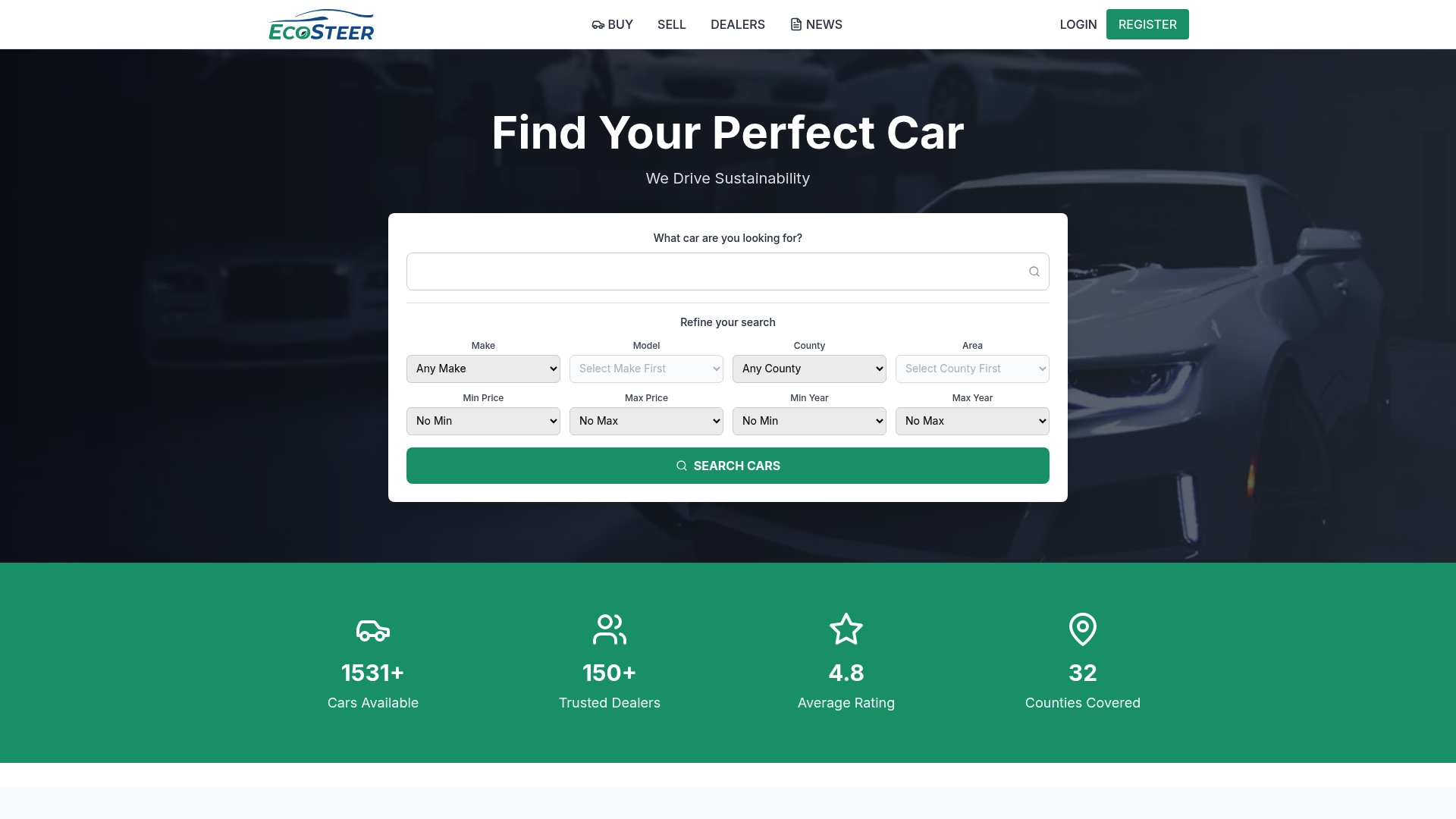
Once you know what a fair county price looks like, acting on it should not mean trawling dozens of tabs. We built county pages so you can jump straight to cars for sale in Dublin or any other county, compare specs side by side and skip listings that do not match your filters. Verified dealer profiles mean you can check who you are dealing with before you ever pick up the phone, and our find a car dealer tool narrows that search to your own county or the one next door.
| What you want to do | Where to go on EcoSteer |
|---|---|
| Browse all county listings nationally | Cars for sale in Ireland |
| Search Dublin specifically | Cars for sale in Dublin |
| Search Kildare specifically | Cars for sale in Kildare |
| Find a verified dealer near you | Find a car dealer in Ireland |
- County filters narrow results by price, year, mileage, transmission, body type and fuel type in one pass.
- Verified-dealer badges flag sellers you can contact with confidence before you travel.
- Location pages cover counties from Carlow to Dublin, so you can compare your own county against a neighbour in minutes.
If you are ready to put this guide into practice, start with your own county’s listings on our main cars page and compare against one neighbouring county before you make an offer.
FAQ
Which car is the cheapest to buy in Ireland?
City cars sit at the bottom of the market, typically in the €6,000 to €11,000 range nationally. Prices within that band still shift by county and by mileage, so always compare similar-spec listings before assuming one car is genuinely the cheapest available.
How can I work out the market value of my car in Ireland?
The most reliable method is comparing your car against several live listings of the same year, mileage and trim in your own county, then checking the national segment band for context. Remember that asking prices typically settle 3 to 7% lower in a dealer sale and 2 to 4% lower in a private sale once negotiation is factored in, as outlined in EcoSteer’s guide to negotiating car prices.
What is the worst month to buy a car in Ireland?
Demand tends to firm up just before the new registration plate change, which can push asking prices higher in the weeks around that period. Shopping in the quieter months after the plate change, typically late summer into autumn, generally gives buyers more room to negotiate.
What are the car tax bands in Ireland for 2026?
Motor tax in Ireland is set by either CO2 emissions band or engine size, depending on when the car was first registered, with rates published and updated by the Department of Transport rather than fixed indefinitely. Check the current official rates for your car’s registration date before budgeting, since the applicable band depends on your specific vehicle.
Sources
- Autoza Irish Used Car Index — Q2 2026 (publication record)
- Autoza/irish-used-car-index-q2-2026 · Datasets at Hugging Face
Recommended
Ecosteer Editorial
Author