Volkswagen ID.4 in Ireland 2026: What It Really Costs Once the Grants Are In
The ID.4 has been Ireland's best-selling EV three years running. Here is the honest Irish arithmetic - what the SEAI grant and VRT relief actually take off the price, real-world range on Irish roads, EUR 120 motor tax, five-year cost per kilometre, and the one software check that changes what a used one is worth.
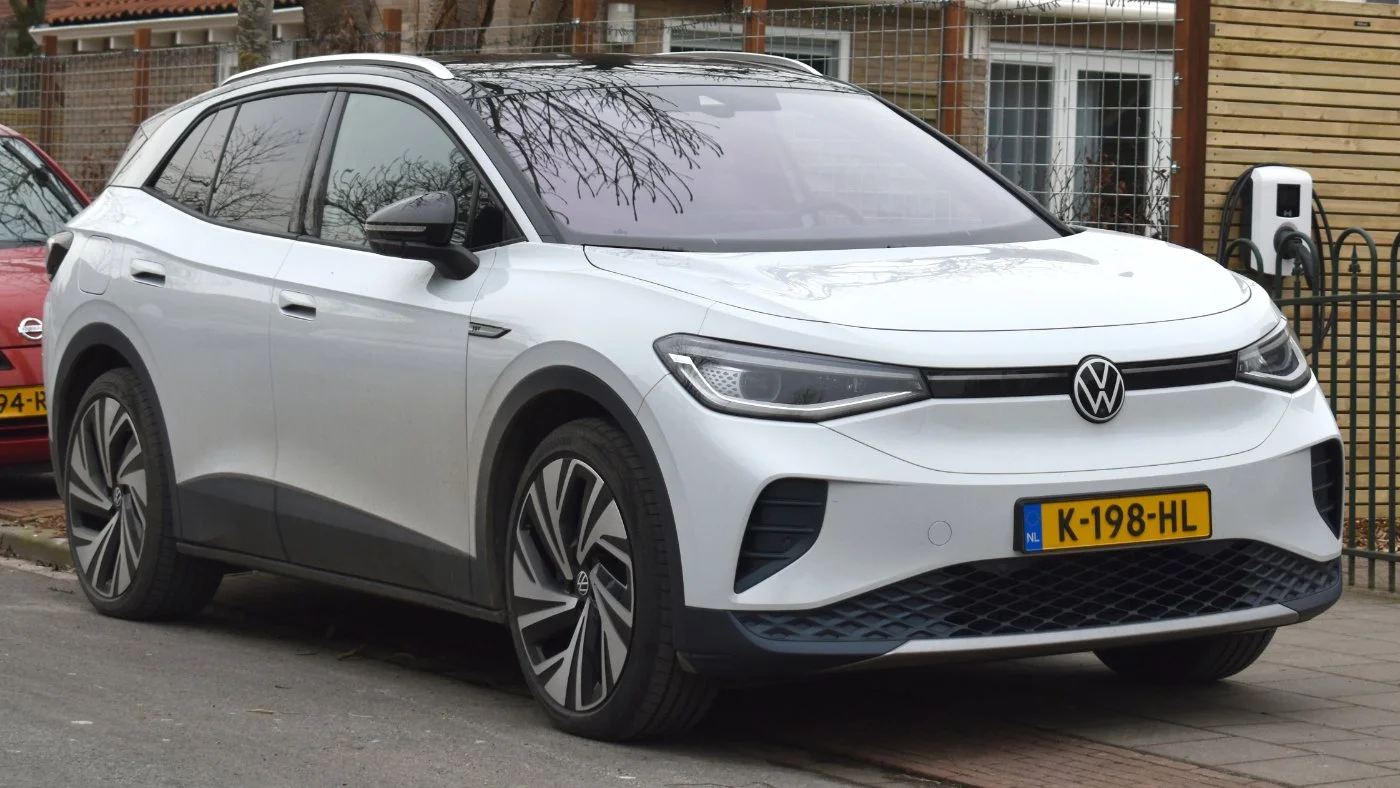
Volkswagen ID.4 Pro. Photo: Dennis Elzinga, CC BY-SA 4.0.
The Volkswagen ID.4 has been Ireland's best-selling electric car for three years running. Not the most exciting EV on sale, not the fastest-charging, and not the one that wins internet arguments. It sells because when something beeps unexpectedly on a wet Tuesday in Roscommon, there is a Volkswagen dealer within reach.
That is a bigger factor in Irish EV buying than any spec sheet admits. Here is the honest arithmetic on what one actually costs to buy and run here.
What the grants really take off the price
Irish EV pricing is confusing because the number on the windscreen is not the number you pay. Two separate supports apply:
- SEAI EV Purchase Grant - up to EUR 3,500 on new battery-electric cars under EUR 60,000 OMV. Dealers apply it at the point of sale, so you never handle the paperwork.
- VRT relief - up to EUR 5,000 off Vehicle Registration Tax. Full relief applies at the lower end of the range and tapers above EUR 40,000 OMV, which is why the fast versions look disproportionately expensive.
- SEAI Home Charger Grant - up to EUR 600 towards a home wallbox. Separate application, worth doing.
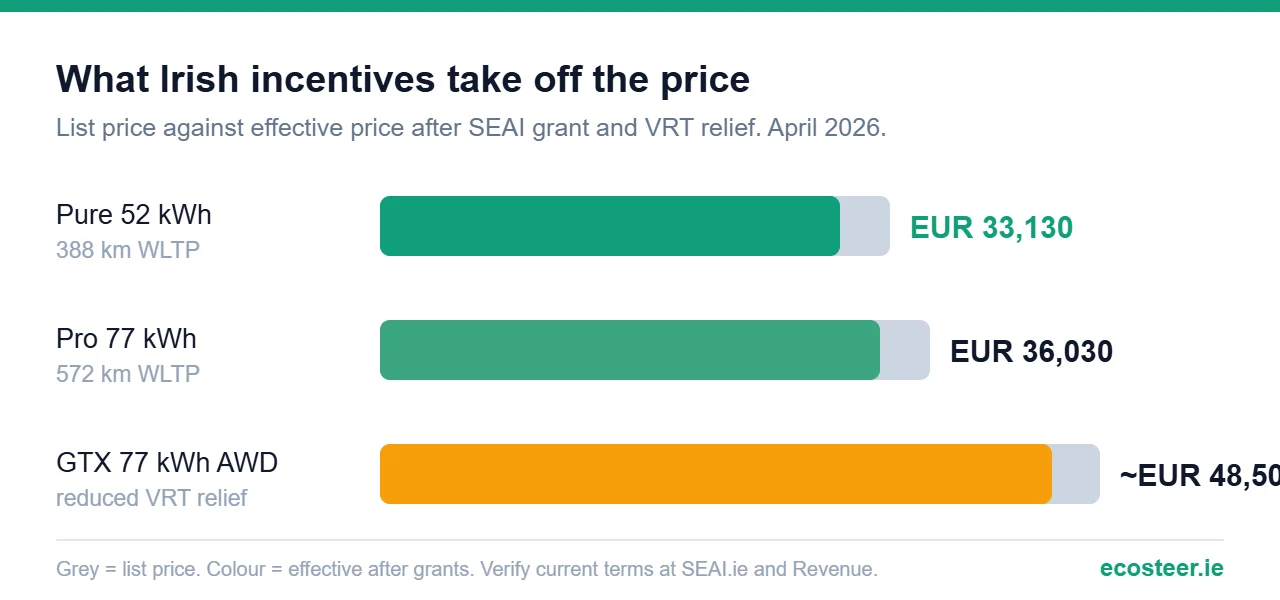
The practical read: the mid-range Pro is the version the incentives were designed for. Once you climb past EUR 40,000 the VRT taper quietly removes a chunk of the benefit, and the performance versions stop making financial sense unless performance is genuinely the point.
Range: the brochure figure and the Irish figure
| Version | Battery | WLTP range | Real-world | DC charging |
|---|---|---|---|---|
| Pure | 52 kWh | 388 km | ~320 km | 135 kW |
| Pro | 77 kWh | 572 km | ~445 km | 175 kW |
| GTX AWD | 77 kWh | ~480 km | ~370 km | 175 kW |
445 km of real range covers Dublin to Kerry, Galway or Donegal without planning your life around a charger. 320 km does not, quite - it works if your driving is genuinely local and you charge at home.
Winter matters here. Without a heat pump, expect to lose 30% or more of your range below 5 degrees. With one, the loss narrows to 20-25%. On a Pro that is the difference between roughly 310 km and 360 km in January. The heat pump is an option, not standard equipment, and it is one of the few boxes genuinely worth ticking in an Irish climate.
Running costs
Motor tax is EUR 120 a year - the flat rate every battery-electric car pays, regardless of size or power. A petrol family SUV of similar size sits at EUR 280 or above.
Annual cost at 20,000km (Pro 77 kWh)
| Item | Cost |
|---|---|
| Home charging (85% of miles, night rate) | ~EUR 420 |
| Public DC charging (15%) | ~EUR 140 |
| Motor tax | EUR 120 |
| Insurance | EUR 750-1,300 |
| Servicing | EUR 280-380 |
| Total excluding depreciation and finance | ~EUR 1,710-2,360 |
The split matters more than the total. Charging at home on a night rate is where the savings live; if you cannot charge at home, an EV's running-cost advantage shrinks considerably. Be honest with yourself about that before you buy.
The used-buying check that changes the price
If you are buying a used ID.4, one thing outweighs everything else on the checklist: the 2024 over-the-air software update.
Before it, the 77 kWh car charged at 135 kW on a fast charger. After it, 175 kW. On a motorway stop that is roughly 36 minutes versus 28 for a 10-80% top-up, every time, for the life of the car. The same update fixed the sluggish infotainment that generated most of the early complaints.
The used market has priced this in. A post-update car holds around 5 percentage points more of its value at three years than a pre-update one. Verify the software version on the dashboard or ask a VW dealer - do not take a seller's word for it.
The rest of the checklist
- Battery state of health - a VW dealer can test it. Expect 90% or better at 100,000km on the 77 kWh car.
- Heat pump fitted? Hard to spot visually. Ask for the original spec sheet or run a VIN check.
- Door handle recall completed on early 2021-2022 cars.
- 12V battery age - the small conventional battery, not the traction pack. Weakens around year four and throws a cascade of alarming warnings that a EUR 120-180 replacement clears.
- VW dealer service stamps for warranty validity.
- Tyre tread and age. These cars weigh around two tonnes and eat tyres faster than the equivalent petrol car.
Living with it: the honest complaints
- Touch-sensitive sliders for temperature and volume instead of physical knobs. In cold or wet hands they are genuinely irritating. This is the single most common owner complaint.
- No front boot. The area under the bonnet is full of charging electronics. The 543-litre main boot is generous, but there is no extra storage up front.
- Charging speed is good rather than class-leading. Cars built on 800-volt architecture charge meaningfully faster on the fastest stations - though they also cost several thousand euro more.
- Brake corrosion. Regenerative braking does most of the work, so the discs get little use and can rust. Worth a look at any inspection.
Which one to buy
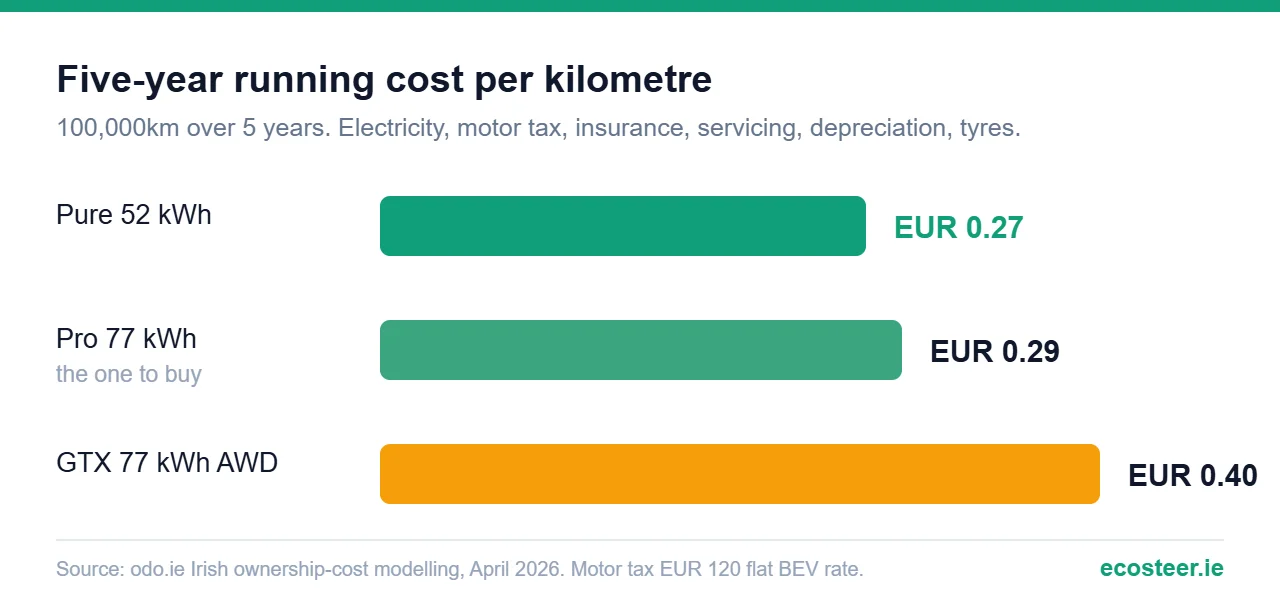
Buy the Pro 77 kWh, with the heat pump, on post-2024 software. It takes the full grant treatment, gives you 445 km of usable range, and settles at roughly EUR 0.29 per kilometre over five years.
Skip the Pure unless your driving is genuinely short-range and home-charged. It saves under EUR 3,000 and costs you around 125 km of real range - a poor trade for most buyers.
Skip the GTX unless you want the performance for its own sake. Above the EUR 40,000 threshold the incentives thin out and the five-year cost rises sharply.
NCT notes
EVs pass the NCT easily - far fewer moving parts. Two model-specific watch items: tyre wear from the weight, and brake discs that may be corroded from underuse. The engine warning light is still an automatic fail under Phase 2, so run an OBD scan first. The Road Safety Authority and NCTS publish the full criteria; motor tax for any registration can be checked at motortax.ie, and grant terms at SEAI.ie.
The verdict
The ID.4 is not the EV enthusiasts argue about. It is the one that makes sense for a family in Athlone or Cork who want to stop buying petrol without gambling on a brand with three service points in the country.
Real range that handles Irish distances, EUR 120 motor tax, the strongest residuals of any EV here, and a dealer in every county. Buy the Pro, tick the heat pump, check the software version, and it will be an unremarkable car to own - which for most people is the entire point.
Buying? Browse Volkswagen listings on Ecosteer.
Selling? Place your ad on Ecosteer - free for cars under EUR 3,000, ultra-low fees above that.
Dealers: Join the Ecosteer dealer network or call +353 87 170 8603.
Sources: SIMI new car registration data 2023-2026; Irish ownership-cost data Volkswagen ID.4 Ireland guide, April 2026; SEAI published grant terms; Revenue VRT relief schedule; Volkswagen Ireland published specifications; Euro NCAP. Lead photo by Dennis Elzinga, licensed CC BY-SA 4.0 via Wikimedia Commons. Figures are general guidance - verify current grant eligibility at SEAI.ie, motor tax at motortax.ie, and pricing with Volkswagen Ireland before purchase. Ecosteer Mobility Limited is not affiliated with Volkswagen Ireland. This article is information, not financial advice.
Tags
Primary Admin
Author