Nissan Juke Ireland (2019-2026): Prices, Motor Tax and Buyer's Guide
A data-backed Irish buyer guide to the second-generation Nissan Juke: Nissan Ireland prices and WLTP CO2, motor tax worked out from the Department of Transport schedule, the reliability record, and the checks that separate a good Juke from an expensive one.

The Nissan Juke is one of the small crossovers Irish buyers keep coming back to, and the second-generation car - on sale here since 2020 - is now deep enough into the used market that there is real choice at every budget. It is also a model where the annual motor tax bill can swing by more than a hundred euro depending on nothing more than the year on the plate.
This guide pulls together the figures that actually decide whether a Juke is a good buy in Ireland: Nissan Ireland's own WLTP data, the Department of Transport tax schedule, and the reliability record independent testers have logged. Every number below is sourced, and the sources are listed at the end.
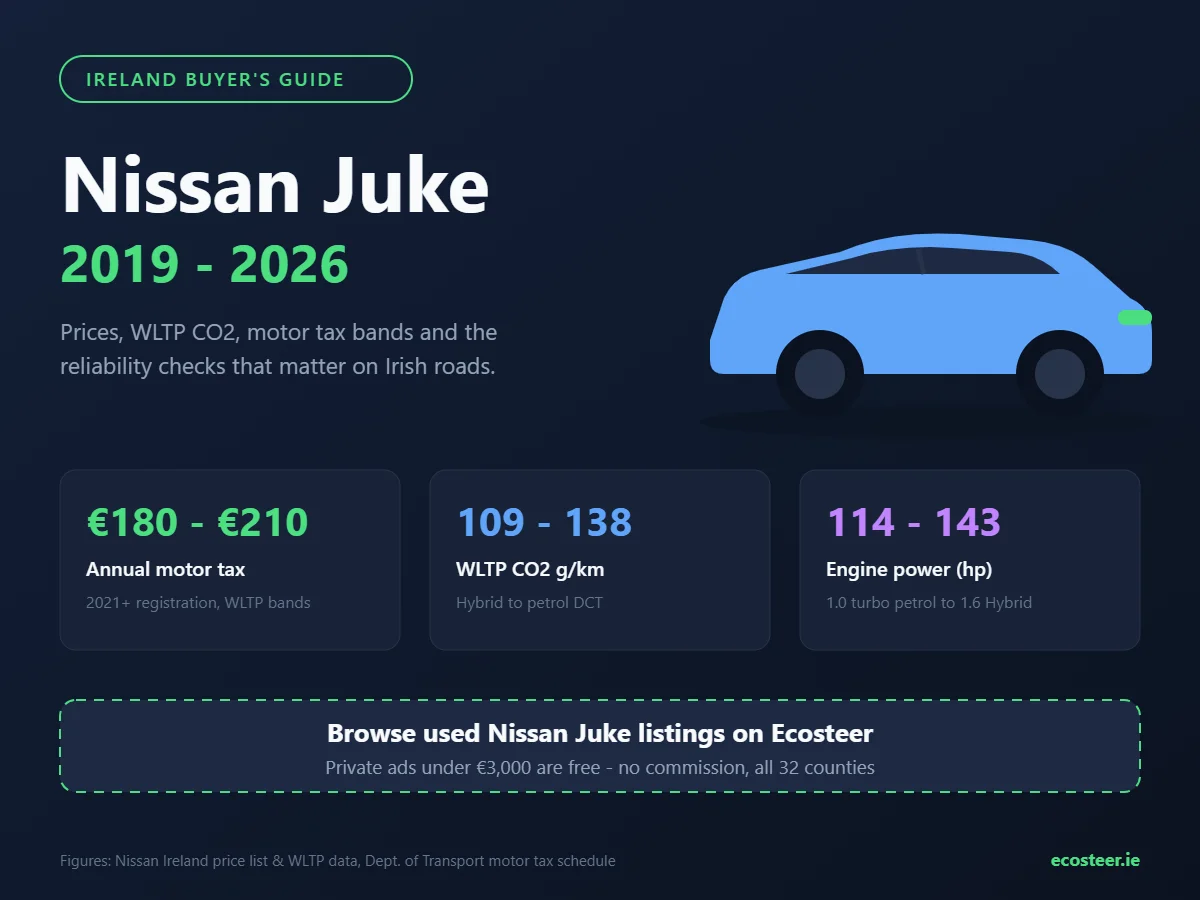
Nissan Juke in Ireland: model overview
The current Juke is a five-door, five-seat small SUV built on the Renault-Nissan CMF-B platform. Nissan Ireland currently lists it from €30,900, with four grades: SV from €31,400, SV Premium from €32,400, N-Design from €34,400 and SVE from €35,400. Two powertrains are offered - a 1.0-litre turbo petrol and a 1.6-litre full hybrid - and the published WLTP range across the line runs from 109 to 138 g/km of CO2, with power between 114 and 143 hp.
Practicality improved sharply over the first-generation car. CompleteCar.ie measured 354 litres of boot space in the Hybrid, rising to 1,237 litres with the rear seats folded; the petrol versions carry 68 litres more because they do not have to package a battery. Braked towing capacity is 750kg.
Nissan Juke engine options and specifications
| Specification | 1.0 DIG-T Petrol | 1.6 Hybrid |
|---|---|---|
| Engine | 999cc, 3-cylinder turbo | 1,598cc 4-cylinder + electric motor |
| Maximum power | 114 hp (84 kW) | 143 hp (105 kW) system output |
| Torque | 200 Nm at 3,000 rpm | 148 Nm petrol / 205 Nm electric |
| Transmission | Manual or 7-speed DCT automatic | Hybrid automatic |
| 0-100 km/h | 10.7 - 11.8 seconds | 10.1 seconds |
| Top speed | 180 km/h | 166 km/h |
| Emissions standard | Euro 6D Full | Euro 6D Full |
| Drivetrain | Front-wheel drive | Front-wheel drive |
Nissan quotes a combined 6.1 l/100km and 138 g/km for the N-Connecta petrol DCT, against 4.8 l/100km and 109 g/km for the equivalent Hybrid. CompleteCar.ie recorded roughly 6.0 l/100km in real-world testing of the Hybrid, which is in the region of the official claim rather than far adrift of it - a reasonable expectation to carry into a test drive.
Nissan Juke pros for Irish buyers
- Low tax on the Hybrid. At 109 g/km the Hybrid sits in Band A5, which is €180 a year - competitive for a car of this size and power.
- Genuinely useful electric assistance in town. Nissan states the Hybrid can run on electric power at up to 55 km/h when there is charge available, which suits Irish commuting and school runs.
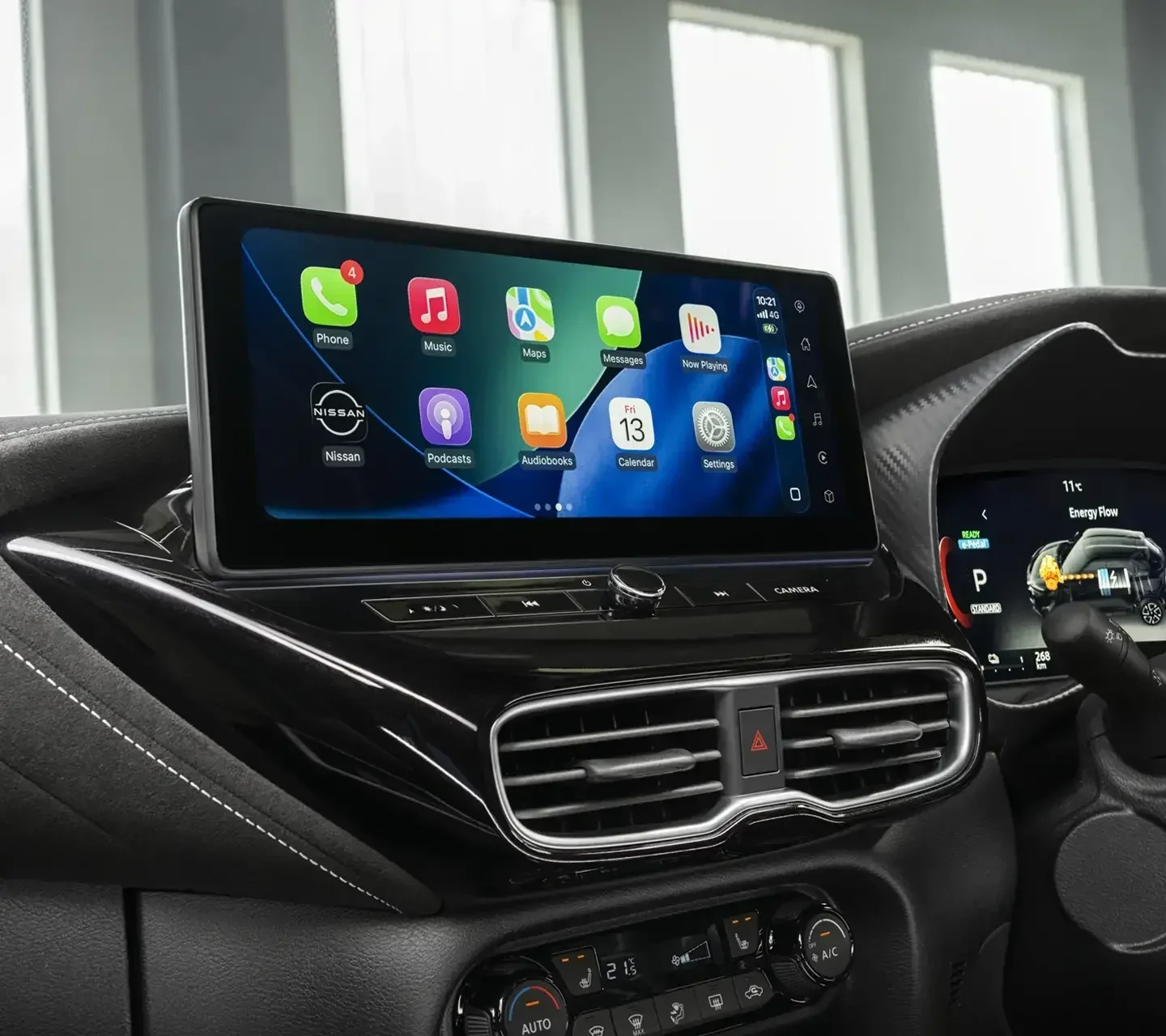
- Strong equipment from mid-grade upwards. SV Premium and above bring privacy glass, a 12.3-inch display, wireless phone charging and keyless entry as standard.
- The DCT replaced the CVT. Later automatics use a seven-speed dual-clutch unit rather than the continuously variable transmission fitted to Nissan's earlier small cars.
- Wide dealer coverage. Nissan has an established franchised network across the country, which matters for warranty work and recall checks.
Nissan Juke cons to weigh up
- A poor independent reliability record. What Car? placed this generation of Juke 38th out of 38 cars in its small SUV class with a score of 55.2 per cent, and ranked Nissan 29th of 30 manufacturers overall.
- Hybrid boot penalty. The battery costs 68 litres of luggage space against the petrol car.
- Rear visibility and cabin light. The small rear side windows still make the back seats feel enclosed, a trait carried over from the original Juke.
- Average warranty. Cover is three years or 60,000 miles from new - shorter than the five-year cover offered by some rivals and well short of Kia's seven years.
- Motorway refinement. The hybrid powertrain is audible under load, and this is a car tuned more for town than for long N-road runs.
Nissan Juke motor tax in Ireland: work it out from the CO2
Irish motor tax is set by the vehicle's CO2 figure and by the date of its first registration - including registration abroad, for imports. Cars first registered from 1 January 2021 use the WLTP schedule; cars first registered between July 2008 and December 2020 use the older schedule. The rates below are from the Department of Transport's published table.
| CO2 (g/km) | Band (2021 onwards) | Annual tax, 2021+ reg | Annual tax, 2008-2020 reg |
|---|---|---|---|
| 91 - 100 | A4 | €170 | €180 |
| 101 - 110 | A5 | €180 | €190 |
| 111 - 120 | A6 | €190 | €200 |
| 121 - 130 | B1 | €200 | €270 |
| 131 - 140 | B2 | €210 | €280 |
| 141 - 150 | C1 | €270 | €400 |
Applied to the Juke: the 109 g/km Hybrid is €180 a year, and the 138 g/km petrol DCT is €210 a year - provided the car was first registered in 2021 or later. An identical 138 g/km car first registered in 2020 is charged €280 instead. On a 121-130 g/km car the gap is even wider, €200 against €270. This is the single most common place where two apparently identical used Jukes turn out to cost different amounts to run, and it is worth checking before you agree a price.
CompleteCar.ie lists the 2023 Juke Hybrid it tested at 112 g/km with €190 annual tax, which is consistent with the schedule above - 112 g/km falls into Band A6. Always confirm the CO2 figure printed on the vehicle registration certificate for the specific car, and check the reg on motortax.ie before committing.
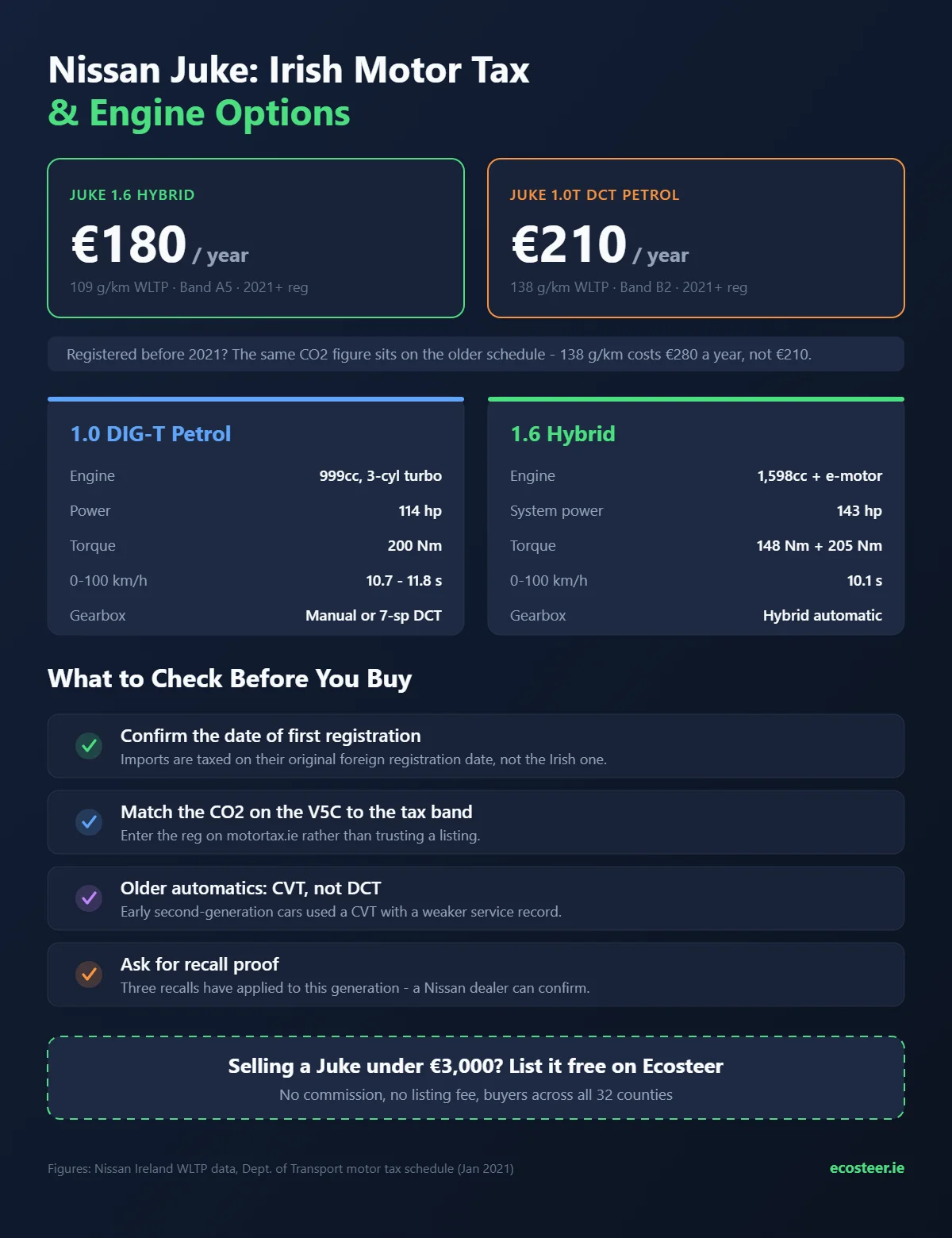
Nissan Juke reliability and what to check before you buy
This is the part of the Juke story that needs honest treatment. In What Car?'s most recent reliability survey the 2019-onwards Juke finished last in the small SUV class, 38th out of 38, on 55.2 per cent. Nissan as a brand finished 29th of 30 manufacturers on 89.9 per cent. That does not make every Juke a bad car, but it does mean the individual car's history matters more than usual.
Three recalls have applied to this generation, covering a rear seat back that may not latch securely after folding, a driver's airbag that may tear during inflation, and a fault in the hybrid electric vehicle control software. A franchised Nissan dealer can confirm from the VIN whether the remedial work has been carried out - ask for that in writing rather than taking a seller's word for it.
On automatics, know which gearbox you are buying. Owner reports collected by Honest John flag continuously variable transmission failures across Nissan's earlier small cars; the second-generation Juke's automatic is a seven-speed dual-clutch unit, so verify the specification on the actual car rather than assuming from the model year.
Pre-purchase checklist
- Confirm the date of first registration, including any foreign registration for imports, and compute the tax band from the CO2 on the registration certificate.
- Get written confirmation from a Nissan dealer that all applicable recalls are closed.
- Check the full service history - stamps, invoices and the intervals actually met, not just a book.
- Drive the automatic from cold and at low speed, listening for hesitation or shunt.
- Check every electrical function: infotainment, cameras, parking sensors, heated elements and warning lights.
- Inspect the alloys and seat trim; most of these cars have carried families.
- Run a history check for finance, write-off and mileage before money changes hands - our guide to checking a car's history in Ireland walks through the steps.
- On a Hybrid, get the battery condition assessed independently. Ecosteer's EV and hybrid battery health check reports state of health rather than leaving you to guess.

Nissan Juke servicing and warranty in Ireland
New Juke cover is three years or 60,000 miles, which can be extended at additional cost. That is average for the segment and shorter than several direct rivals, so on a three- to five-year-old car assume you are buying outside factory cover unless an extension is documented. Nissan Ireland's franchised dealers handle warranty, recall and hybrid-system work; independent specialists are fine for routine servicing, but hybrid battery and high-voltage work is best kept with a dealer that has the equipment for it.
If you would rather buy from a franchised or established retailer than privately, Ecosteer's dealer directory lists sellers across Ireland.
Verdict: is the Nissan Juke a good buy in Ireland?
The Juke earns its place on styling, town-friendly size and - in Hybrid form - a genuinely low €180 annual tax bill for a 143 hp crossover. Where it asks for care is the ownership record: the independent reliability data is weak, and the value of any individual car rests heavily on documented servicing and closed recalls. A well-documented Hybrid with a clean history and a battery health report is a sound used buy. An undocumented automatic with gaps in the service record is a risk that the purchase price rarely compensates for.
Buyers who mostly drive in town should shortlist the Hybrid; those covering high mileage on open roads will find the 1.0 petrol manual cheaper to buy and simpler to maintain, at the cost of a higher tax band.
Nissan Juke Ireland: frequently asked questions
How much is motor tax on a Nissan Juke in Ireland?
For cars first registered from 2021, the 1.6 Hybrid at 109 g/km costs €180 a year and the 1.0 turbo petrol DCT at 138 g/km costs €210 a year. Cars first registered between 2008 and 2020 use the older schedule, where 138 g/km costs €280. Confirm the CO2 on the registration certificate and check the reg on motortax.ie.
Is the Nissan Juke Hybrid worth the extra money over the petrol?
It depends on your mileage profile. The Hybrid is quicker (10.1 seconds to 100 km/h), more economical on Nissan's figures (4.8 versus 6.1 l/100km combined) and sits two tax bands lower, but it costs more to buy and gives up 68 litres of boot space. Urban and mixed drivers recover the difference faster than motorway drivers.
Is the Nissan Juke reliable?
Independent data is not flattering. What Car? ranked the 2019-onwards Juke last in its small SUV class at 55.2 per cent, and Nissan 29th of 30 brands. Individual cars with complete service history and closed recalls can still be a sound purchase, which is why documentation matters more on this model than on many rivals.
How big is the Nissan Juke boot?
354 litres in the Hybrid, rising to 1,237 litres with the rear seats folded. Petrol versions offer 68 litres more because there is no hybrid battery to package.
What should I check when importing a Nissan Juke?
Motor tax is set by the date of first registration abroad, not the Irish registration date, so a 2020 UK car stays on the older tax schedule after import. Budget for VRT, confirm the CO2 figure on the foreign documentation, and run a full history check before paying a deposit.
Buying or selling a Nissan Juke? Use Ecosteer
Ecosteer is Ireland's marketplace for used cars, built to make the numbers on this page easy to act on.
- Browse used Nissan listings on Ecosteer and filter by county, year and budget.
- List your car free - private ads under €3,000 carry no listing fee and no commission, with buyers across all 32 counties.
- Find a dealer near you if you would prefer a retail purchase with a warranty.
External sources
- Nissan Ireland - Nissan Juke model page (WLTP CO2 and power range)
- Nissan Ireland - Juke prices and specifications by grade
- CompleteCar.ie - Nissan Juke Hybrid review, Irish pricing and tech specs
- Department of Transport - Rates of Duty on Motor Vehicles (effective 1 January 2021)
- motortax.ie - check motor tax rates by vehicle registration number
- What Car? - Used Nissan Juke 2019-2025 reliability and common problems
- Honest John - Nissan Juke owner reports and running costs
Vehicle photography courtesy of Nissan, used for editorial purposes.
Tags
Ecosteer Editorial
Author